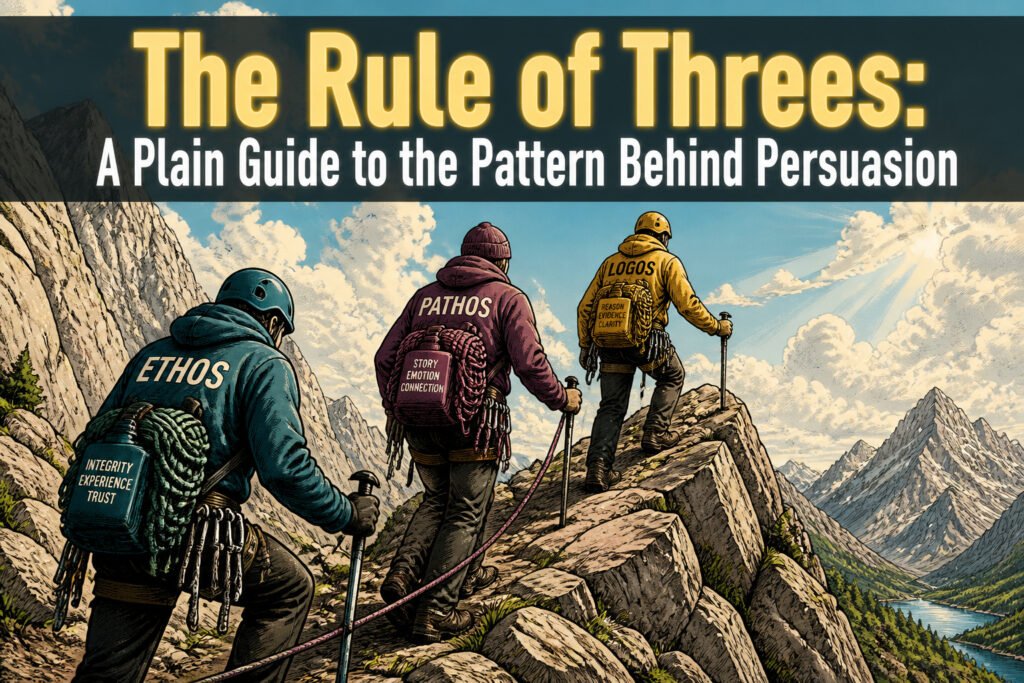
The rule of threes is a communication principle that says groups of three land harder in memory than any other number. The catch is that a forced third point kills the effect; padding a weak argument just to hit the number leaves readers noticing the dead weight. Aristotle built his Rhetoric around this, three books arguing that persuasion stands on three pillars: ethos, pathos, and logos.
What the Rule of Threes Means
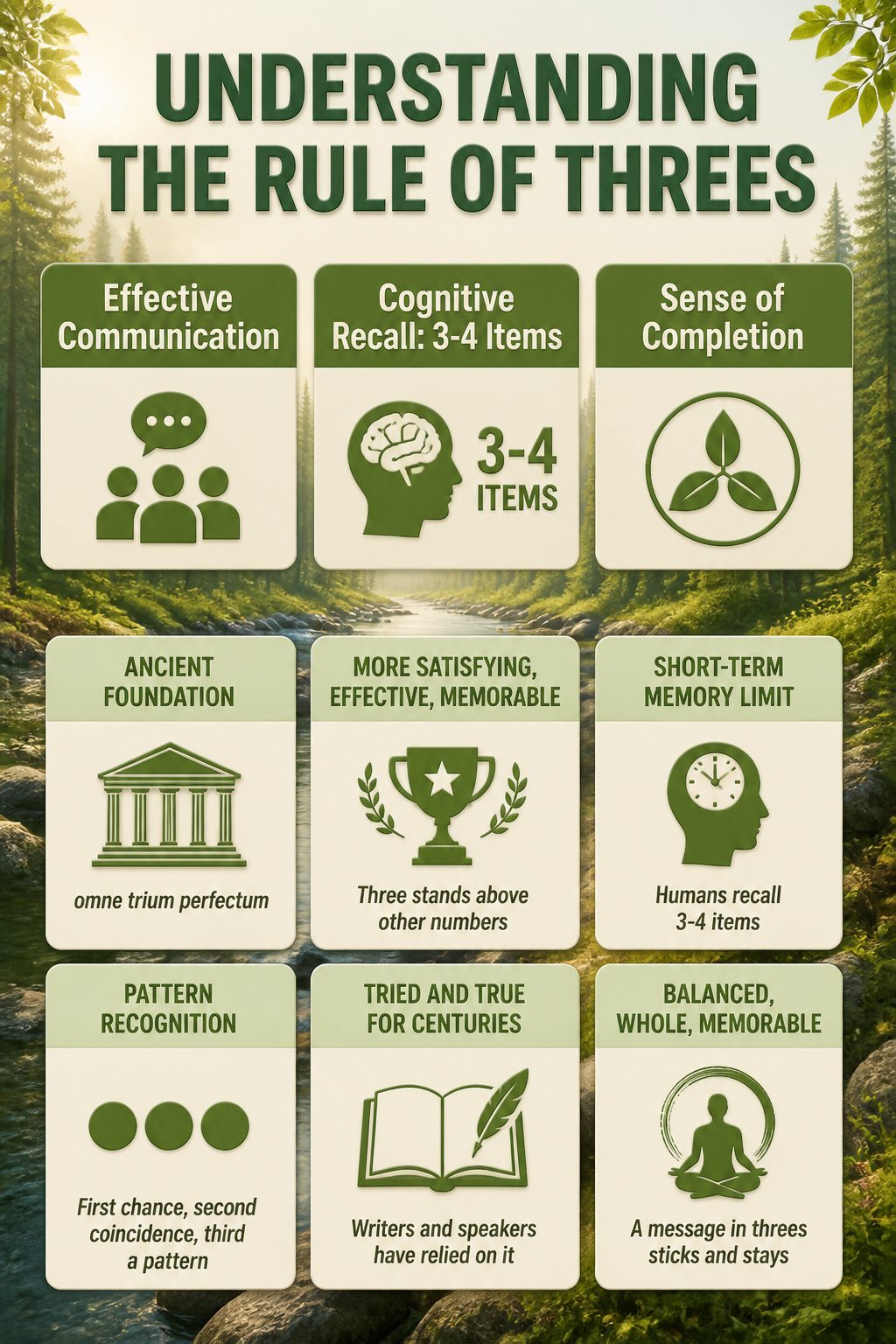
The rule of threes is a communication principle that holds groups of three are more satisfying, effective, and memorable than other numbers. Ancient Romans captured this in the Latin phrase omne trium perfectum, which translates to "everything that comes in threes is perfect." They built speeches and writing around it, trusting that a trio carried a sense of completion other counts lacked.
Cognitive research backs the instinct up: humans can recall roughly three to four items from short-term memory, and three is the minimum needed to establish a recognizable pattern. The first instance reads as chance, the second as coincidence, the third as a pattern with rhythm and weight. Writers and speakers have leaned on this for centuries because it works without the audience noticing why. A message in threes lands as balanced, whole, and easy to hold onto.
Where the Rule Comes From

Aristotle laid the groundwork for the rule of threes in his treatise Rhetoric, itself a three-book work, where he argued that persuasion depends on three pillars: ethos, pathos, and logos. The pattern runs deeper still; he also classified public speech into three genres built around speaker, topic, and listener.
Julius Caesar gave the form its most compact showcase. "Veni, vidi, vici" (I came, I saw, I conquered) works as a hendiatris: three separate words that together express a single, larger idea of swift and total victory. The device survived the centuries intact. Abraham Lincoln leaned on it at Gettysburg with "government of the people, by the people, for the people," a phrase that still echoes because the triplet creates rhythm without the audience quite noticing why it sticks.
Why Three Sticks in Memory
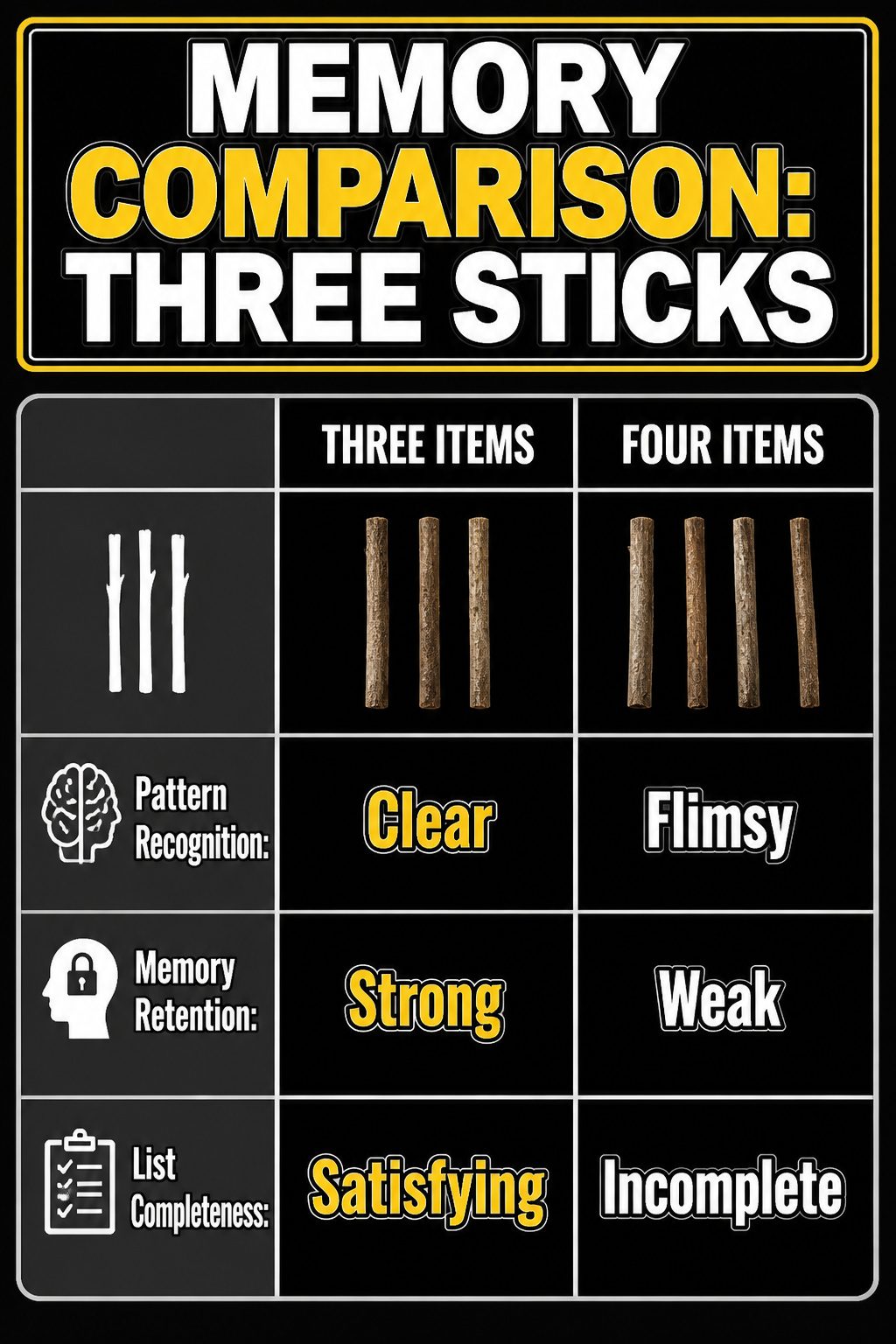
The human brain looks for patterns the way a hungry eye looks for faces in a cloud. Two dots on a page are just two dots. Add a third and suddenly the mind sees a structure, a relationship, something to predict from. Three is the smallest number that forms a recognizable pattern, and that threshold matters for memory.
Cognitive research puts short-term memory at roughly three to four items. Push past that and the mind starts dropping pieces. A list of two feels thin, almost accidental. A list of four strains the buffer. Three sits in the sweet spot: weighty enough to feel complete, light enough to stick. The pattern completes itself without exhausting the listener.
This is why a phrase like "life, liberty and the pursuit of happiness" lands with finality. The third item closes the door. Two would leave it hanging; the ear would wait for more. Three lets the mind relax into the rhythm, store the whole unit as one chunk, and carry it away intact.
Three in Stories and Jokes
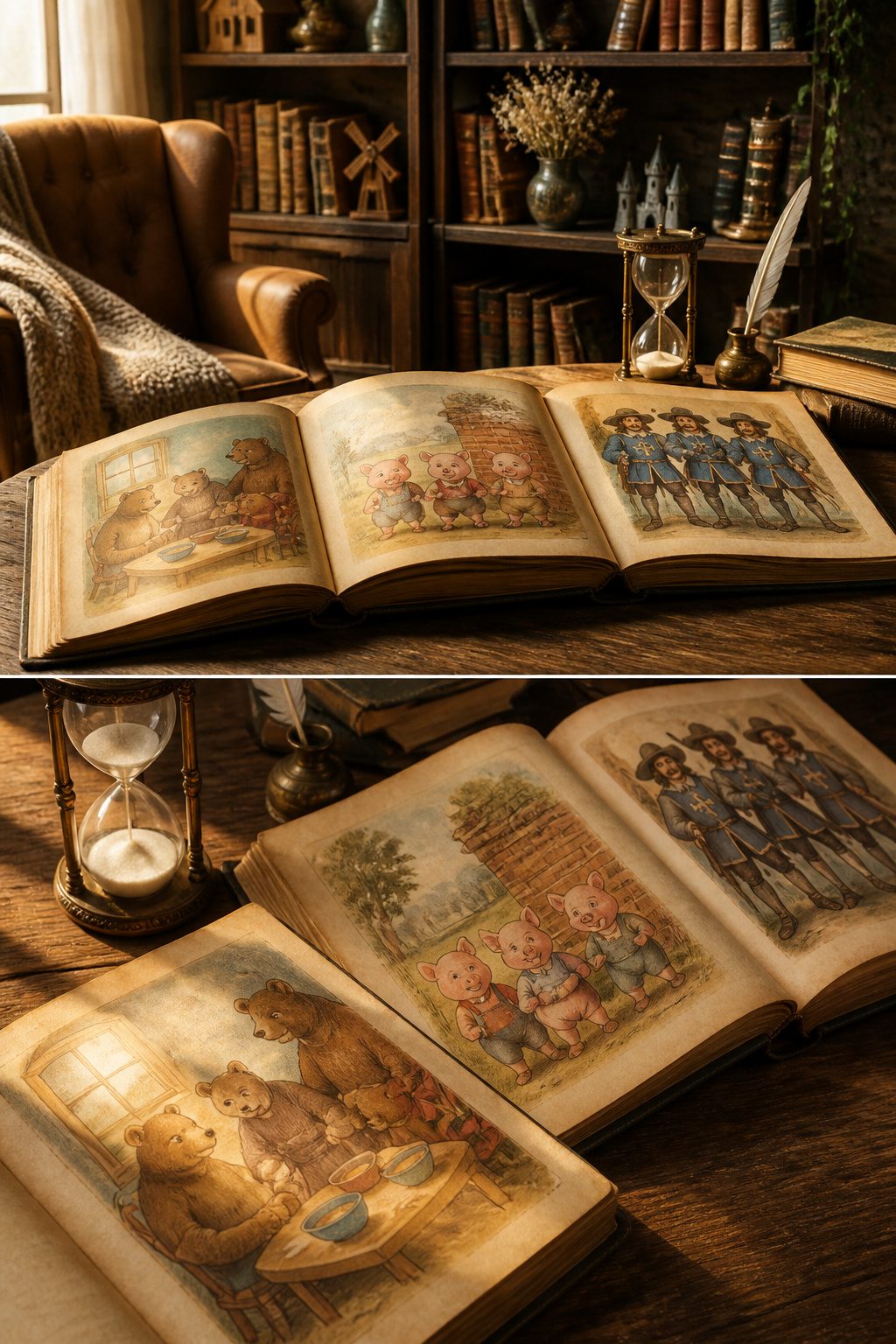
Stories settle into threes almost without trying. The pattern shows up in the oldest fairy tales: three bears, three little pigs, three wishes from the lamp. Goldilocks walks through three bowls of porridge, three chairs, three beds, and only the third of each set feels right. The Three Musketeers operate as a single unit because three gives enough variety for disagreement without collapsing into chaos. Dickens mapped A Christmas Carol onto three spirits, Past, Present, and Future, each visit building pressure the same way a joke builds toward its payoff.
The three-act structure works the same way. Setup, confrontation, resolution. It is descriptive, not mandatory, plenty of stories break it, but the pattern keeps appearing because it mirrors how expectation itself functions. First beat establishes, second complicates, third releases. In jokes, the structure is identical: premise, reinforcement, twist. The listener knows something is coming by the third item, which makes the violation of that expectation land harder.
What convinced me, reading back through stories I thought I knew by heart, is how invisible the pattern becomes once it is working. You do not notice three bears as a device. You simply remember them.
Slogans That Sell in Threes

Marketers have known for decades that three words land harder than two or four. McDonald’s "I’m Lovin’ It" has run since 2003, outliving every previous slogan the chain tried by a wide margin; their record before that barely held four years. Nike’s "Just Do It" carries the same compact force, reportedly pulled from a death row prisoner’s final words, which may explain why the phrase refuses to fade. The pattern is not about literary devices like tricolon or hendiatris, though those help. A flat three-word motto, simple and spoken, does the same work: it creates rhythm without demanding analysis. KFC’s "Finger Lickin’ Good" and ConvertKit’s "Ready. Set. Send." both trade on the same brevity. The consumer gets a complete feeling in the time it takes to cross a street. Shopify stretched theirs slightly to "Sell here, there, and everywhere," a tricolon that still resolves in three beats. The rule of threes in advertising is not about the words alone but about the space they leave empty, the gap the listener fills with their own association. That participation is what makes the slogan stick.
Hendiatris and Tricolon
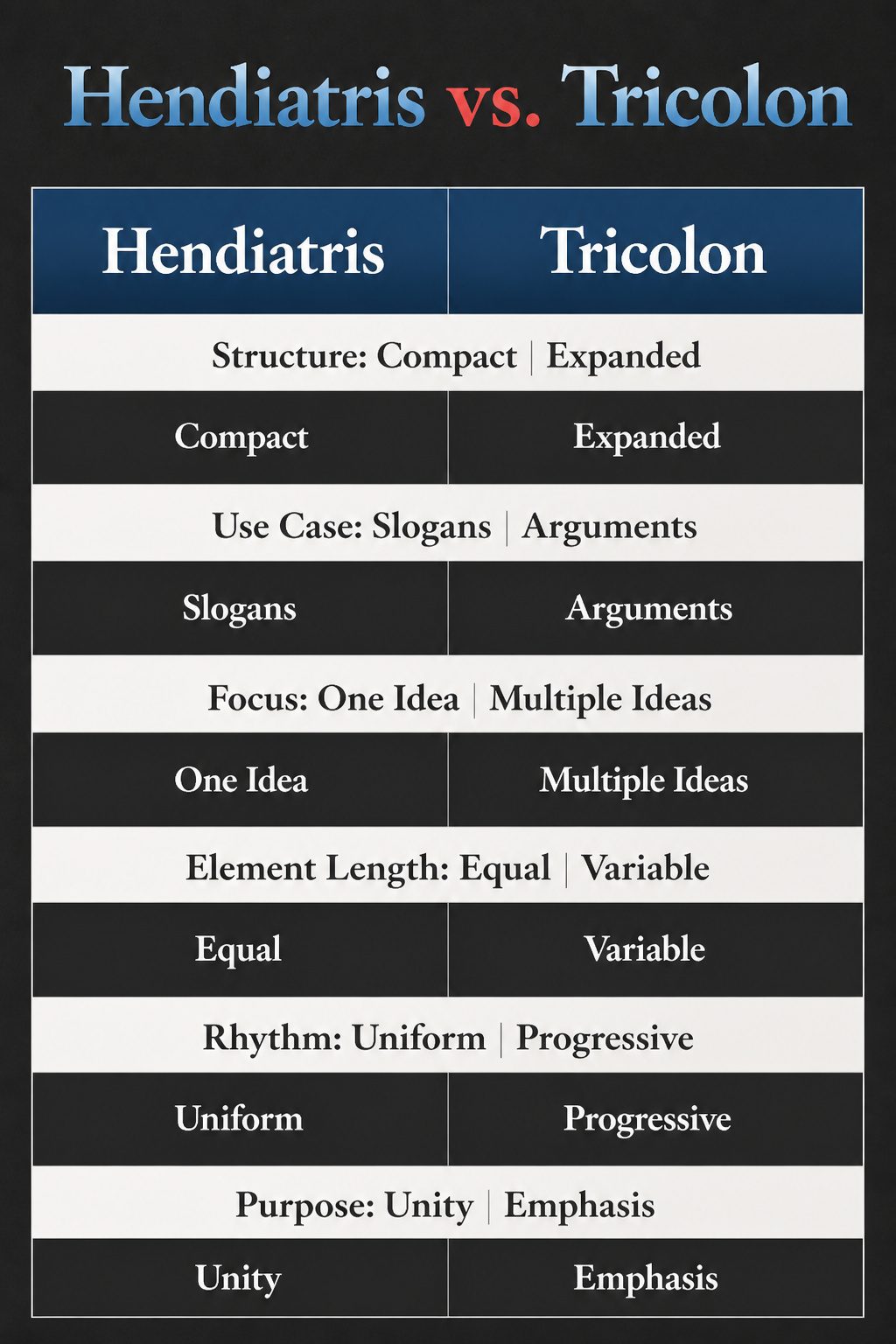
Three words can express one idea so tightly that the phrase becomes a single unit. Hendiatris works this way: "Veni, vidi, vici" does not list three separate actions but compresses them into the idea of swift, total victory. The same structure holds in "Liberté, Égalité, Fraternité" and the Olympic motto "Citius, Altius, Fortius." Each triple is not a sequence so much as a single concept wearing three faces.
Tricolon spreads the load differently. Where hendiatris keeps the parts nearly identical in weight and sound, tricolon runs three parallel elements that may grow in length or shift in substance. Franklin D. Roosevelt’s advice to speakers, "Be sincere, be brief, be seated," keeps the grammar identical but lets the meaning progress. Barack Obama’s 2004 keynote built a longer tricolon: "the height of our skyscrapers, or the power of our military, or the size of our economy." The structure still comes in threes, yet each element expands enough to carry its own clause.
The distinction matters when you write. Hendiatris suits slogans and titles, places where brevity is the whole point. Tricolon fits sentences that need to build or argue, where the reader should feel each item land with separate weight. Lincoln’s "we cannot dedicate, we cannot consecrate, we cannot hallow" gains force from the repetition itself, not from collapsing the three into one meaning. Choose hendiatris when one idea needs a triple stamp; choose tricolon when three ideas need equal standing.
Comedy’s Setup and Punchline

Comedy turns the rule of threes into a timing weapon. Two items build a pattern the audience feels in their bones, and the third snaps it. The Dick Van Dyke Show landed this with "Can I get you anything? Cup of coffee? Doughnut? Toupee?" Coffee and doughnut establish a polite host; toupee hijacks the rhythm into absurdity. The laugh comes from recognition colliding with surprise, not from the word itself.
The comedic rule of threes relies on setting up a pattern of two items and then subverting viewer expectations by breaking that pattern with the third item.
That subversion works because three is the smallest number that forms a complete pattern. Two items are just a pair; three promise a rule. Break the promise at the last second and the brain hiccups into laughter. Quick delivery helps, since less time to anticipate means a harder hit when the pattern cracks. Most comic triples run two or three sentences, though longer setups work if the formula stays intact. The tension builds across the first two beats, releases on the third, and the third must carry the funniest load or the trick falls flat.
Film and Television

Contemporary shows and films still lean hard on the pattern. Charmed built its premise around it: three Halliwell sisters, their "power of three," the trio intact even after cast changes. The joke lands because three is the smallest unit that feels like a pattern; two is a coincidence, four is a committee.
Schitt’s Creek wrings comedy from the same math. Moira Rose’s triple-slap on her fictional soap Sunrise Bay outperforms the original Stooges bit for a lot of viewers, and the show named an episode "The Throuple" just to let David, Stevie, and Jake play out the geometry of an accidental triangle.
Drama uses it too. In Schindler’s List, Oskar Schindler offers Itzhak Stern a drink twice, and Stern refuses both times. The refusals mean something specific: Stern does not yet see Schindler as a moral man worth drinking with. The third offer, accepted near the film’s end, marks the shift in both character arcs because the audience has been counting. Two refusals set the rule; the break on the third carries the weight.
Even recent fantasy follows the form. The season one finale of The Rings of Power turns on three Elven rings, the number doing narrative work before any dialogue explains it.
Beyond Words

The rule of thirds in photography and film works the same way the rule of threes does in writing. A frame is divided into a 3×3 grid, and placing the subject along those lines or at their intersections creates a more balanced, engaging image than centering it. Our eyes move to those intersection points naturally, just as our ears settle into a three-beat rhythm in language.
I noticed this overlap while editing photos for a project last year. The shots that felt right were almost always composed on those third-lines, never dead center. The same pattern governs both: three parts create tension and resolution without overwhelming the viewer or listener. Filmmakers rely on it constantly. Designers use it to place typography and focal points so the eye knows where to land.
Even the structure of stories follows this, beginning, middle, and end. The pattern is so embedded that it often shows up without deliberate effort. What works in a sentence works in a frame. What works in a frame works in a narrative arc. The medium changes; the rule holds.
How I Use It
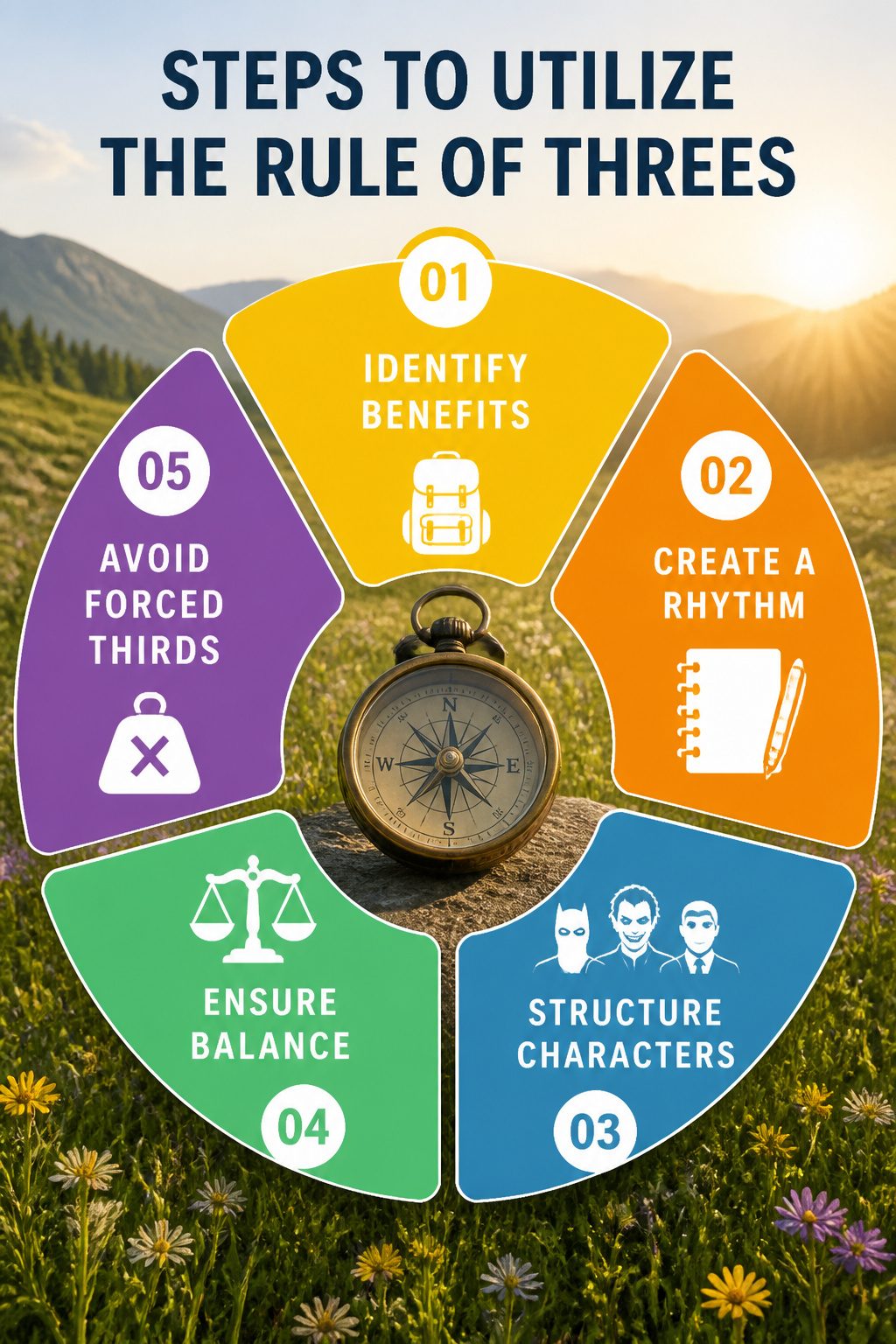
Three beats in a sentence land harder than two or four. I learned that the hard way rewriting a product description that listed two benefits, then tacked on a third to sound complete. The draft felt lopsided, like a joke missing its punchline. The fix was deliberate: "light enough for a daypack, tough enough for a truck, cheap enough to replace without a wince." The rhythm snapped into place once the pattern committed.
For plots, the same structure holds. A three-act arc gives readers a door in, a crisis, and a release. I once outlined a four-part essay series and watched engagement drop on the fourth installment every time. Breaking it to three tightened the narrative and let the middle section carry real tension.
Characters work in threes too. Christopher Nolan’s Batman films pit Batman, the Joker, and Harvey Dent against one another, each embodying order, chaos, and the blurred line between. That triangle forces sharper choices than a simple hero-villain pair allows.
The mistake is forcing a third point when two suffice. I have padded weak arguments with a throwaway item just to hit the number, and readers notice the dead weight. Better to stay at two clean beats than manufacture a limping third.
Frequently Asked Questions
What is the rule of three in writing?
The rule of threes is a communication principle that groups of three are more satisfying, effective, and memorable than other numbers. Humans can recall roughly three to four items from short-term memory, and three is the minimum needed to establish a recognizable pattern. Ancient Romans captured this in the Latin phrase omne trium perfectum, meaning everything that comes in threes is perfect.
How can I use the rule of three in my writing?
Apply it by structuring sentences, plots, and characters in threes for better engagement and memorability. Three beats in a sentence land harder than two or four; a three-act arc gives readers a door in, a crisis, and a release; and three characters can force sharper choices than a simple pair allows. The rule works on three levels: sentences, situations, and stories.
What are examples of the rule of three in literature?
Examples include Goldilocks and the Three Bears, The Three Musketeers, and the three ghosts in A Christmas Carol. Other notable uses are Julius Caesar’s Veni, vidi, vici, Lincoln’s government of the people, by the people, for the people, and Dickens’s three spirits in A Christmas Carol: Past, Present, and Future.