
You can find north at night in about five minutes once you know which stars to line up, but only if the sky stays clear enough to see them. Most people pick the wrong fixed point and walk an hour off course before they realize their mistake. Polaris sits 430 light-years out, close enough to hold steady while everything else wheels overhead, yet it is not the brightest star up there; that is what trips people up.
How to Find North at Night
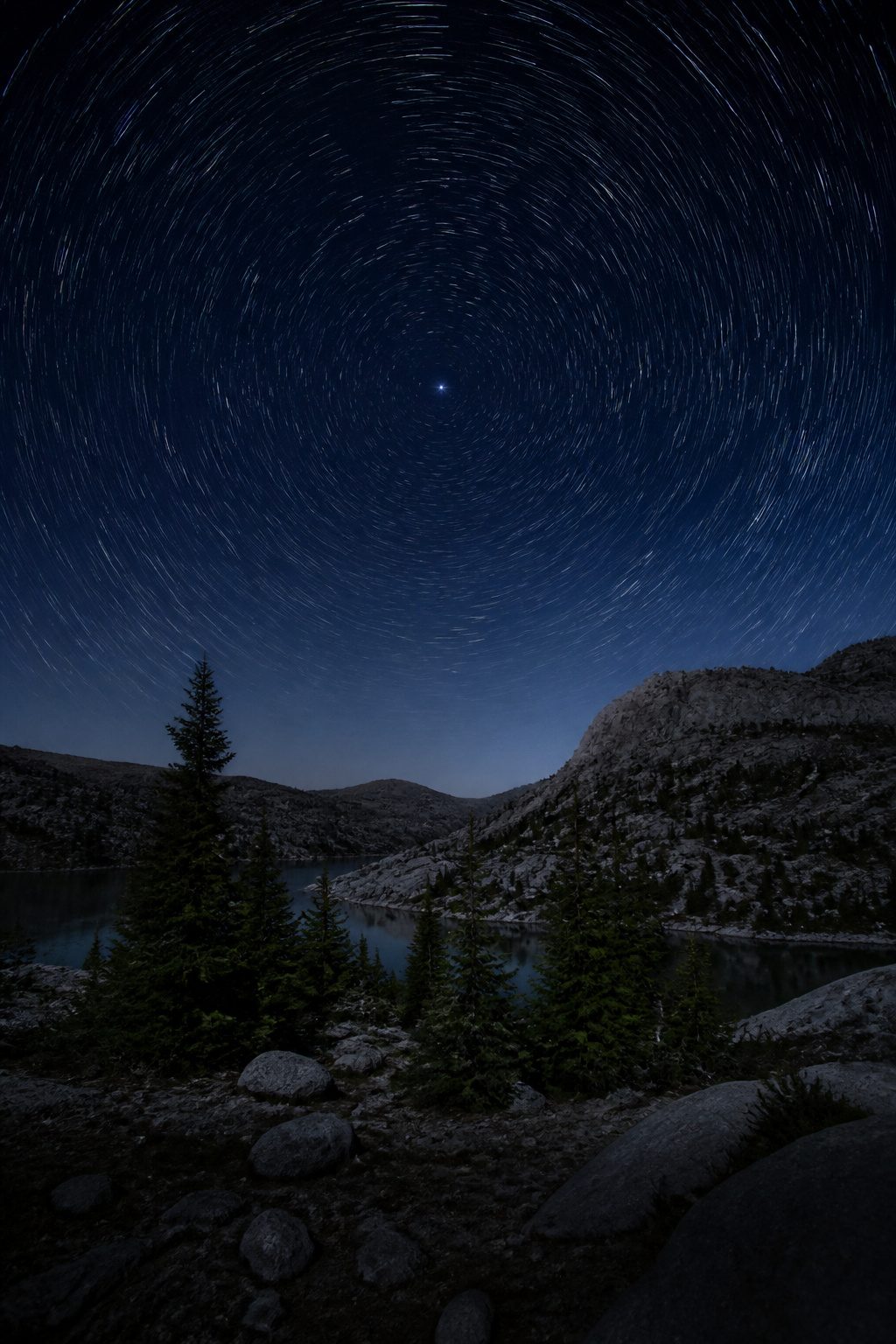
A wrong turn on a solo hike last October left me walking in circles for two hours before I admitted my phone was dead and I had no compass. The trail had forked where the map said it shouldn’t, and every tree looked like every other tree in the dark. That was the night I learned why Polaris barely moves while everything else wheels overhead.
The star sits roughly 430 light-years away, close enough to appear bright but far enough that its position stays fixed above the North Pole. Other stars trace arcs across the sky as Earth turns. Polaris just hangs there, a constant reference point when every other landmark has disappeared into blackness.
Finding it takes practice, and frustration comes fast when clouds roll in or ridge lines block the northern sky. I spent twenty minutes once staring at what I thought was the North Star, only to watch it drift slowly sideways. Wrong star. The mistake cost me an hour of backtracking in morning light.
Birds use this same fixed point for night migration. The reliability that guides them is the same one that can pull a lost hiker back to a trailhead, provided you know where to look and what to look for.
1. Using the Big Dipper
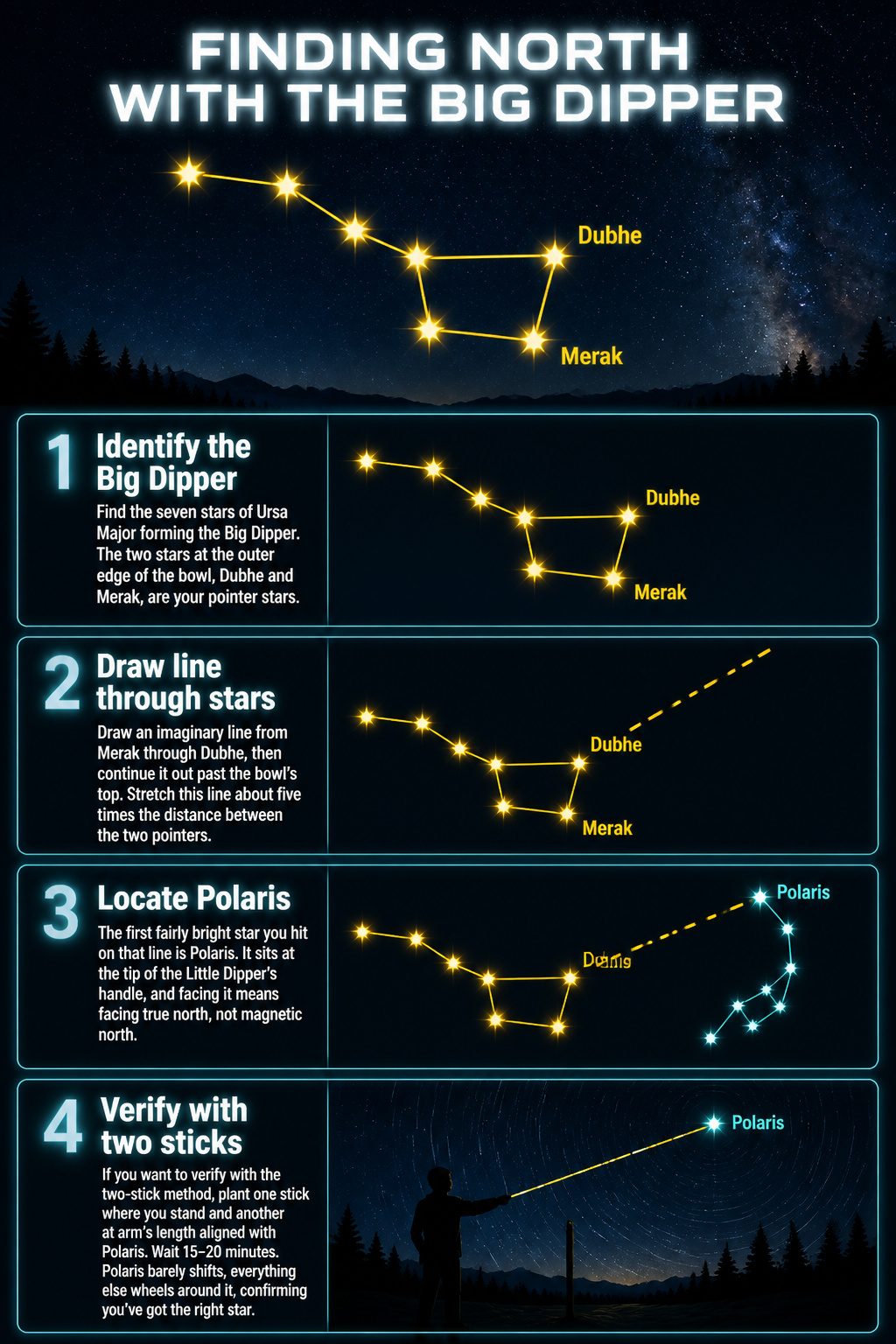
- Find the seven stars of Ursa Major forming the Big Dipper. The two stars at the outer edge of the bowl, Dubhe and Merak, are your pointer stars.
- Draw an imaginary line from Merak through Dubhe, then continue it out past the bowl’s top. Stretch this line about five times the distance between the two pointers.
- The first fairly bright star you hit on that line is Polaris. It sits at the tip of the Little Dipper’s handle, and facing it means facing true north, not magnetic north.
- If you want to verify with the two-stick method, plant one stick where you stand and another at arm’s length aligned with Polaris. Wait 15–20 minutes. Polaris barely shifts; everything else wheels around it, confirming you’ve got the right star.
2. Using Cassiopeia
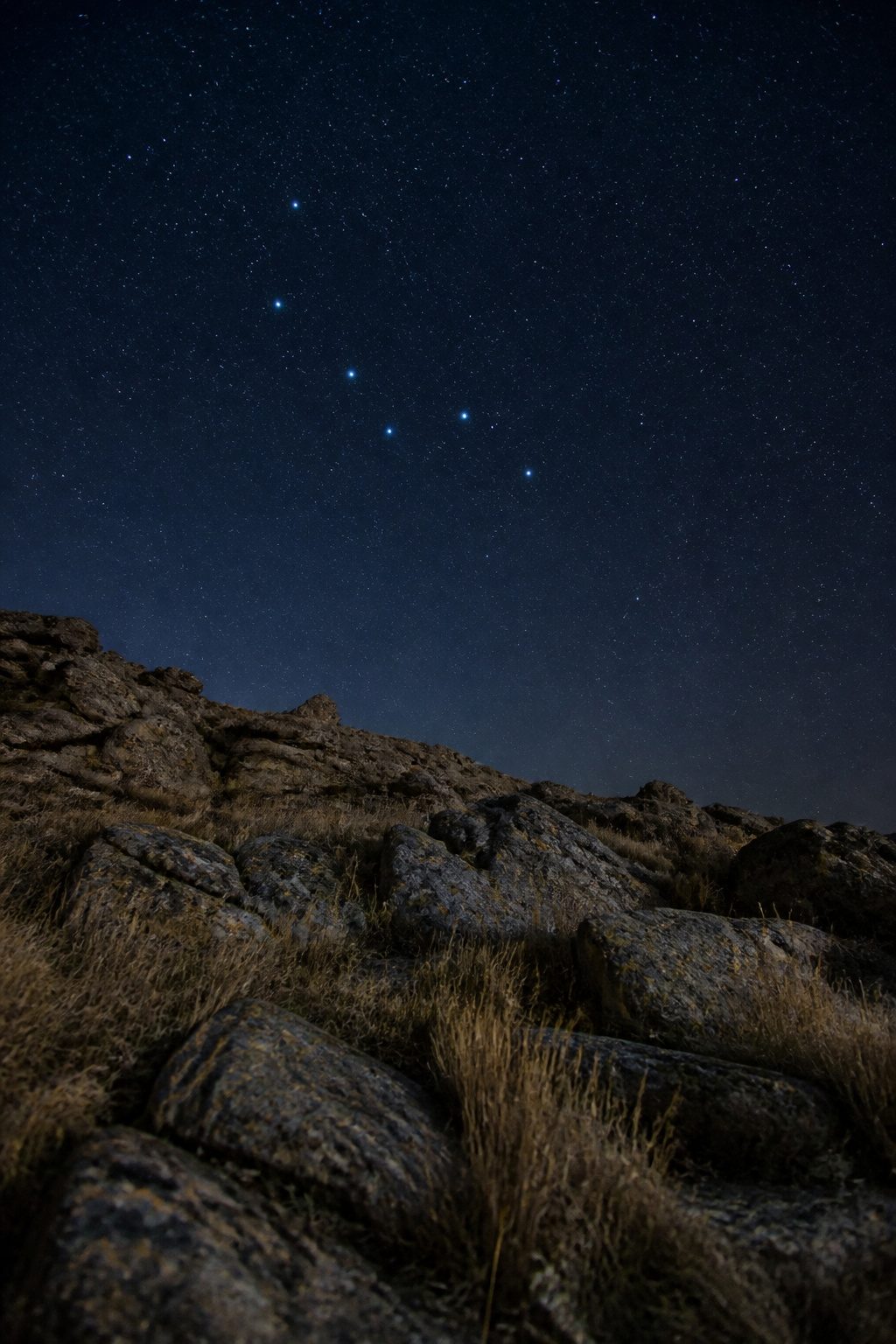
Cassiopeia saves the night when the Big Dipper has slipped below the horizon. The constellation sits opposite the Big Dipper, tracing its own circle around Polaris, and its distinctive W or M shape is hard to miss once you know to look for it.
The center point of that W is the star Caph. Draw a line straight out from Caph, and it leads toward Polaris. If both constellations are visible, Polaris sits almost exactly halfway between them, which makes a handy cross-check.
Seasons matter here. Cassiopeia rides highest when the Big Dipper dips lowest, so late autumn through winter tends to be prime time for this method. Trees or ridgelines that hide the Dipper often leave Cassiopeia clear, and the reverse holds too. Having both in your back pocket means one reliable pointer stays up no matter how the sky turns.
3. Using Orion’s Belt
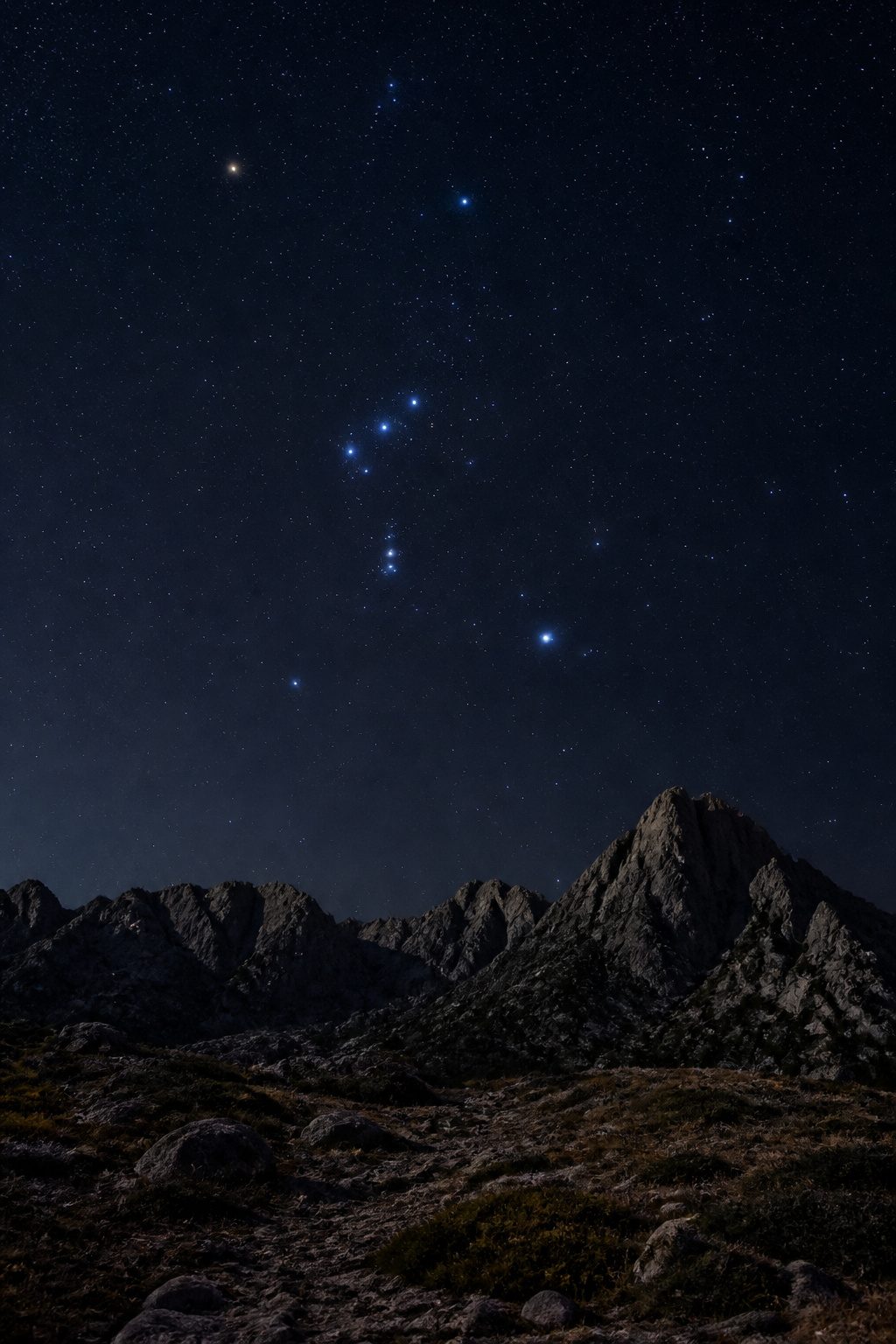
Orion’s Belt sits almost exactly on the celestial equator, which makes it one of the most reliable east-west markers anywhere on Earth. The three stars form the only short straight line of bright stars in the entire sky, so once your eyes find it, the rest follows.
Mintaka, the easternmost star in the belt, rises within one degree of true east and sets within one degree of true west. That holds whether you are in Maine or Arizona. Track the belt’s angle as Orion wheels across the sky: the line tilts one way when the constellation climbs in the east, stands nearly vertical at its highest point, and tilts the other as it drops toward the western horizon. The motion itself confirms the direction.
The catch is that Orion gives you cardinal direction, not precise bearing. A compass beats it for walking a straight line. But on winter nights when the Big Dipper hugs the northern horizon or trees block the view, Orion often rides high and clear. That is when the belt earns its place in the kit.
4. Using the Moon
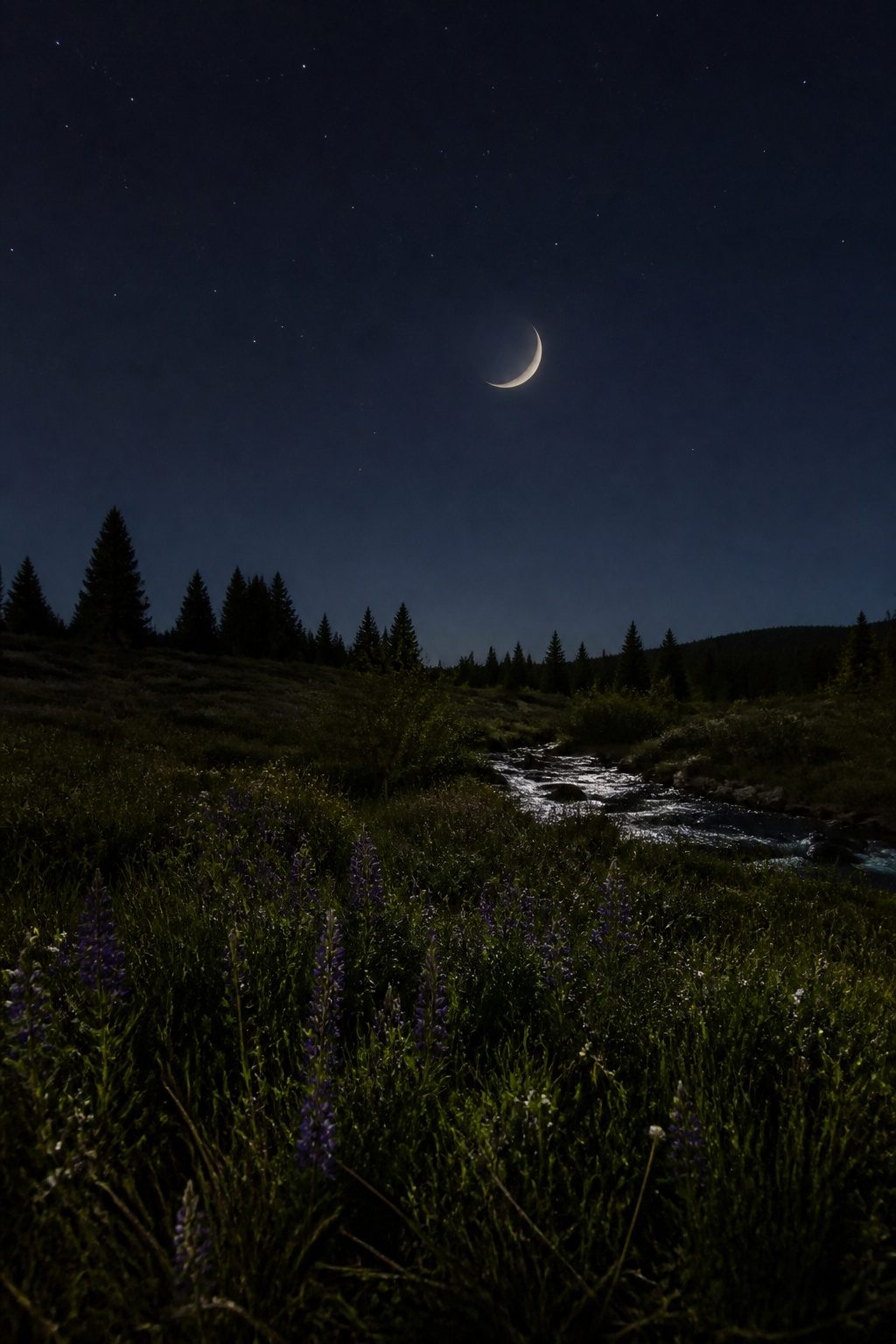
The moon’s phase decides whether it helps or misleads. A thin crescent gives the clearest reading. Draw a line connecting the two tips of the crescent, extend it straight down to the horizon, and that point marks south if you are in the Northern Hemisphere. The line follows the moon’s illuminated arc, which faces the sun, so the horns point away from it.
A full or gibbous moon breaks this method. Without sharp, distinct horns to connect, the imaginary line wanders. Near-full phases blur the reference points entirely.
The moon still offers a rough east-west check if you watch it move. Over an hour, its drift across the sky runs generally westward, same as the sun’s path. That motion alone won’t give you north, but it can confirm whether another method is pointing the right way. Cloud cover or a tree line blocking the horizon kills both techniques, so the moon is only useful when you have open sky and the right phase.
5. Two-Stick Star Movement
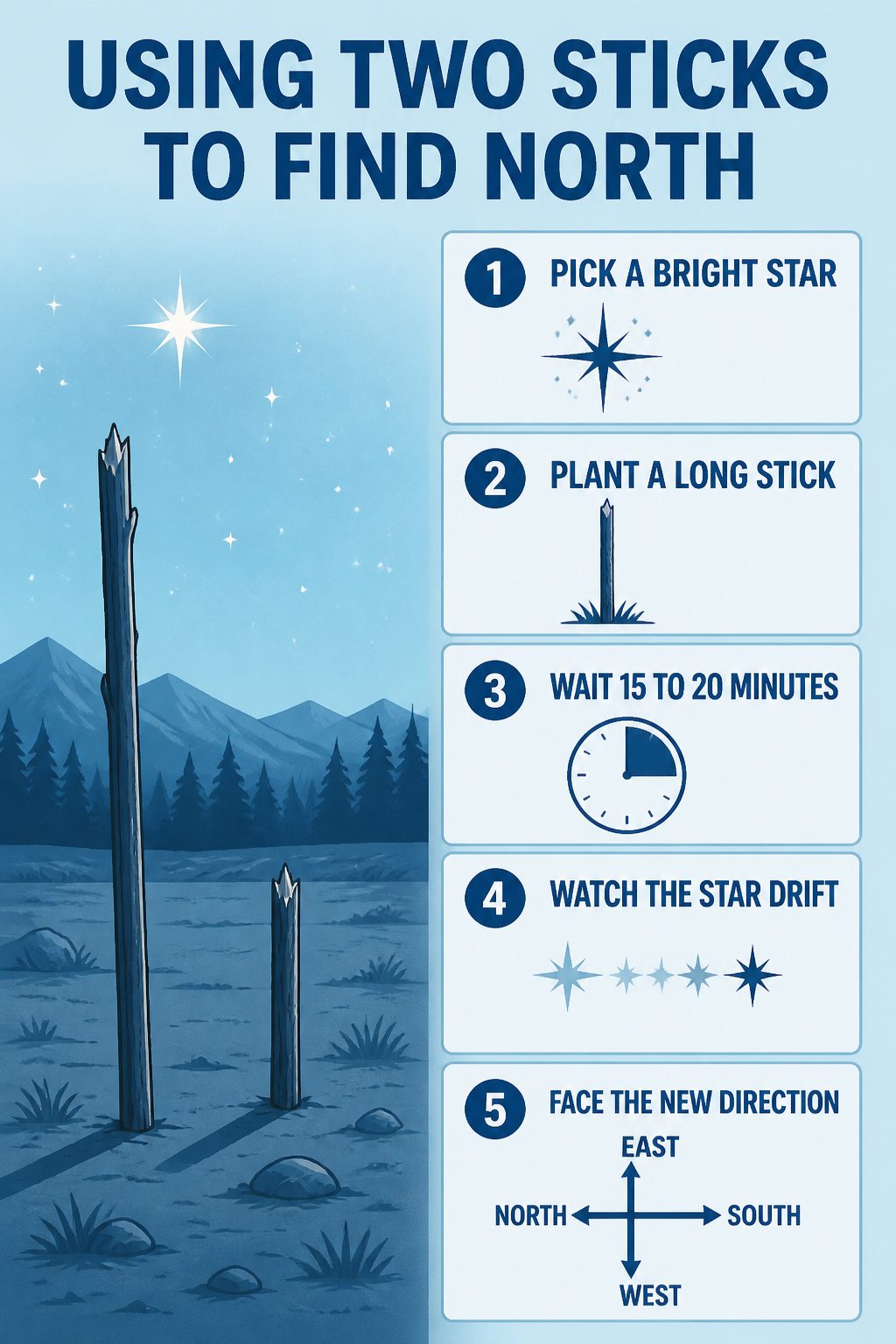
Two bright sticks and patience will find north even when you do not know a single constellation.
- Pick a bright star. Any star works, but the bright ones are easier to track without losing your place, especially if thin clouds drift through.
- Plant a long stick in the ground and kneel so the tip lines up with your star. Place a shorter stick between you and the first one so the tops of both sticks and the star form a straight line.
- Wait 15 to 20 minutes. The star only seems to move; the earth is what turns.
- Watch where the star drifts from your original sight line. Rising means east, setting means west. If it arcs clockwise around Polaris, you are looking north.
- Face the direction the star moved to confirm: up for east, down for west, right for south, left for north in the Northern Hemisphere.
Dim stars work in theory. In practice, they disappear behind branches or haze while you wait, and you start over with nothing to show for the lost minutes.
What Polaris Actually Does
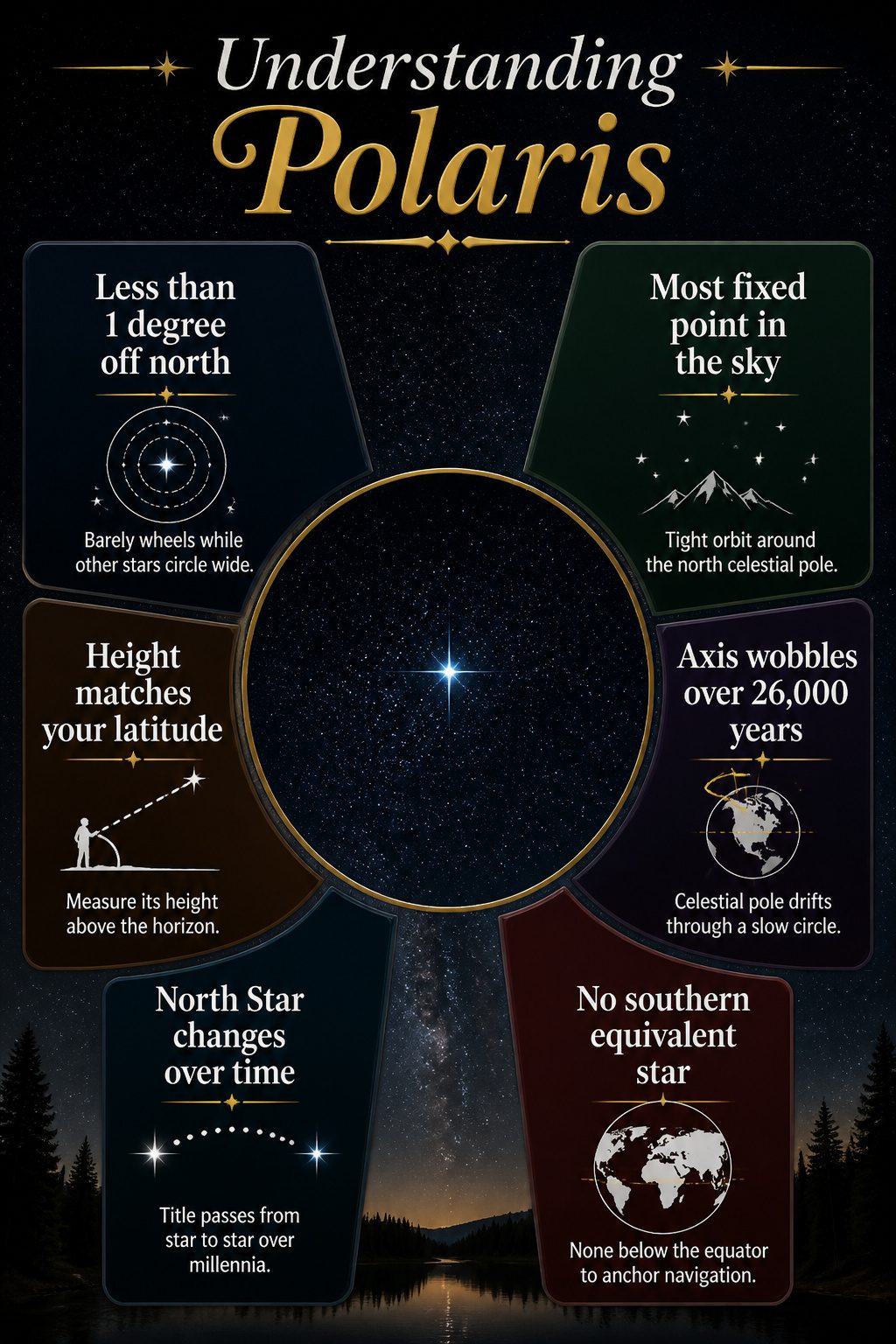
Polaris sits less than a degree off the north celestial pole, which is why it barely wheels across the night sky while other stars sweep out wide circles around it. That tight orbit makes it the most fixed point up there, not the brightest. Sailors figured this out centuries ago and built whole systems of latitude sailing around measuring its height above the horizon, which matches your latitude almost exactly. Stand in London at about 51 degrees north and Polaris hangs roughly 51 degrees up; drop down to 41 degrees latitude and it drops with you.
The title of North Star passes from star to star over millennia. Earth’s axis wobbles like a spinning top over about 26,000 years, and the celestial pole drifts through that slow circle.
About 14,000 years ago, the celestial pole pointed toward the bright star Vega, and as it sweeps out its slow circle, it will again point to Vega in about 12,000 years. Sometimes there’s no bright star near the celestial pole, as is the case in the Southern Hemisphere at present.
That absence is permanent for now. Below the equator, no equivalent star exists to anchor southern navigation the way Polaris does in the north. Methods that work in Maine or Minnesota simply fail in Argentina or Australia, which is why anyone learning to find north at night needs to know which hemisphere they’re standing in before trusting the sky.
Day Methods That Fail at Night
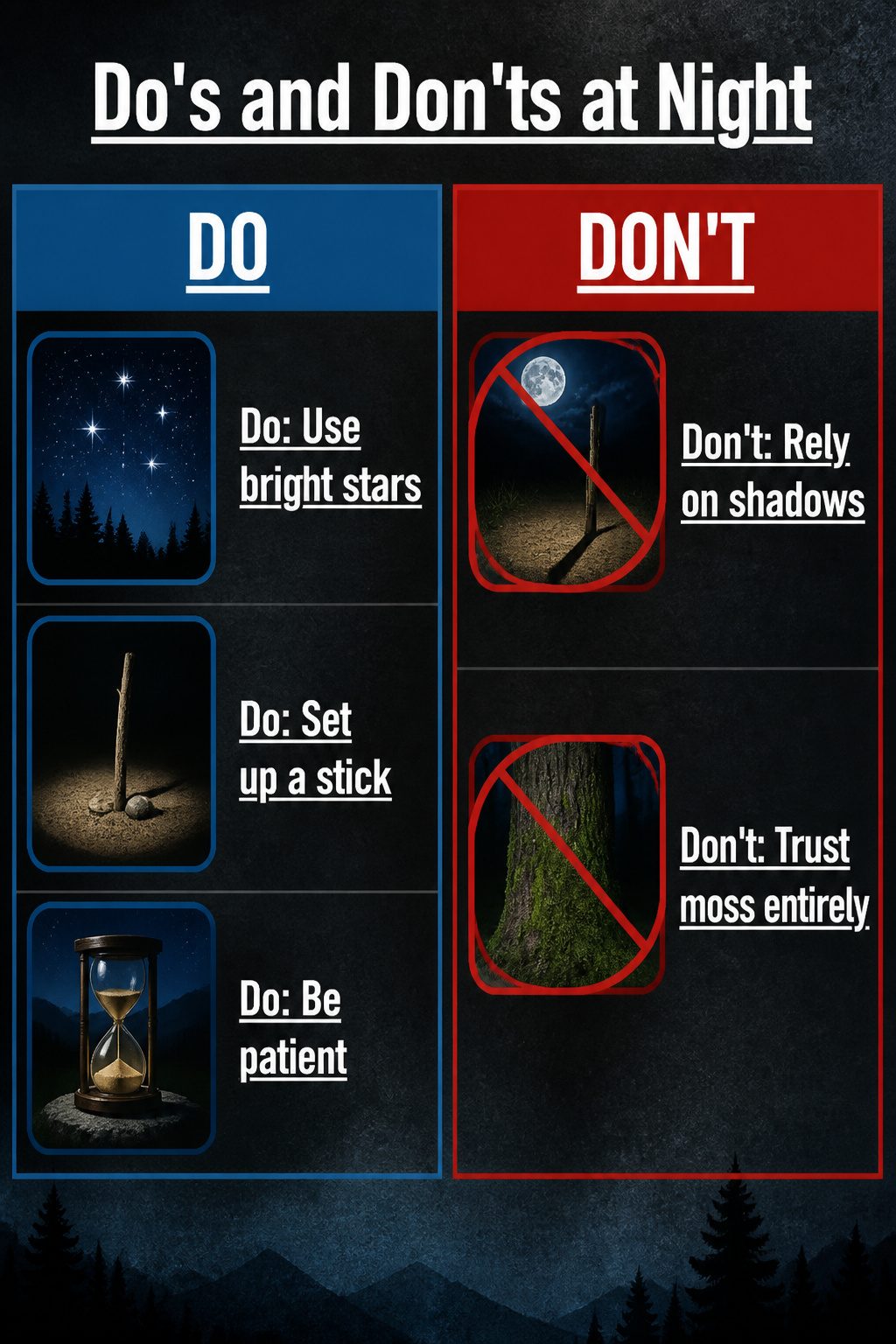
A shadow stick in sunlight traces a clean east-west arc across the ground, giving you true direction by marking the shortest shadow at local noon. Moonlight works the same way in theory, but the practice falls apart fast. The shadows are too faint to mark accurately, and the moon moves its own width across the sky in about an hour, so your reference point drifts before you finish setting up.
Moss on trees gets passed around as a compass substitute, but it grows where moisture lingers, not strictly north. The shaded side of a trunk, a damp hollow, the lee of a ridge: moss colonizes all of them. Relying on it has sent more than one person walking in circles. The only reliable night methods point to the sky, not the ground.
Picking the Right Method for Conditions
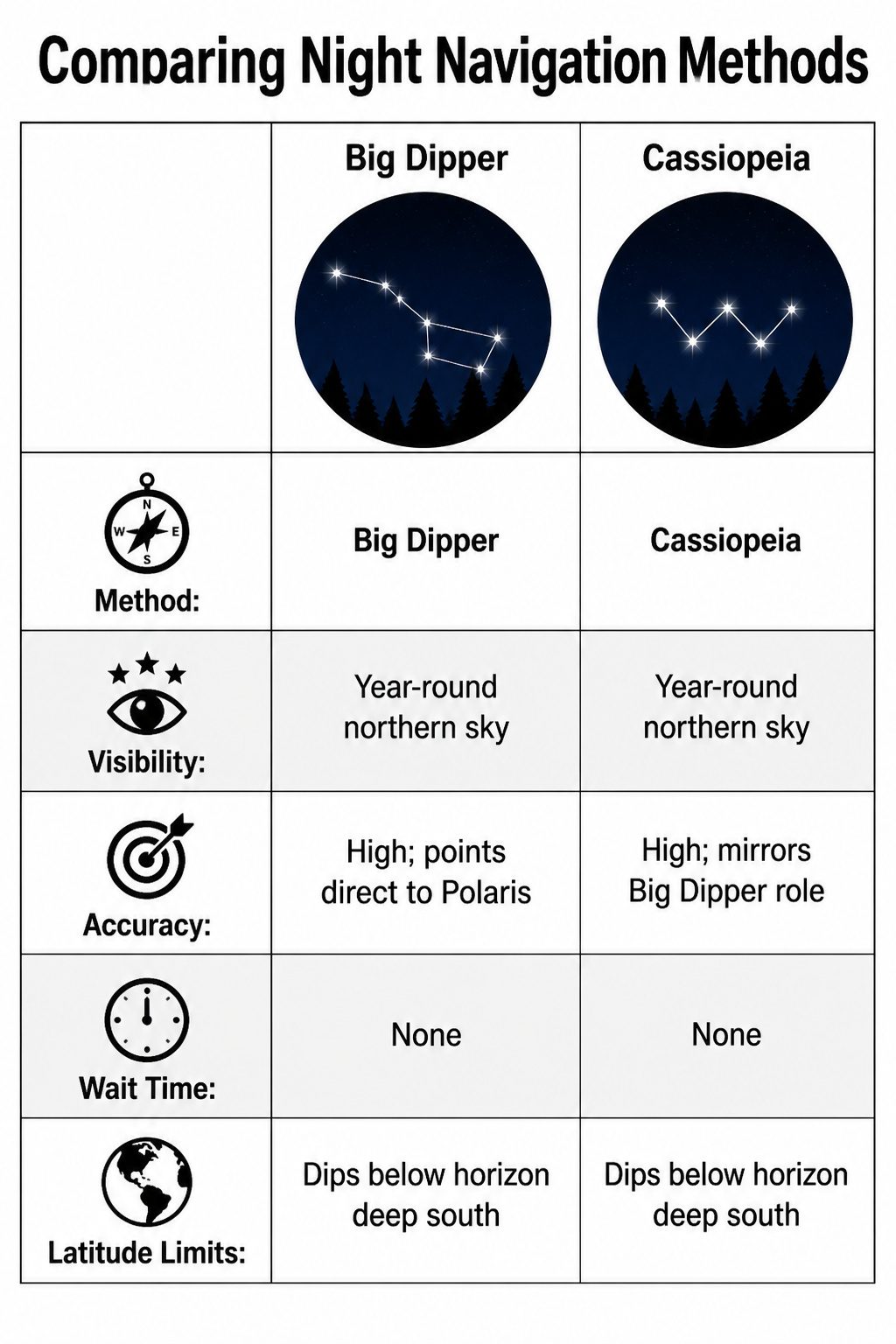
The Big Dipper sits high most nights where I live, but that changes fast once you drop below about 35 degrees north. In southern Florida or Texas, the whole asterism can slip under the horizon, leaving you staring at empty sky where the pointer stars should be. Cassiopeia rides opposite Polaris and fills that gap nicely; its W shape stays visible when the Dipper ducks out.
Orion works from practically anywhere, though the belt gives you east-west alignment, not north. The moon is the brightest target of all, but only a crescent gives you usable horns to draw a line from, and heavy cloud cover kills it outright. The two-stick method, watching any star drift for five to ten minutes, functions on any clear night regardless of latitude or season. The trade is time and patience.
| Method | Visibility | Accuracy | Wait Time | Latitude Limits |
|---|---|---|---|---|
| Big Dipper | Year-round northern sky | High; points direct to Polaris | None | Dips below horizon deep south |
| Cassiopeia | Year-round northern sky | High; mirrors Big Dipper role | None | Dips below horizon deep south |
| Orion’s Belt | Global | Moderate; gives east-west only | None | None |
| Crescent Moon | Needs clear sky, crescent phase | Moderate; line to horizon | None | None |
| Two-stick star drift | Any clear night | Moderate | 5–10 minutes | None |
The two-stick tradeoff is real: no constellation knowledge required, but you spend those minutes lying still on cold ground.
Frequently Asked Questions
How do I find the North Star?
Locate the Big Dipper and trace a line from the two pointer stars at the outer edge of its bowl, Dubhe and Merak. Extend that line about five times the distance between the pointers, and the first bright star you hit is Polaris, sitting at the tip of the Little Dipper’s handle. Facing Polaris means facing true north, not magnetic north.
What if I can’t see the North Star?
Use Cassiopeia’s distinctive W or M shape, which sits opposite the Big Dipper and rotates around Polaris. Draw a line straight out from Caph, the center point of the W, and it leads toward Polaris. Orion’s Belt also works anywhere on Earth; its easternmost star, Mintaka, rises within one degree of true east and sets within one degree of true west.
Can I use the moon to find direction?
Yes, but only during a crescent phase. Connect the two tips of the crescent with an imaginary line, extend it straight down to the horizon, and that point marks south in the Northern Hemisphere. The method fails with full or gibbous moons because the horns blur, and you need open sky with a clear view of the horizon.