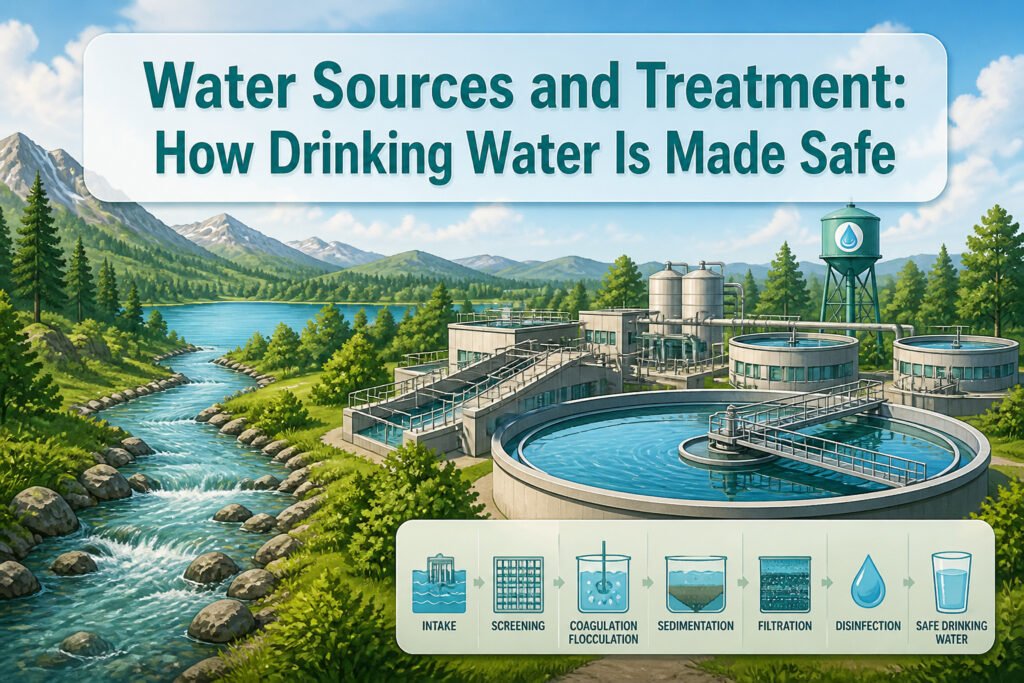
Water sources and treatment is the process of turning raw surface or groundwater into safe drinking water through a sequence of chemical and physical steps. The catch is that "treated" no longer guarantees fully addressed contamination, especially as PFAS and pharmaceuticals slip through plants built for an earlier era. In 2022, 6 billion people used safely managed drinking-water services, while 2.2 billion did not.
Where Drinking Water Starts

Drinking water comes from two places: the surface or the ground. Rivers, lakes, and reservoirs supply most public systems, while aquifers, those underground layers of porous rock, feed wells that pump water up from below.
Surface water collects everything upstream. Agricultural runoff, industrial discharge, and wildlife activity all flow into it, so treatment plants typically work harder on what they pull from lakes and rivers. Groundwater used to carry a cleaner reputation. Water percolates through soil and rock, which filters out some contaminants naturally. That natural filtration still leaves it open to chemical pollutants that seep down from above, and across the US that contamination is becoming a larger concern.
In 2022, 6 billion people used safely managed drinking-water services: water from an improved source on premises, available when needed, and free from fecal and priority chemical contamination. That left 2.2 billion without that level of service, including 115 million people still collecting untreated surface water directly.
Coagulation and Flocculation

Raw water pulled from lakes or rivers carries sediment, clay, and organic matter so small that gravity alone won’t pull them down. These particles all carry a negative surface charge, which keeps them repelling each other like matching poles of a magnet. The fix is adding a positively charged coagulant, typically aluminum sulfate or ferric sulfate, to neutralize that charge. Once the balance shifts, particles stop pushing apart and start clumping.
That first chemical step is coagulation. What follows, flocculation, is really the same process continuing: slow, gentle stirring lets those initial clumps collide and merge into larger, heavier flocs called, appropriately, floc. Mechanical paddles or hydraulic mixers keep the motion controlled. Too fast, and the shear forces tear the flocs back apart; too slow, and the collisions don’t happen often enough to build size. Operators aim for flocs large and stable enough to settle readily in the next stage.
In practice, plants treat coagulation and flocculation as one continuous operation rather than two separate stops. The chemistry starts the job, the mixing finishes it, and the water leaving this stage carries particles finally big enough to remove.
Sedimentation

The floc particles that formed during coagulation and flocculation are now heavy enough to do some real work. In the sedimentation tank, they sink slowly through the water column and collect at the bottom as sludge. The clearer water above them is what moves on to filtration, while that accumulated sludge gets removed separately.
What struck me, reading through how this plays out in actual plants, is how much this single step protects everything downstream. By dropping most of the heavy material here, the filters face far less load. They clog slower, run longer between backwashes, and treat water that is already significantly cleaner.
Some particles will still slip through. Sedimentation handles the bulk, not the fine fraction, which is exactly why the sequence matters. Skip ahead to filtration without this pause, and you are asking those filters to do a job they were not sized for. The plants that run well respect the order: grow the floc, let it settle, then hand off what remains.
Filtration

Sand, gravel, and sometimes activated carbon form the layers in traditional filters, each catching what the last stage missed. The water moves through at a controlled rate, and particles get trapped in the pores while the cleaner water keeps going. Some facilities run dual-media setups, anthracite over sand, which grab finer bits than single layers manage.
Activated carbon does more than strain particles. It pulls out organic compounds, the herbicides and pesticides that slip past sedimentation, and it fixes taste and odor problems. Beverage manufacturers rely on granular activated carbon for beer and soda production, and those point-of-use kitchen filters use the same material as their main treatment.
But filtration alone will not stop pathogenic bacteria. Escherichia coli and other coliform organisms can pass right through, which is why disinfection follows as a separate step. Backwashing the filters regularly matters more than most people think, because clogged media let contaminants through and ruin the headway you already gained.
Disinfection

Chemical disinfectants are the last line of defense between treated water and the roughly 505,000 people who die each year from diarrheal diseases linked to contaminated drinking water. Two disinfectants handle most of this load in American plants.
Chlorine remains the standard for keeping water safe as it travels through miles of pipe. A small residual amount stays in the water, killing bacteria and viruses that might slip in post-treatment. The tradeoff is byproduct control; chlorine reacts with organic matter to form compounds you do not want in high doses, so plants balance dosage carefully.
Ozone is the stronger actor against tough cysts. It inactivates Giardia and Cryptosporidium, two pathogens that chlorine struggles to kill, and it strips out taste and odor compounds from seasonal algae blooms. The downside is that ozone dissipates fast. It leaves no residual, so water needs a chlorine backup for distribution. Some larger plants run both in sequence, ozonation first, then chlorine, to get the strengths of each.
The choice between them, or a hybrid system, depends on what your source water brings in and what regulators require for the finished product.
pH Adjustment

The final step in making treated water safe to drink is bringing its pH into a range that won’t corrode pipes or leave a metallic aftertaste. After disinfection, the water is often too acidic. Lime or soda ash gets added in controlled amounts to nudge it upward. The target is typically between 6.5 and 8.5, the window where water neither attacks copper plumbing nor tastes flat and unpleasant.
This adjustment happens after the heavy lifting of filtration and disinfection is already done, which is why some treatment descriptions barely mention it. The chemicals are cheap, the dosing is continuous, and the change is subtle. But skip it, and a utility starts replacing infrastructure faster than it should, or fielding calls about water that tastes wrong even when it is technically clean. The pH meter runs all day, and operators tweak the feed rate based on what it reads. It is not dramatic work, but the cost of ignoring it shows up downstream, literally.
Chemical Treatment Methods

Chlorine remains the workhorse of municipal water treatment, and for good reason. A small dose, typically between 0.2 and 4.0 milligrams per liter depending on source quality, inactivates bacteria, viruses, and protozoa that filtration leaves behind. The water enters the plant, gets its measured shot of chlorine or chlorine dioxide, and sits in a contact basin long enough for the chemical to do its job. Too little contact time, and pathogens slip through; too much, and you get the swimming-pool taste people complain about.
Ozone works faster and leaves no residual taste, which is why some plants have switched. But ozone demands on-site generation, costs more, and offers no lingering protection in the distribution pipes. Chlorine hangs around, guarding against recontamination between the plant and your tap. That tradeoff, stability versus comfort, shapes most utility decisions.
Chlorine’s health effects get attention, and not unfairly. Disinfection byproducts form when chlorine meets organic matter in the source water, and those byproducts carry their own risk profile. Some plants now use chloramines, a chlorine-ammonia blend, to cut byproduct formation while keeping pipe protection. UV and electronic radiation methods kill without chemicals entirely, though like ozone they leave no residual shield.
The choice usually comes down to what your source water carries and what your pipes need after treatment.
Biological Treatment

Biological treatment puts living organisms to work on the water itself, and the first time I read about it I assumed it was some fringe experiment. It is not. Wastewater plants have run this for decades, using bacteria and other microorganisms to break down organic pollutants the same way nature does in a stream, only faster and in a tank.
Two processes happen side by side. In biological oxidation, the microorganisms digest organic material and release carbon dioxide, ammonia, and minerals. Those minerals stay dissolved in the water and exit with the effluent. In biosynthesis, the same organisms convert what they eat into dense biomass, new microbial cells that eventually grow heavy enough to settle out as sludge.
The practical setup is straightforward. Pumps force air into large aeration tanks, mixing wastewater with a small seed of solid waste to feed the bacterial colony. The water typically spends three to six hours in this stage, long enough for the colony to consume the remaining organic matter. What falls to the bottom is removed; what leaves the tank has shed the carbon-based load that earlier stages could not touch.
It is not the method you hear about at the dinner table when talk turns to clean water. But for dissolved and suspended organic compounds that coagulation and filtration miss, biological treatment is the established fix.
Advanced Oxidation and Ion Exchange
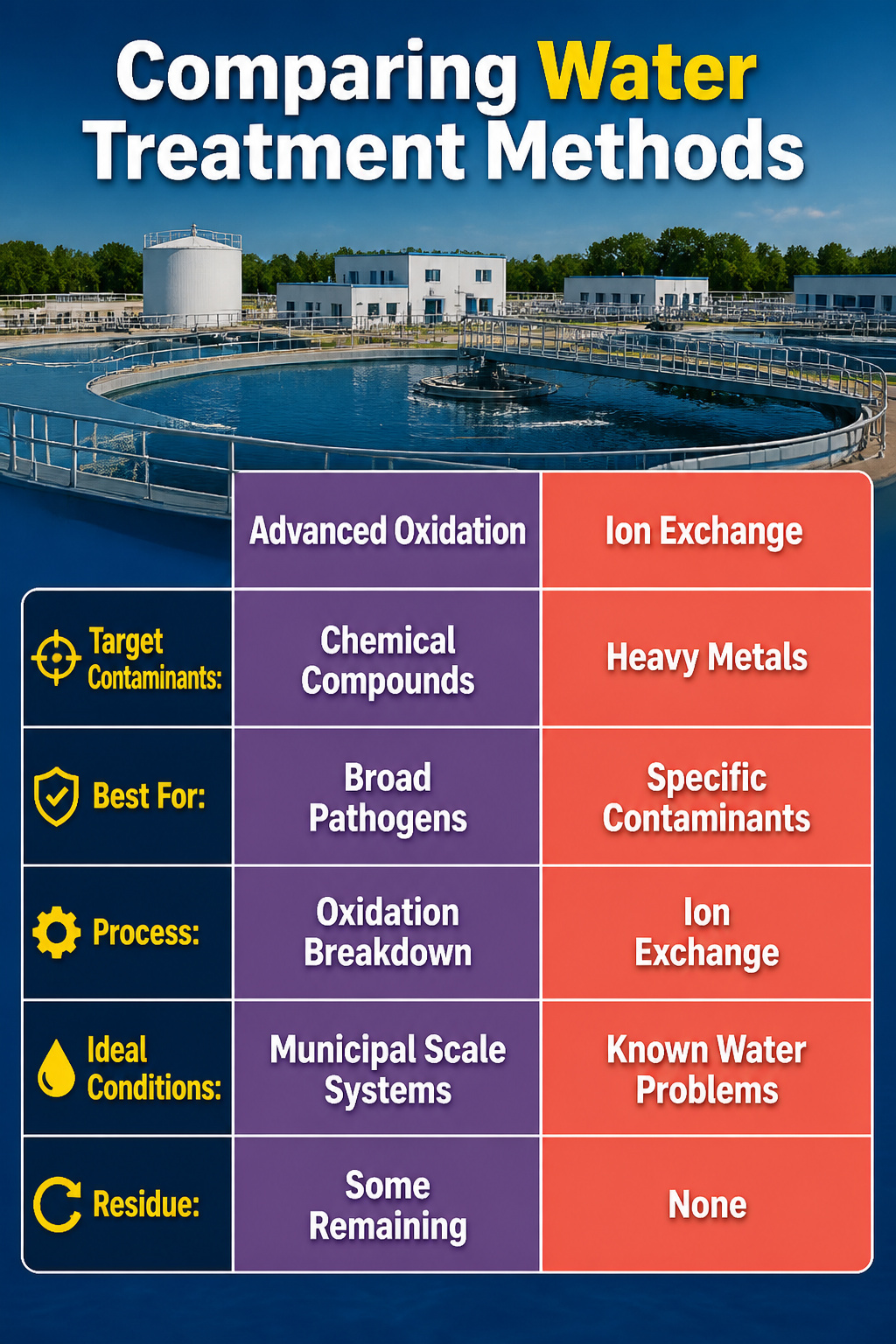
Some contaminants slip past standard disinfection, which is where advanced oxidation and ion exchange come in. UV light paired with hydrogen peroxide breaks down chemical compounds that chlorine misses, a process the Orange County Groundwater Replenish System uses after microfiltration and reverse osmosis on its 70 mgd flow. Ozone works differently: it inactivates Giardia and Cryptosporidium while stripping out taste and odor compounds from seasonal algae blooms, then dissipates without leaving residual chemicals behind. The tradeoff is infrastructure; the largest fully ozonated plant in Texas runs at municipal scale, not household.
Ion exchange handles what oxidation cannot. Resin beads swap harmless ions for heavy metals like lead or arsenic, targeting specific contaminants rather than broad pathogens. The method works best when you already know your water’s problem; it is overkill for routine disinfection and insufficient alone. Between them, UV plus peroxide, ozone, and ion exchange fill gaps in conventional treatment, each addressing a narrow threat that standard chlorination leaves untouched.
What the EPA Requires
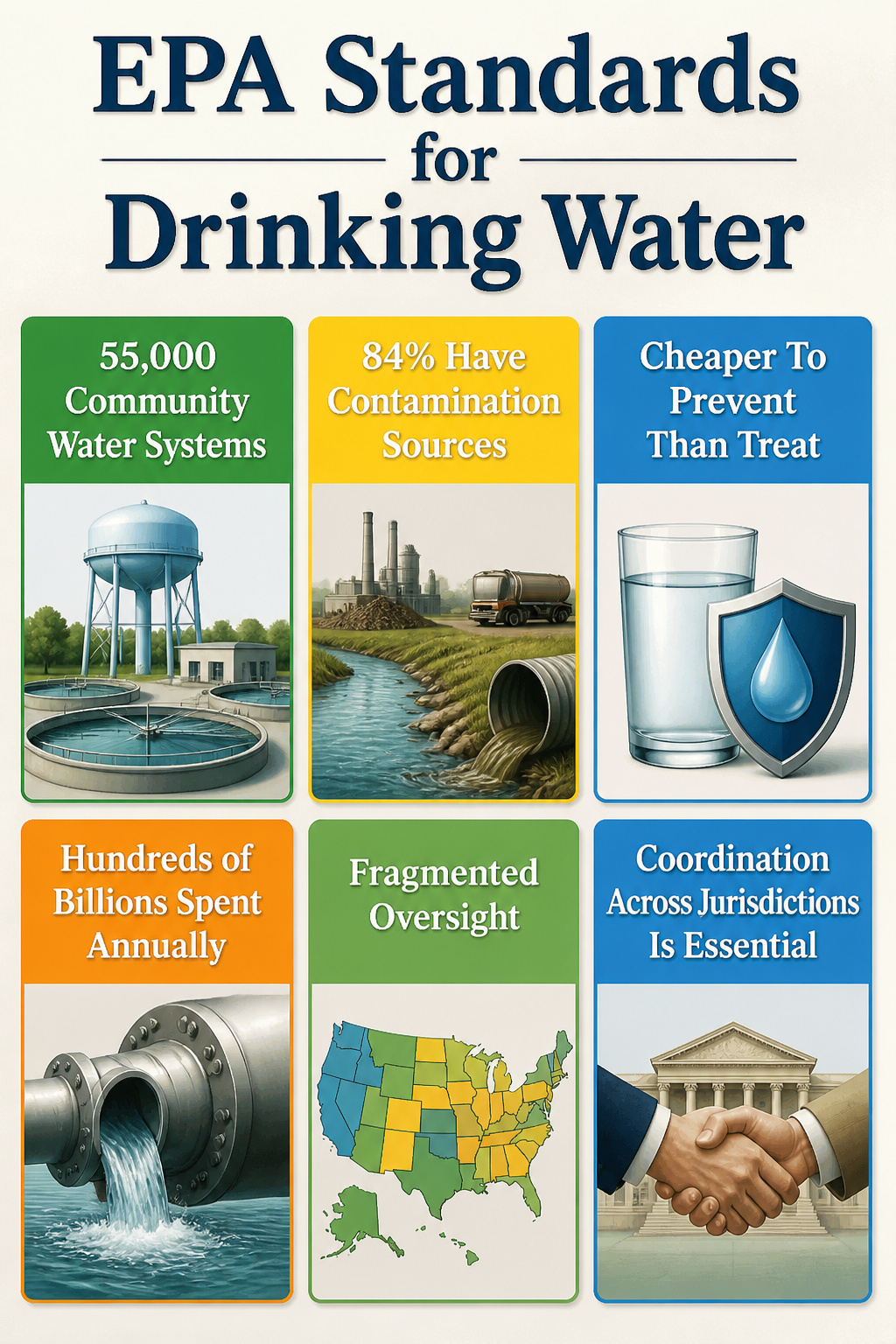
The Environmental Protection Agency oversees more than 55,000 community water systems across the country, setting the standards that determine whether tap water is safe to drink. Only a small percentage of those systems report violations of health standards in any given year, which sounds reassuring until you notice the rest of the picture. More than 84 percent of all drinking water systems have at least one potential source of contamination sitting within two miles of their intake or well. That gap between "meets standards" and "faces real risk" is where the system’s strain shows.
Local, state, and federal coordination over drinking water is fragmented at best. The EPA sets the national rules, but California’s State Water Resources Control Board runs its own parallel oversight, and plenty of other states layer their own requirements on top. Partnerships across those jurisdictional lines matter more than most people realize, because contamination prevention at the source is cheaper than treatment after the fact. Water systems nationwide have already spent hundreds of billions on treatment and distribution infrastructure, plus billions more annually just to keep things running. The money is going out; whether the coordination keeps pace is harder to measure.
Emerging Contaminants

PFAS and pharmaceuticals are slipping through treatment plants built for a different era. These chemicals, used in nonstick pans, food packaging, and countless manufacturing processes, weren’t on anyone’s radar when most municipal systems were designed. The Environmental Protection Agency found activated carbon treatment effective for PFAS removal in a 2018 examination, with anion exchange, reverse osmosis, and nanofiltration also in play. But here’s the gap: long-term health studies still lag behind the chemistry.
To prepare for broader implementation of water reuse practices nationwide, it is essential to identify chemicals of emerging concern and microbial contaminants during the assessment of alternative water sources.
What this means for anyone watching their tap is that "treated" no longer equals "fully addressed" for every contaminant class. The EPA proposed retaining federal limits for PFOA and PFOS in 2026 while rescinding requirements for four other PFAS, though neither proposal was finalized as of August 2026. Spent carbon and resins from this newer filtration carry their own disposal headaches. We are, in effect, learning what these chemicals do to us while we are already drinking them.
Household Water Treatment

Point-of-use filters sit right at the faucet or inside a pitcher, and they handle the contaminants municipal treatment might miss or that pick up in the pipes on the way to your glass. The National Sanitation Foundation draws a useful line between these and whole-house, or point-of-entry, systems: POE units treat everything at the door, while POU targets only where you actually drink. For most households, that final barrier is enough.
I started looking harder at POU options after reading what the EPA actually regulates versus what people assume it catches. Faucet-mounted units and under-sink filters strip lead, chlorine taste, and sediment without touching your shower flow. Reverse osmosis units go further, though they waste water in the process. A filter that does not get maintained becomes a reservoir for what it caught; change cartridges on schedule or you are drinking yesterday’s contaminants. Whole-house systems like Natzeo backwash filters knock out iron, color, and odor before water reaches any tap, but they will not stop bacteria or viruses. That gap matters if your source is well water or if your immune system runs compromised. No home unit removes everything, and none of them make unsafe source water safe by themselves. The taste improvement is real. The safety claims often oversell.
Frequently Asked Questions
What are the main stages of water treatment?
The main stages are coagulation and flocculation, sedimentation, filtration, disinfection, and pH adjustment. Coagulation neutralizes particle charges so contaminants clump together; flocculation stirs those clumps into heavier floc that settles out. Sedimentation drops that material to the bottom, filtration strains what remains through sand and carbon, disinfection kills pathogens with chlorine or ozone, and pH adjustment prevents pipe corrosion and off tastes.
What contaminants are typically removed during water treatment?
Treatment targets sediment, clay, organic matter, bacteria, viruses, protozoa like Giardia and Cryptosporidium, and chemical pollutants including pesticides, herbicides, and heavy metals. Activated carbon grabs organic compounds and taste or odor problems, while ion exchange resins swap out lead and arsenic. Emerging contaminants such as PFAS and pharmaceuticals increasingly slip through conventional systems and need advanced oxidation or specialized filtration.
How does the water treatment process work?
Raw water enters a plant, gets dosed with positively charged coagulants so small particles clump into settleable floc, then sits in sedimentation tanks where that floc drops out as sludge. The clearer water above runs through layered filters of sand, gravel, and often activated carbon to trap finer particles and organic compounds. Disinfectants like chlorine or ozone kill remaining pathogens; a final pH adjustment with lime or soda ash protects distribution pipes and taste before the water heads to taps.