
You can find north with any analog watch in about thirty seconds, but only if you start with the dial perfectly flat. Tilt it even slightly and the geometry collapses. The step everyone skips, holding the face level while they sight the sun, is the same reason an afternoon bearing drifts fifteen degrees without warning. I learned that on a ridge once, north wandering until I noticed the watch had tipped on my palm.
1. Hold the Watch Flat

The watch face has to sit perfectly flat and dial-up for any of this to work. Tilt it toward you, tilt it away, and the angle between the hour hand and the sun becomes a guess instead of a geometry problem. I learned this the hard way on a ridge in late afternoon, wondering why north kept drifting until I noticed the watch had tipped on my palm.
Gravity matters less than geometry here. The sun’s rays need to strike the dial at a right angle to the plane you’re reading, and a tilted watch breaks that plane. The shadow or alignment you are about to use depends on a flat reference, the same way a real compass needle needs a level housing to swing true.
This rule holds whether you are north or south of the equator. Both hemispheres start from the same flat, dial-up position; the difference comes later, in which marker you point at the sun. Get the level wrong now and the hemisphere fix will not save you.
2. Point the Hour Hand at the Sun

The sun’s path across the sky splits this method into two entirely different moves, and getting the hemisphere wrong will point you south when you mean north.
In the Northern Hemisphere, the sun tracks across the southern half of the sky. Point the hour hand at the sun, then find the midpoint between that hand and 12 o’clock. That midpoint faces south; north sits opposite. The logic is straightforward: at noon you’re already facing roughly south, so the hour hand itself approximates the sun’s position, and the halfway split corrects for the hours before or after midday.
The Southern Hemisphere reverses everything. There the sun crosses through the northern sky, so the geometry flips. Point the 12 o’clock marker at the sun instead, then split the difference between 12 and the hour hand. Same midpoint calculation, different starting point, and the result points north rather than south.
I learned this distinction the hard way on a trip where I assumed the method was universal. The watch trick works, but only when you match the starting point to the sky you’re standing under.
3. Find the Midpoint

With the hour hand aimed at the sun and the 12 o’clock mark fixed on the dial, the halfway point between them marks south in the Northern Hemisphere. The geometry is simple enough once you picture it: the sun completes its arc in about twelve hours, and your watch face compresses that arc into a circle. At 6 a.m., the hour hand and 12 sit 180 degrees apart; the bisection points due south. By noon they overlap, and south runs straight through both. The method works because any hour hand position encodes how far the sun has traveled from its southernmost peak, and splitting the difference recovers that reference line.
South of the equator the same logic applies, but the sun tracks through the northern sky instead. There you point the 12 o’clock marker at the sun, and the midpoint between it and the hour hand gives you north.
The weak spot in all this is estimating that midpoint by eye. A few degrees of sloppiness at the center of the dial becomes a wide miss on the horizon. The Hodinkee example of 4 p.m. puts the hour hand at the 4 and 12 at the top; the true bisection is exactly at 2. Guessing "somewhere between 2 and 3" steers you fifteen or twenty degrees off actual south, enough to walk parallel to your intended path for miles. The flatter you hold the watch and the more carefully you sight along the imagined line, the tighter your result.
4. Adjust for Daylight Saving Time

Daylight Saving Time throws off the watch-as-compass trick because the sun runs on solar time, not clock time. When DST is active, set the watch back one hour before you point the hour hand at the sun, or split the difference mentally and use the midpoint between 1 o’clock and the hour hand instead of noon and the hour hand. Four separate pages flag this as the most common reason people get a wrong bearing. The error is usually 15 degrees, enough to send you a full quadrant off over distance. I have forgotten this step myself on a March afternoon and wondered why the ridgeline I expected to hit sat off my left shoulder. Solar noon in most places already drifts 15 to 20 minutes from clock noon across the year; adding the DST hour on top makes the mismatch serious.
5. Use the Compass Bezel
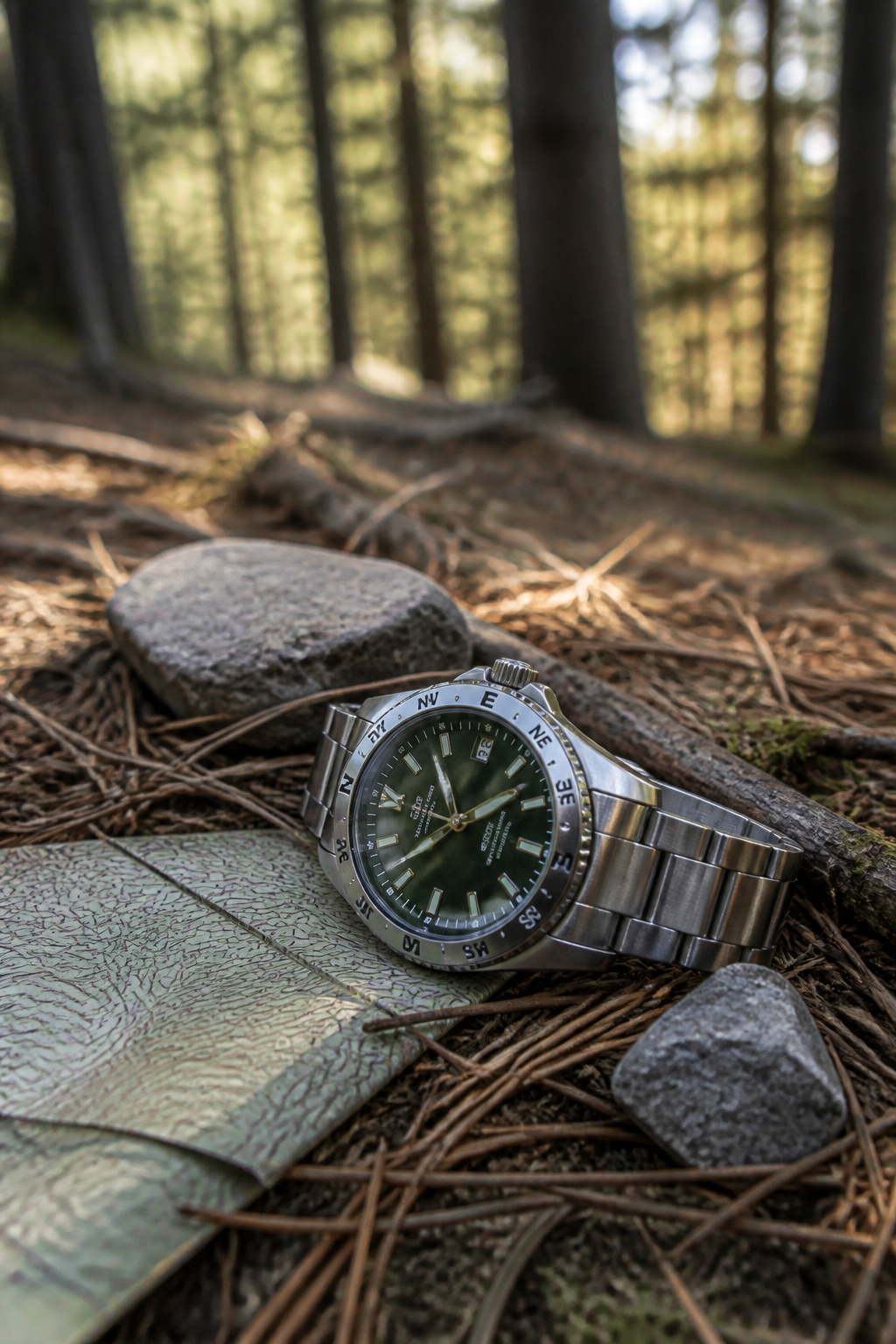
A compass bezel turns the watch method from a one-time check into something you can walk with. On models like the Seiko Alpinist or certain Timex Expedition variants, the bezel rotates freely, no clicks, with simple N-S-E-W markers. Once you’ve found north by the sun-and-hands method, you rotate that bezel so the south marker sits at the midpoint between hour hand and 12:00. The bezel now holds your bearing while you walk, no need to keep glancing back at the sun.
This is optional gear, not required. The basic watch-as-compass works on any analog face. But walking a straight line through timber or brush, stopping to re-aim the hour hand every few minutes gets old fast. The bezel keeps you on line while your eyes stay on the terrain.
One real limit: between the Tropics of Cancer and Capricorn, the bezel method drifts off at certain seasons. Seiko notes this outright. Most of the continental U.S. sits outside that band, so the warning matters more for readers in Central America or Hawaii than for someone in the Rockies or the Appalachians.
Analog vs. Digital Watches

A digital watch face will not work for this method, and that catches more people than you might expect. The technique needs a physical hour hand pointing at the sun, something a string of numbers on a screen simply cannot do. Some digital watches offer an analog display mode, but that still fails; the image rotates electronically without the mechanical relationship between hand position and internal gear orientation that makes the trick possible. The hour hand must be a real, physical component.
I learned this the hard way on a hike years ago, pulling up my wrist to check a Casio only to remember there was nothing there to point. The watch told time perfectly, but time was not what I needed in that moment. If your only watch is digital, the method is unavailable to you. Borrow an analog piece, or carry a small button compass instead.
Calibrate a Compass Watch

Electronic compass watches need a quick setup before they point true north. The declination setting matters most, and getting it wrong sends you walking a few degrees off course without realizing. Most units let you dial in the offset for your location, either by looking up the number or letting GPS fill it in.
Calibration itself is the part people skip. The watch wants you to rotate it slowly, about 15 seconds per full turn, while it samples the magnetic field. Rushing this step leaves the sensor confused by stray interference from the band, your phone, or nearby power lines. Two full rotations usually finish the job.
The whole process sits apart from the old analog watch-and-sun trick, though search results often lump them together. If your watch face shows a compass rose and a digital readout, this is the method that applies.
Where the Method Fails

The watch-as-compass method starts to fall apart when you get too close to the Tropic of Cancer or the Tropic of Capricorn. The sun tracks so near to overhead that finding a reliable midpoint between the hour hand and twelve o’clock becomes guesswork rather than measurement. Seiko’s own instruction manuals flag this plainly, noting that in low latitude areas south of the Tropic of Cancer, the compass may not function properly at certain times of the year. The same warning applies north of the Tropic of Capricorn in the Southern Hemisphere.
In low latitude areas (south of the Tropic of Cancer), the compass may not function properly at certain times of the year.
What this means for the reader: if you are hiking in southern Florida, the Sahara’s southern edge, or northern Australia, the method is unreliable seasonally. The closer to the equator, the more often the sun sits too high to cast a useful angle. Most guides skip this entirely, which is why I wanted to flag it here before someone trusts their watch in terrain where the trick simply does not hold.
Frequently Asked Questions
How do I use a watch as a compass?
Point the hour hand at the sun, then find the midpoint between that hand and the 12 o’clock marker. In the Northern Hemisphere that midpoint faces south; north sits opposite. In the Southern Hemisphere, point the 12 o’clock marker at the sun instead, and the midpoint between 12 and the hour hand gives you north.
What adjustments do I need to make for Daylight Saving Time?
Set your watch back one hour before you point the hour hand at the sun, or split the difference between 1 o’clock and the hour hand instead of noon and the hour hand. Skipping this step usually throws your bearing off by about 15 degrees, enough to send you a full quadrant off over distance.
Can I use a digital watch as a compass?
No, this method only works with an analog watch that has a physical hour hand. The technique depends on that real, mechanical hand pointing at the sun so you can measure the angle to 12 o’clock. A digital display, even in analog mode, lacks the actual hand position needed for the geometry to work.