Safety tips for driving in the fog are the habits that keep you from becoming one of the 38,700 annual crashes the Federal Highway Administration tracks in low-visibility conditions. Fog fools your eyes: it flattens depth perception, hides obstacles until they are dangerously close, and makes your speed feel slower than the needle reads. The difference between a hard brake and a collision often comes down to whether you trusted instruments over instinct when the gray wall closed in.
1. Slow Down and Maintain a Safe Speed
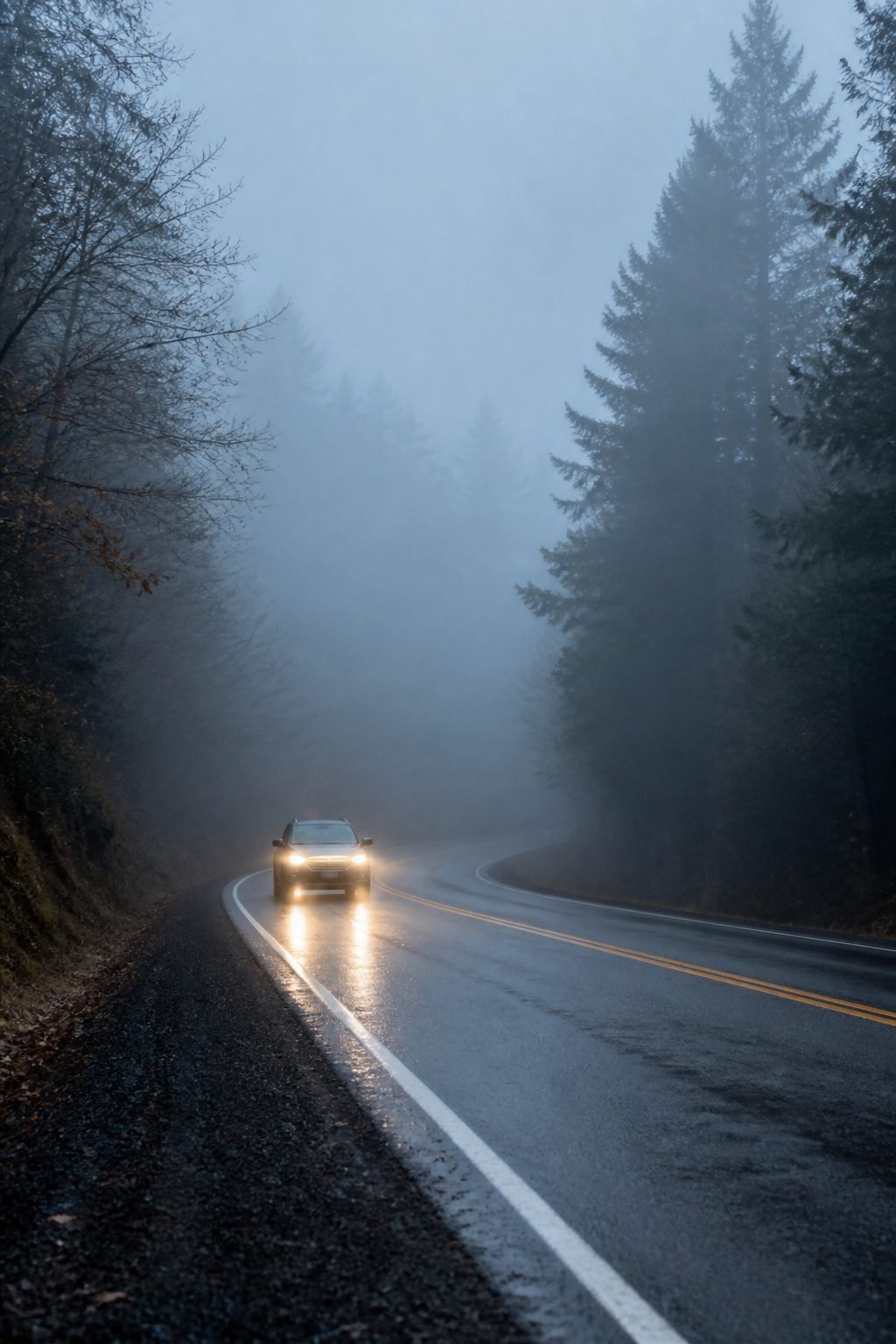
Fog plays a trick on your eyes that you only notice once it has already cost you distance. The moisture droplets scatter light in ways that flatten depth perception, so a car ahead looks closer than it is, or further, or somehow both at once. The Federal Highway Administration tracks what this costs: over 38,700 crashes happen each year in low-visibility conditions, with 600 deaths and 16,300 injuries tied to those numbers. That is not a rare edge case. That is Tuesday morning on the interstate.
The real problem is that fog thickens without warning. One mile you can see three taillights ahead; the next, you are guessing where the lane ends. Reducing speed is what buys back the reaction time your eyes just lost. At 55 mph you cover 81 feet per second. At 35 mph you cover 51. Those 30 feet are often the difference between a hard brake and a phone call you do not want to make. Your speedometer is the only honest instrument in the car at that moment, because fog will tell you that 45 feels fast enough, or too slow, or nothing at all. Trust the needle, not the feeling.
2. Use Low-Beam Headlights and Fog Lights
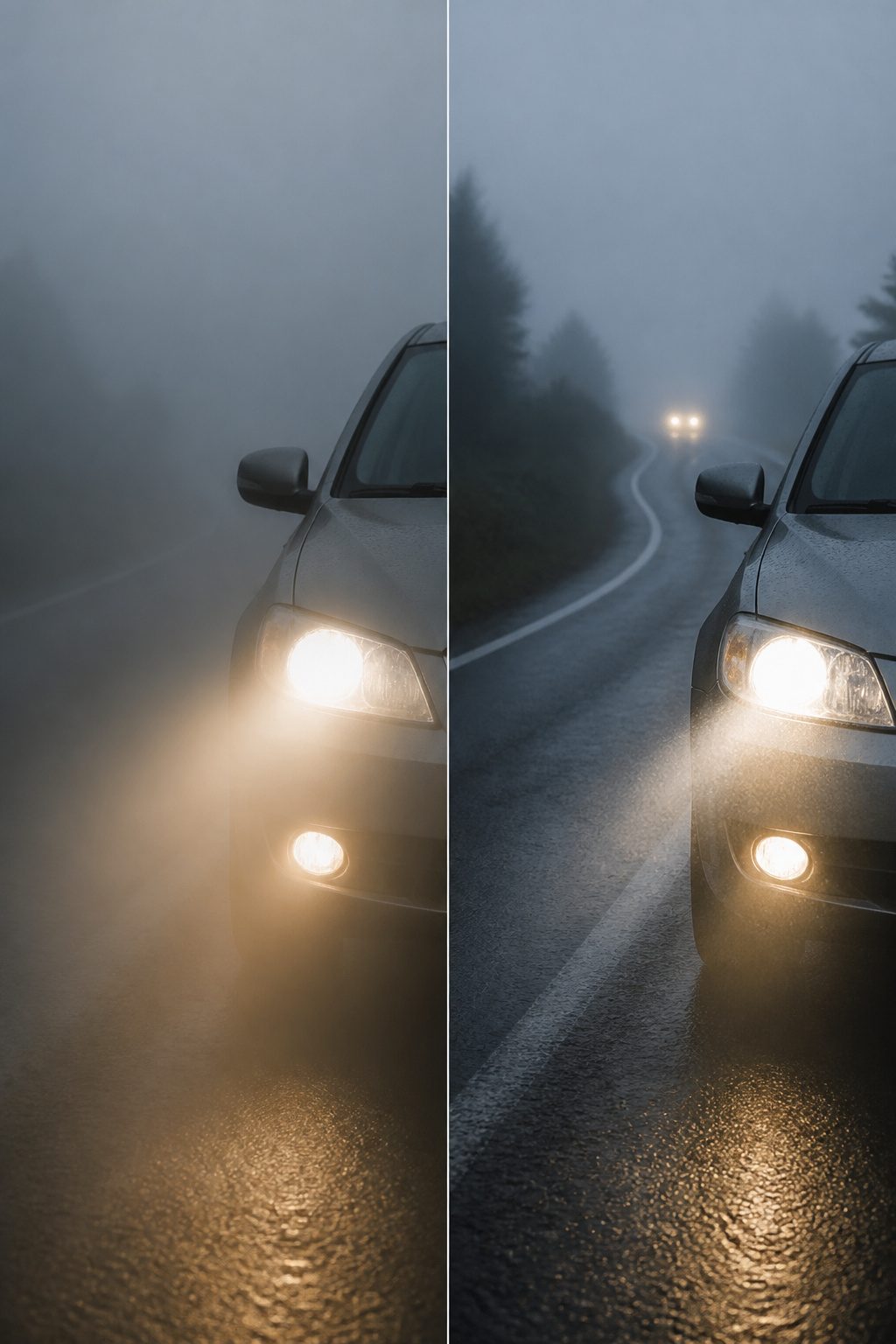
High beams in fog are a reflex that backfires. The light hits the water droplets and scatters straight back into your eyes, so the brighter you go, the less you see. Low beams and fog lights sit lower and cut under that moisture layer, putting light on the road instead of bouncing it into your face.
Some drivers still wonder if high beams ever help. They do not. The National Weather Service notes that the glare only makes it harder to spot road markings and vehicles ahead. If your car has fog lights, pair them with your low beams. Sources do not spell out exact settings, so the practical move is simple: low beams on, fog lights on if you have them, high beams off. Your taillights stay lit too, which matters for whoever is behind you in the mist.
3. Increase Following Distance
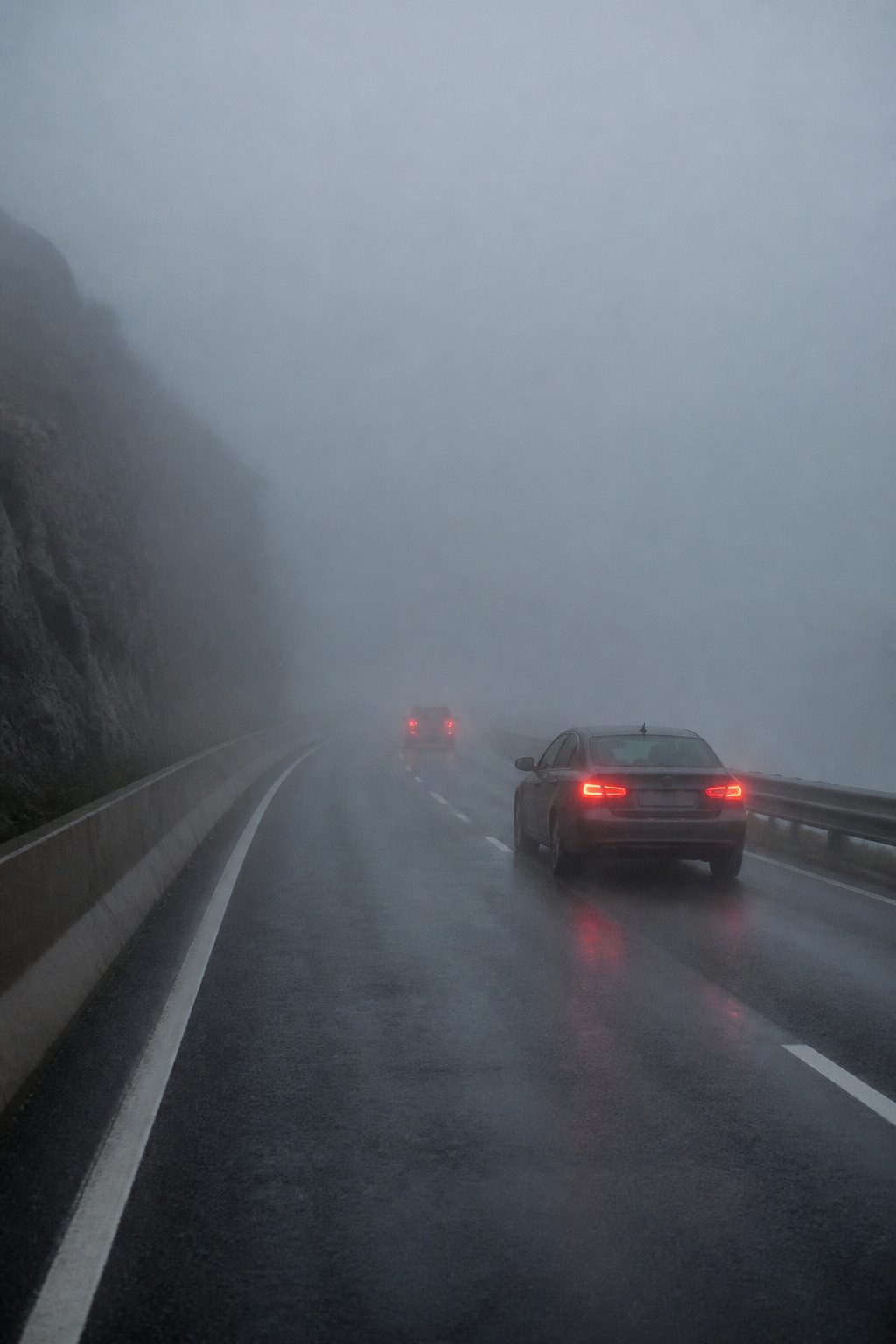
Fog cuts the distance you can see, and that same fog steals the time you have to react. Three to five car lengths is the minimum buffer that leaves room for both surprises. The car ahead might brake for something you cannot see yet, or slow for a patch of thicker fog, and with visibility already shortened your stopping distance stretches past what it would on a clear day.
I used to run closer in bad weather, figuring the taillights ahead were enough warning. They are not. Those lights give you the car, not the obstacle the car is braking for, and by the time you see brake lights flash you have already eaten most of your margin. Extra space turns a near collision into a hard brake you walk away from.
Take the vehicle off cruise control when you do this. Fog creates an optical illusion of moving slowly, and speed creeping up while spacing stays fixed is how pileups start. Check the speedometer, add the car lengths, and let the gap do the work your eyes cannot.
4. Minimize Distractions
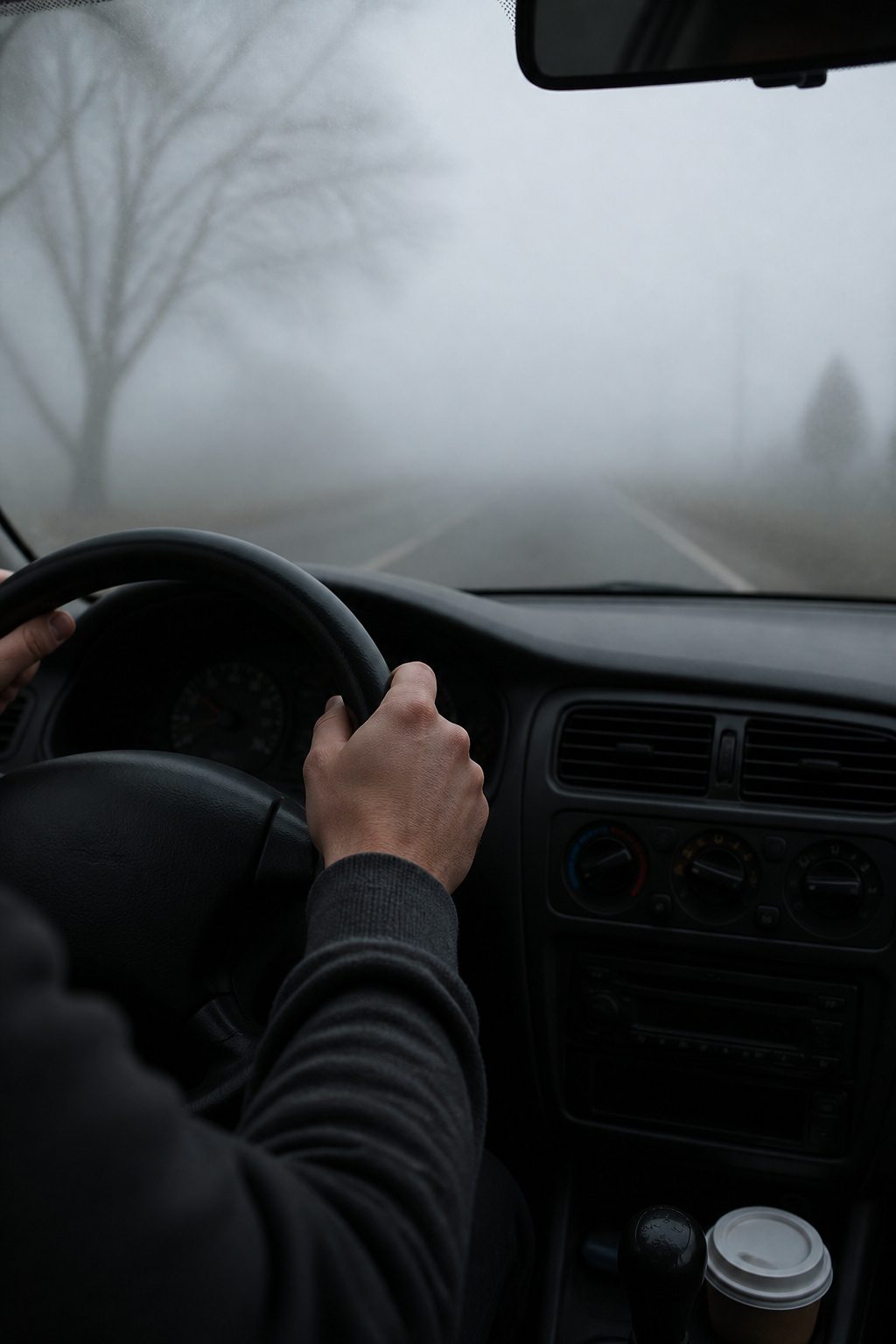
The radio went off first. Then the phone flipped to Do Not Disturb. Fog has a way of making you realize how much noise you normally tolerate behind the wheel, and every bit of that attention belongs on the road when you can barely see past the hood.
Passengers need to know the deal too. One winter morning a few years back, I had three people in the truck chatting about breakfast plans while a deer materialized maybe forty feet ahead. Nobody saw it but me. After that, the rule became simple: fog means quiet. No calls, even hands-free. No reaching for playlists. The cognitive load is already high enough without splitting focus between a conversation and a windshield full of gray.
Hands-free devices still pull your mind elsewhere. The same I Drive Safely guidance I picked up years ago sticks with me here: your eyes and your thoughts both need to stay on what the fog might be hiding. A brake light, a stalled car, a cyclist with no lights. These things give you almost no warning, and half your attention is half your reaction time gone.
5. Use Road Markings as Guides
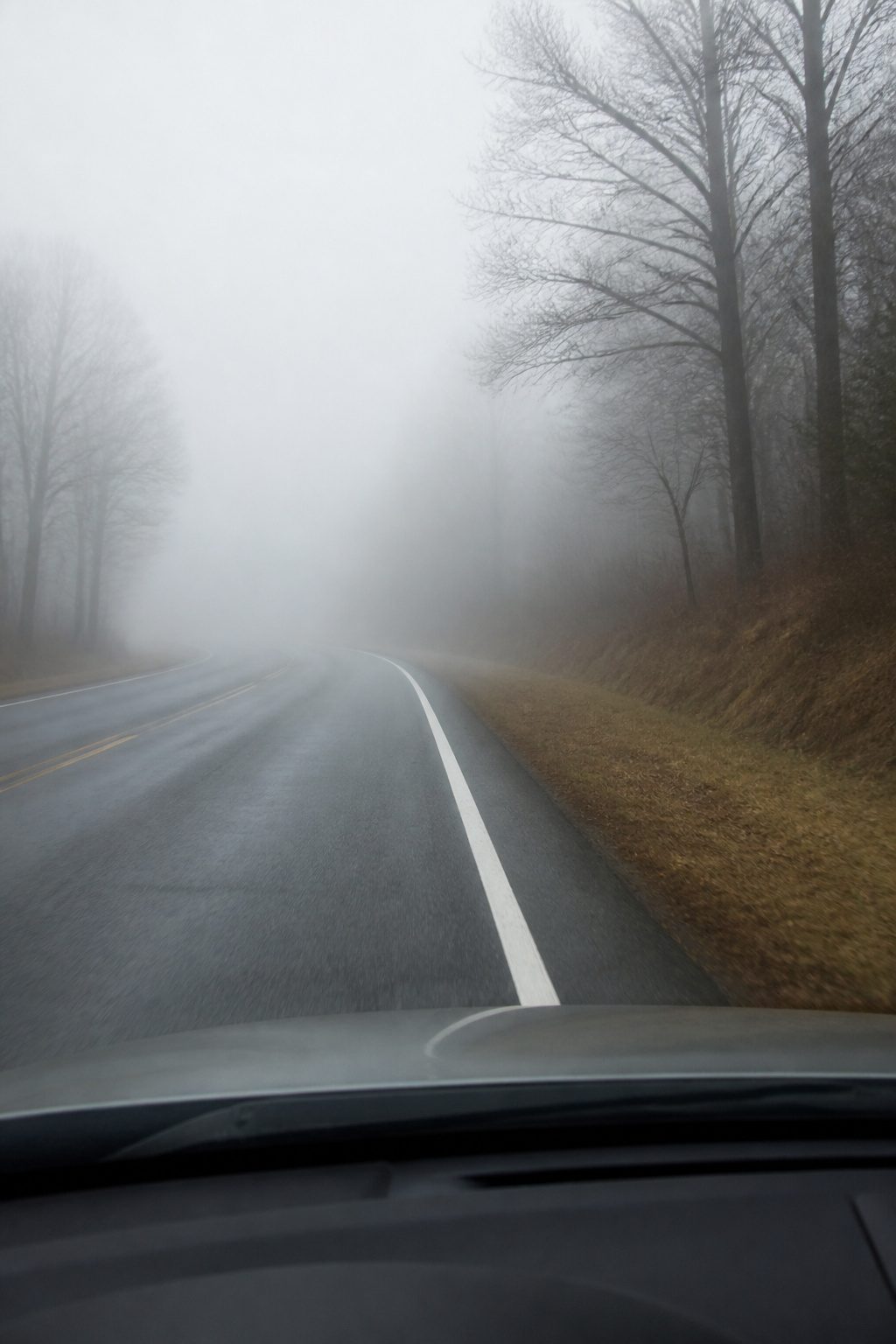
The white line painted on the right edge of the road gives a fixed reference point that does not brake or swerve. Center markings carry the opposite risk, drawing you toward headlights you may not see until too late.
Following the taillights ahead is a mistake that ends in guardrail scrapes or worse. The driver in front might be lost, distracted, or about to exit. Their brake lights mean slow traffic, not safe passage. Road markings stay where they are. Fog only hides them; it does not move them.
J.D. Power notes the right-side line specifically, not the center. The logic is simple enough: oncoming traffic occupies the other half, and if you cannot see well, neither can they. Drifting left puts two blind drivers on a collision course. The right edge leaves that entire lane as buffer.
When the paint fades or the shoulder drops away, the line still beats a red glow in the mist. The glow moves. The paint does not.
6. Use Windshield Wipers and Defrosters
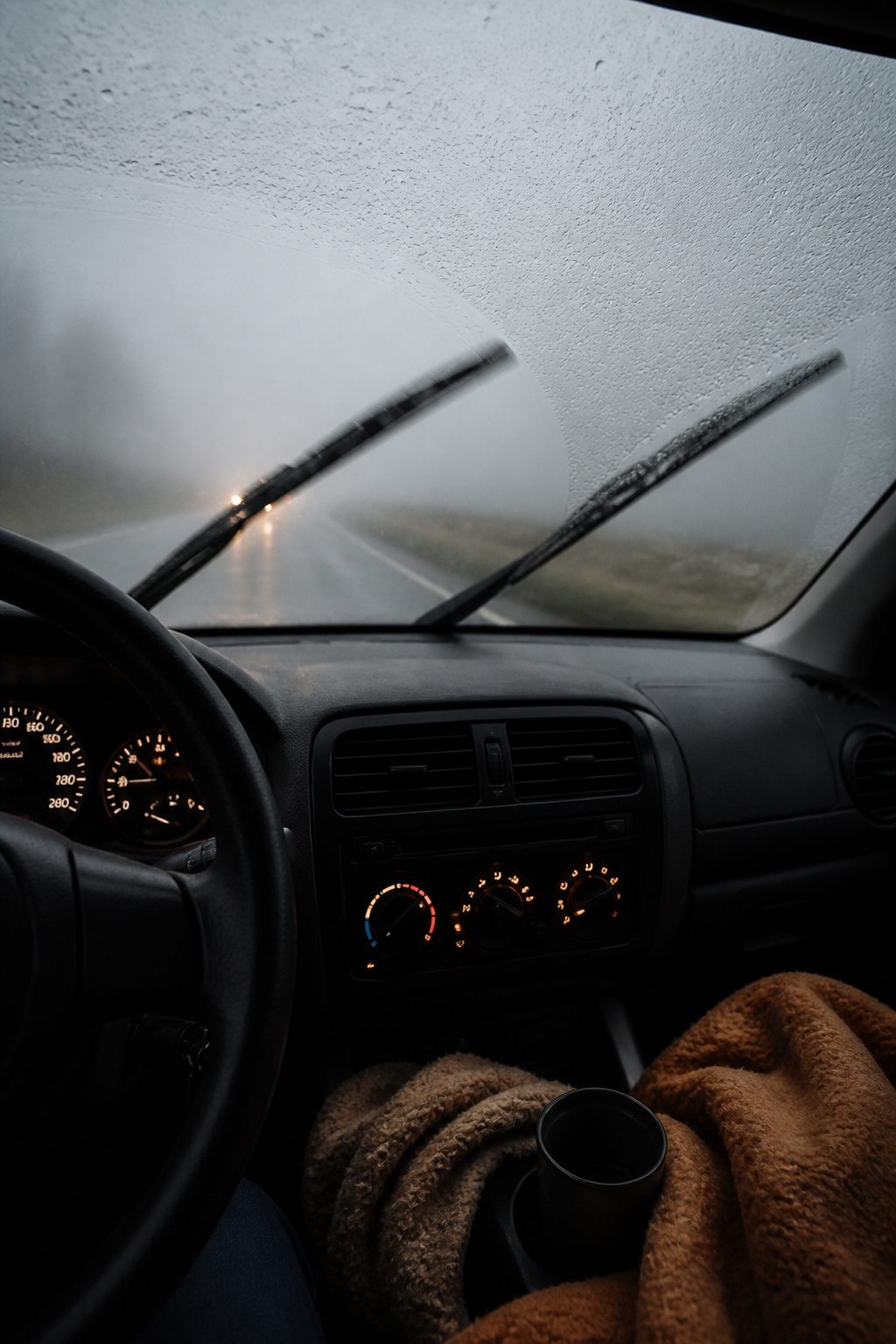
The inside of your windshield can fog up faster than the outside in certain conditions, and knowing why keeps you from fighting the wrong battle. Fog forms when the glass surface drops to or below the dew point of the air inside your car; warm, moist breath and damp jackets raise that dew point, while cold outside air pulls the glass temperature down. The result is interior condensation that no amount of wiper fluid will touch.
Your defroster handles this by blowing dry, warmed air across the inside surface, pushing the glass temperature back above the dew point so moisture stops collecting. Run it on warm-to-hot to dry things out rather than merely moving air around. The wipers, meanwhile, deal with the exterior film of moisture that fog leaves on the glass itself, the droplets or ice crystals that build depending on temperature. Both systems working together keep the only view you have worth having.
7. Avoid Sudden Maneuvers
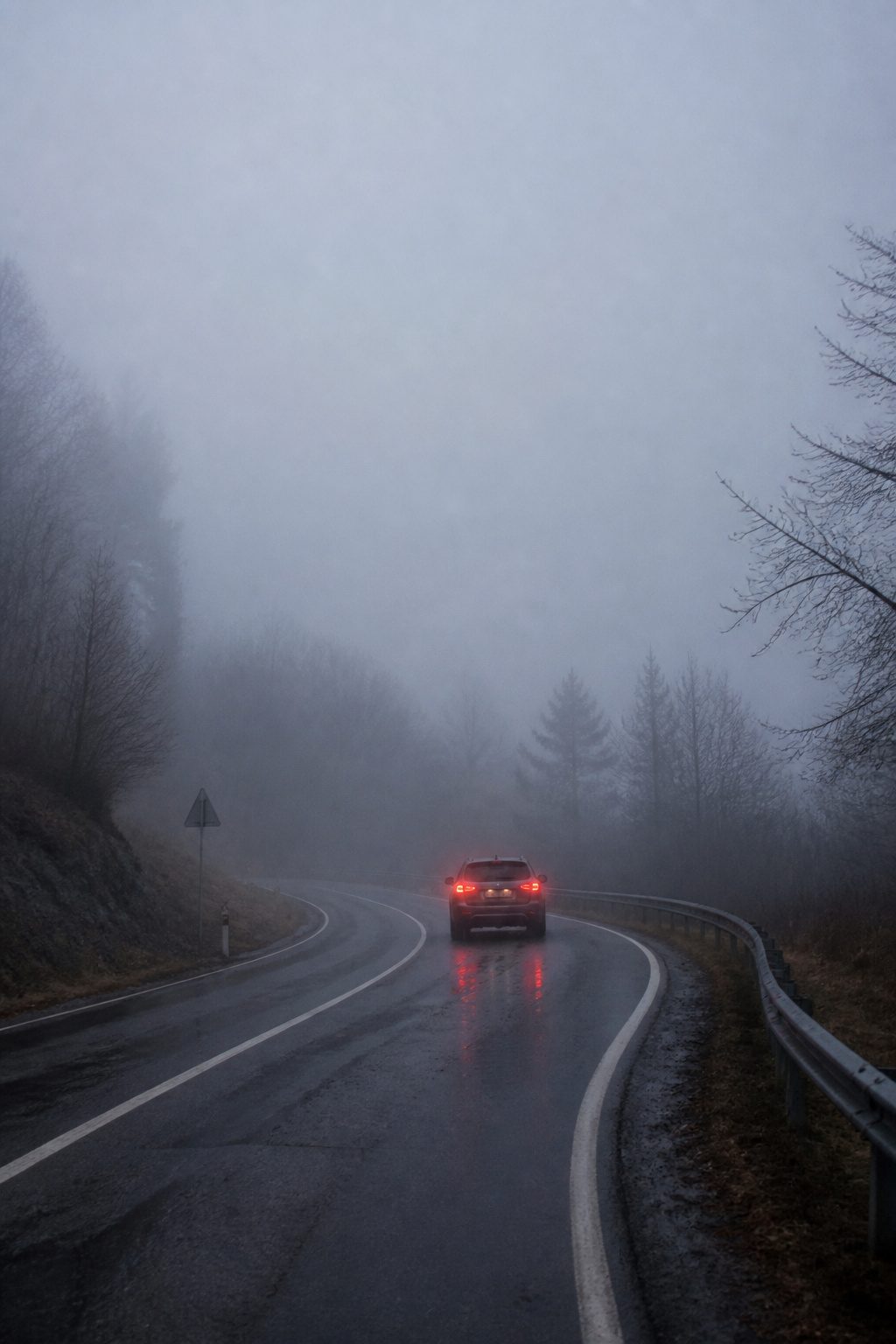
Fog does not hide just the road ahead. It hides you from the driver behind, and that distance is harder to judge than it looks. A sudden brake or a sharp swerve gives the car back there almost no time to adjust, especially when their own reaction time is already cut by the same gray wall you are squinting through.
Brake, steer, and change lanes gradually so the brake lights and turn signals do their job as warnings, not surprises. I learned this the hard way on I-5 south of Sacramento years ago, tapping the brakes for a phantom exit ramp and watching the pickup behind me fishtail into the next lane. No contact, but close enough. The fog had compressed everything; my small move read as an emergency to him.
Chain-reaction crashes in fog often start with one driver doing something the others cannot process in time. Predictable movements let everyone keep a little more space and a little more calm. Smooth is fast in weather like this; the opposite costs more than the seconds you think you are saving.
8. Turn On Hazard Lights When Necessary
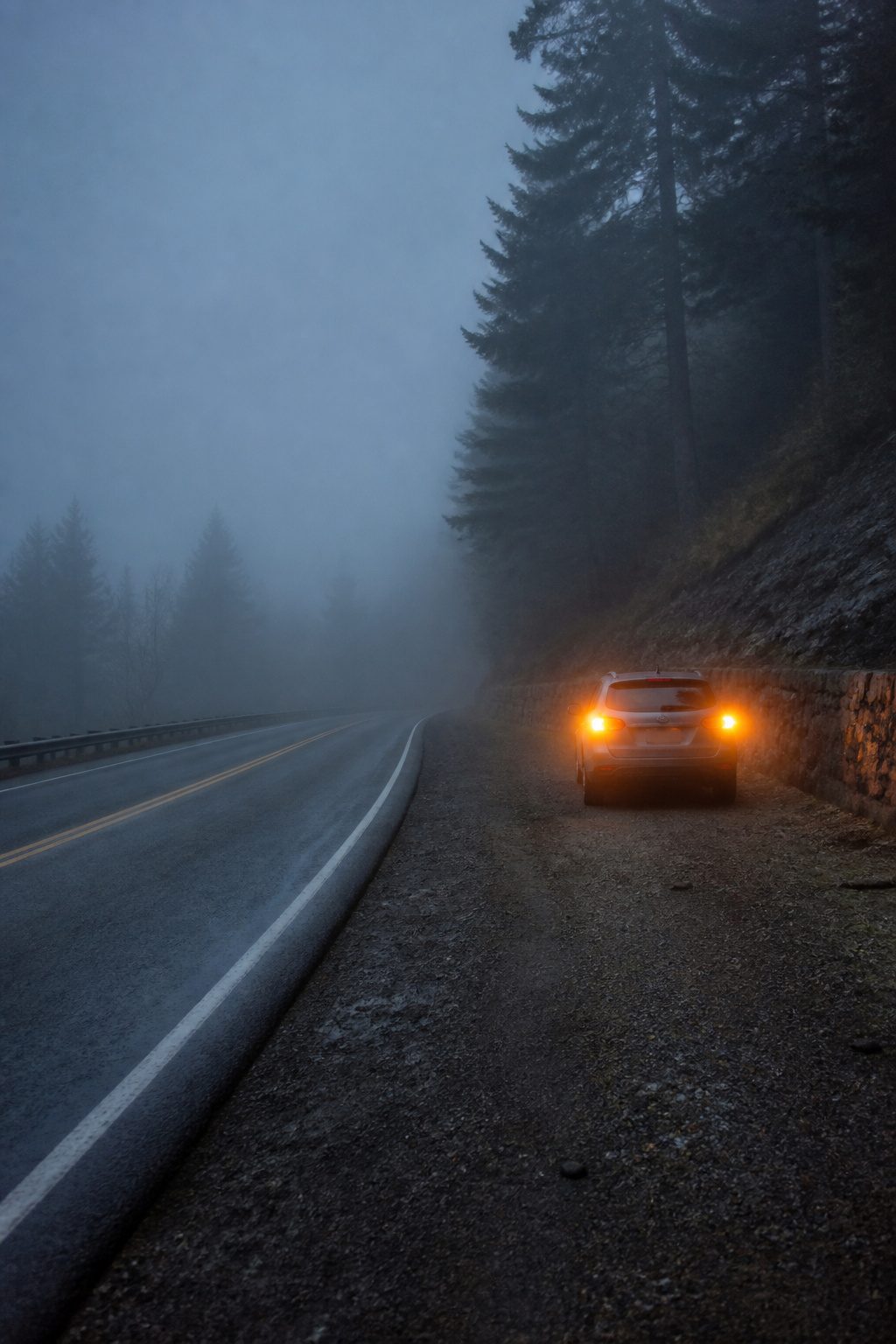
Hazard lights serve one clear purpose in fog: they tell the driver behind you that something has changed. When visibility drops sharply and your speed has to fall well below the flow of traffic, a car crawling at 25 mph on a 55 mph road becomes a stationary object to the person approaching from behind. The flashers close that gap in perception.
The catch is that laws vary by state on whether you can run hazards while the vehicle is still moving. Some states permit it only when stopped or below a certain speed; others treat moving with flashers as a ticketable offense. A driver in heavy fog is already managing enough without guessing whether their state is one of the permissive ones.
What convinced me, reading through the guidance, is that the safer play splits neatly. If you are still rolling but drastically slowed, rely on your regular taillights and extra following distance. If conditions force you to pull onto the shoulder or into a lot, hazards go on immediately, and the headlights go off so you do not read as a moving vehicle to anyone else still on the road. The flashers then mark a stopped obstacle, which is exactly what you are.
9. Pull Over If Visibility Is Too Low
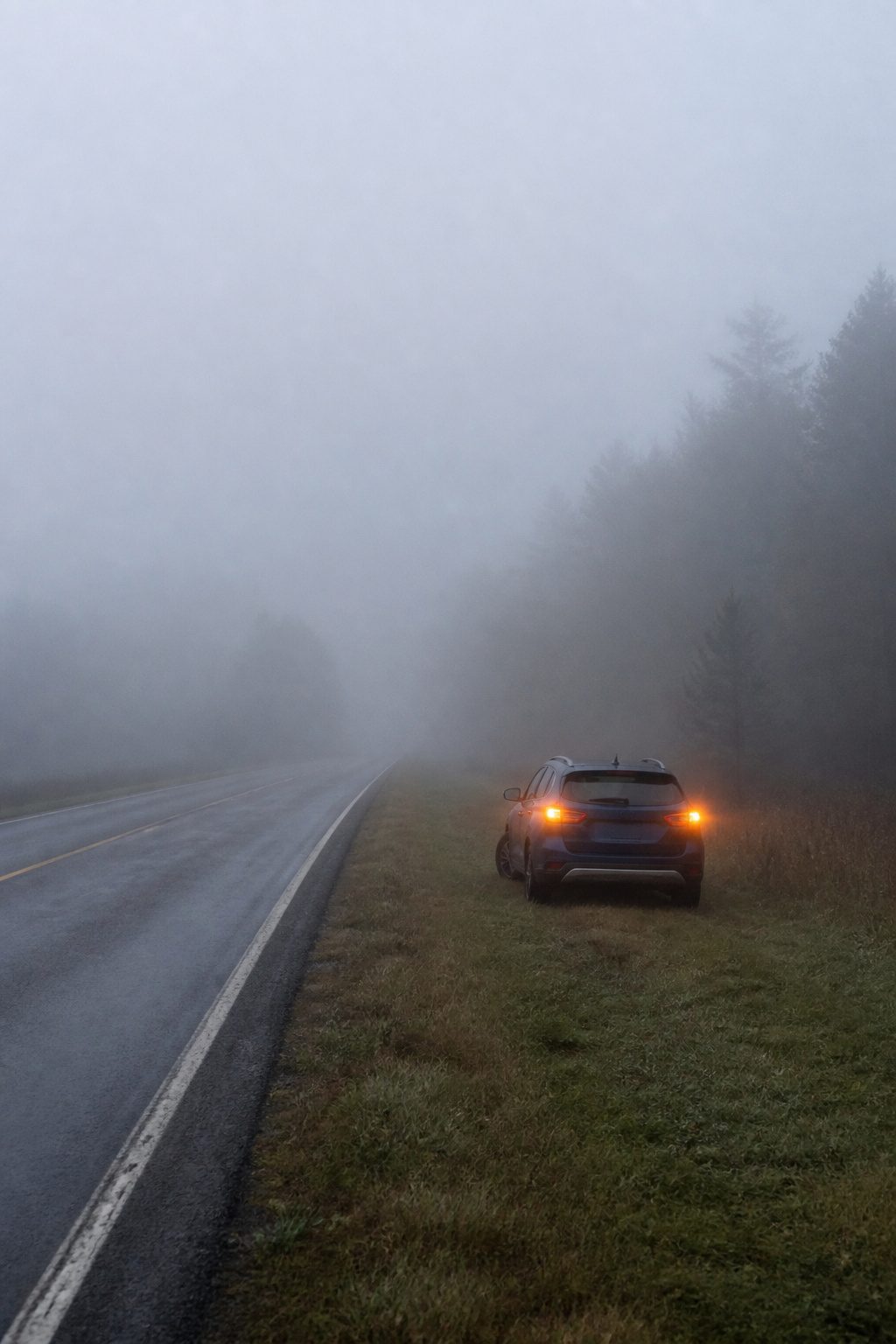
Fog can thicken faster than your eyes adjust. Last October, somewhere past the Bakersfield exits on I-5, the wall ahead went from gray to nothing in about two hundred yards. That was the trip where I learned the shoulder is not a safe place to stop.
A rest area, a parking lot, even a driveway off the main road gives you distance from the travel lanes. The sources I trust on this all say the same thing: once you’re stopped, leave the hazard lights on but switch the headlights off. Headlights in fog, from behind, read like a car still moving in the lane. Hazard lights broadcast stopped vehicle; headlights broadcast I’m driving, follow me.
If no lot appears and the shoulder is the only option, get well off the paved surface, onto grass if it’s there, and stay belted in your seat. The fog will lift. Waiting it out beats becoming a statistic someone else failed to see in time.
Visibility Issues Fog Creates
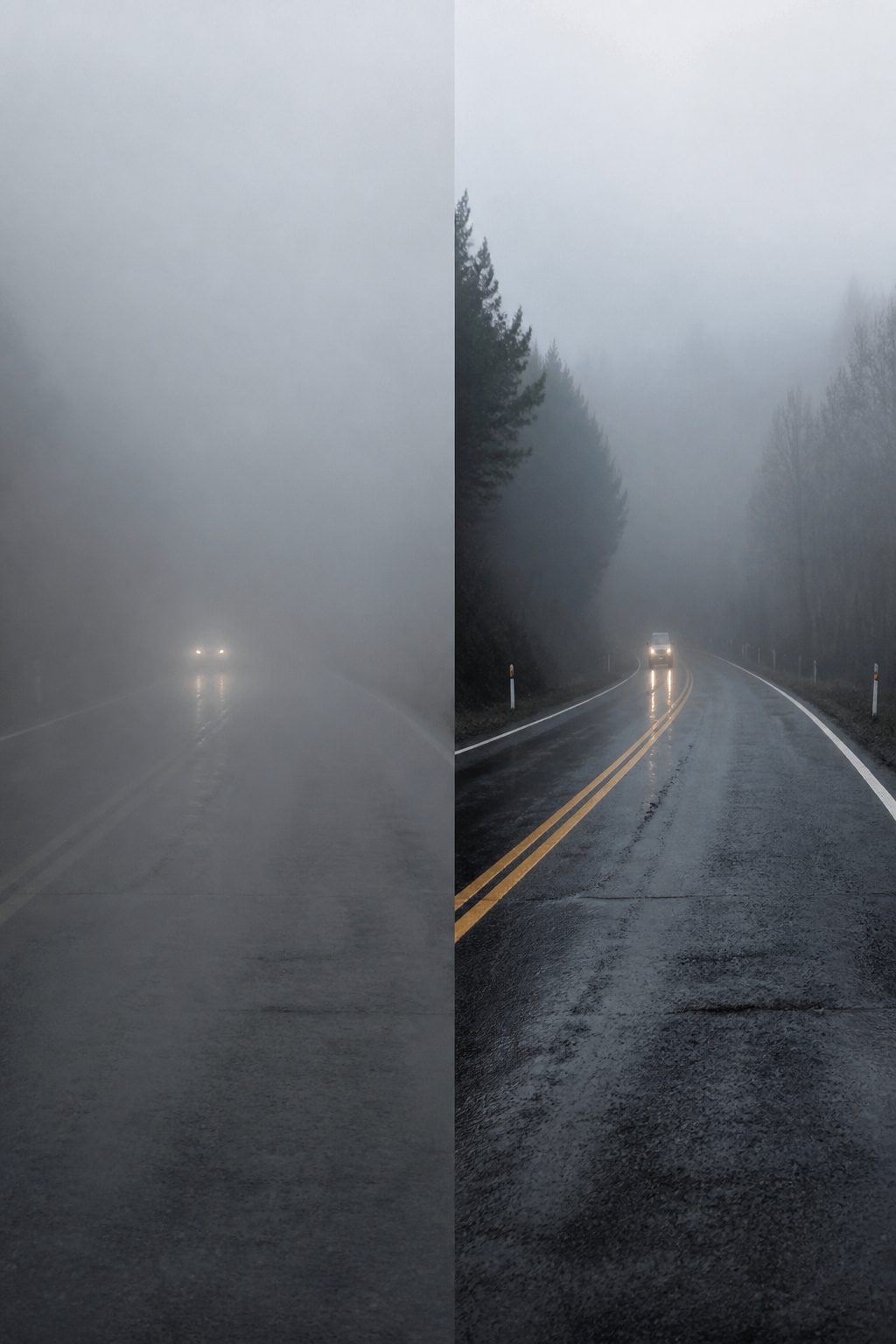
Fog drops visibility to the point where you may not see an object until it is too close to react. The Federal Highway Administration ties this directly to over 38,700 crashes annually in low-visibility conditions, with 600 deaths and 16,300 injuries each year. Those numbers are not abstract; they reflect how suddenly a morning commute can turn unforgiving.
The problem runs deeper than distance alone. Fog creates optical illusions that make your own speed feel slower than it is, which is why the speedometer matters more than your gut. Judging whether another car is moving, how fast, and how far away it sits becomes a guess wrapped in gray. Thick rolling clouds can hide road signs, pedestrians, and stopped vehicles without warning, and when every driver around you is struggling with the same distorted depth perception, the risk compounds. Fog can get thicker without warning, and the hazards you cannot see are only half the danger; the other half is the driver ahead who slows abruptly because they just spotted what you have not.
Why Cruise Control Fails in Fog
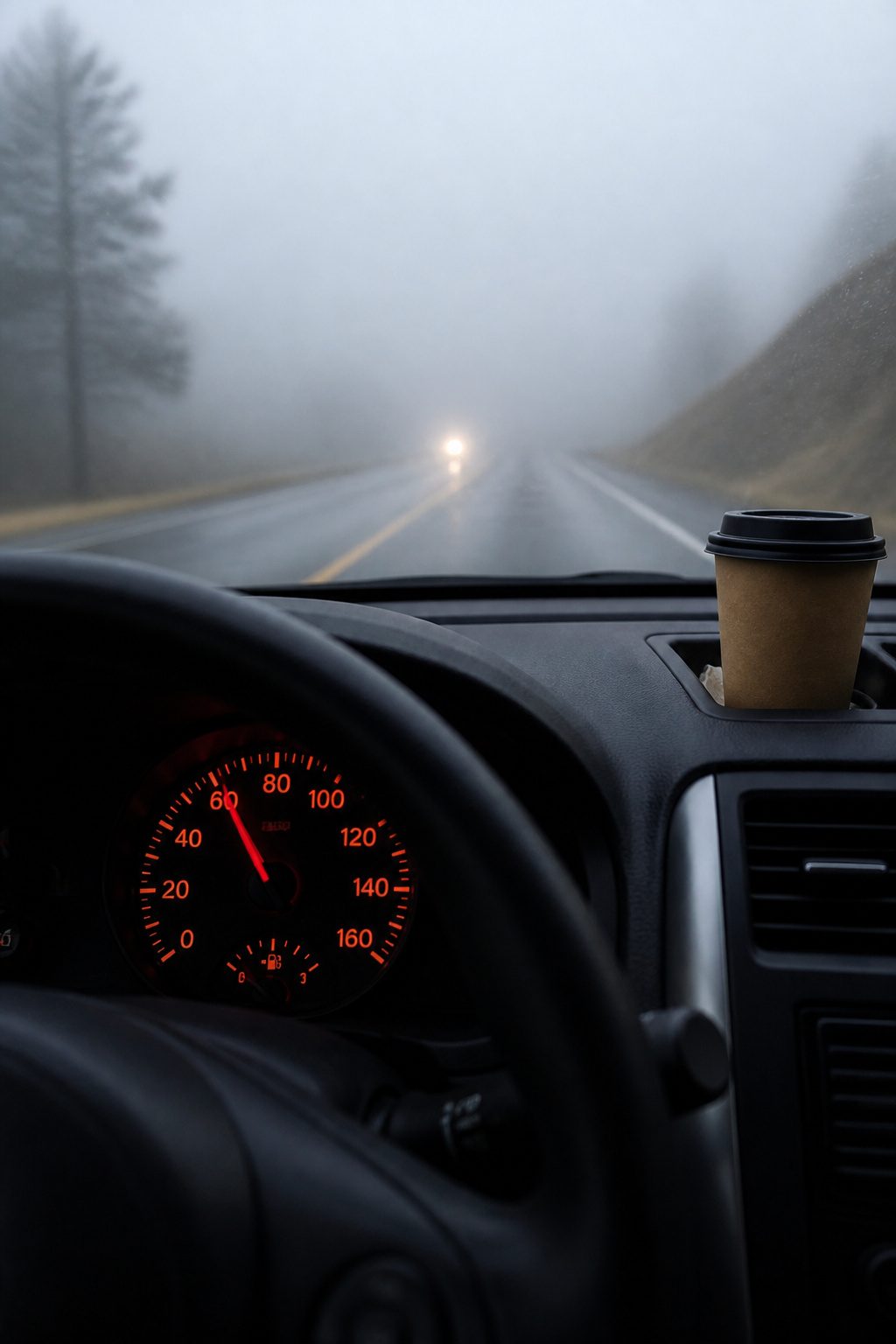
Cruise control feels like a convenience until the road ahead disappears into gray. I learned to treat fog as a hands-on condition: your foot belongs on the accelerator, not resting while a servo maintains 55 mph. Keeping manual throttle control lets you lift off the gas the instant visibility drops, no button-punching or brake-tapping to disengage.
The sources all converge here, and the physics are straightforward. Fog patches vary; one moment you see three car lengths, the next you see eight. A driver with direct pedal feel shaves reaction time by the full beat it takes cruise control to recognize a cancel command. Three to five car lengths of following distance, the spacing fog demands, also requires constant micro-adjustments that cruise cannot manage smoothly.
Some sources note the optical illusion fog creates, making speed feel slower than the needle shows. Cruise control locks in that false comfort. Checking the speedometer helps, but your right foot still needs the authority to bleed speed before your eyes confirm the hazard. Manual control turns that into muscle memory rather than a deliberated sequence.
Defensive Driving in Fog
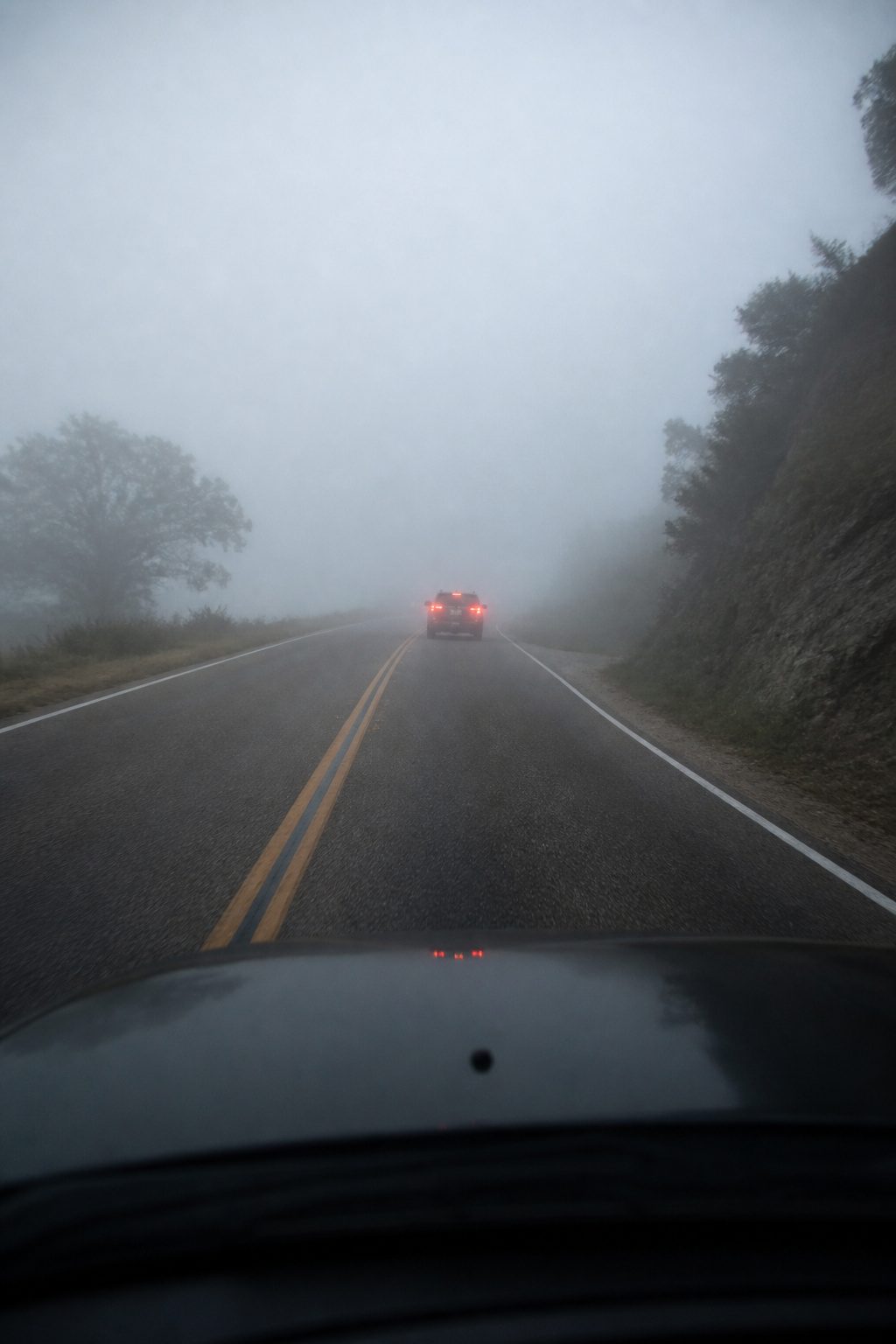
The real hazard in fog is not what you see. It is what you do not see until you are nearly on top of it. Other drivers’ lights become your early warning system, so scan the gray ahead for any hint of red or white. A single taillight materializing out of nothing means a car is moving slower than you are, or it has stopped entirely. Both demand the same response: get off the gas and open space.
Stopped traffic catches people because fog erases the usual cues of brake lights ahead and slowing traffic around you. On Interstate 5 through California’s Central Valley, where tule fog pools in winter, chain-reaction crashes still happen when drivers maintain highway speed into a stationary line they never saw coming. The defensive move is to position your vehicle so you always have an escape lane, either the shoulder or the next lane over, and never box yourself between two semitrucks with nowhere to go.
Your side mirrors matter more in fog than on clear days. Check them every few seconds for lights that appear from behind; a car closing fast in low visibility is a driver who has not slowed down yet, and they may not see you until it is too late to stop. If the lane beside you is open, drift toward it slightly to create a buffer. The extra foot or two of lateral space is often the difference between a near miss and a collision when someone drifts across the line.
Yellow-Tinted Sunglasses in Fog
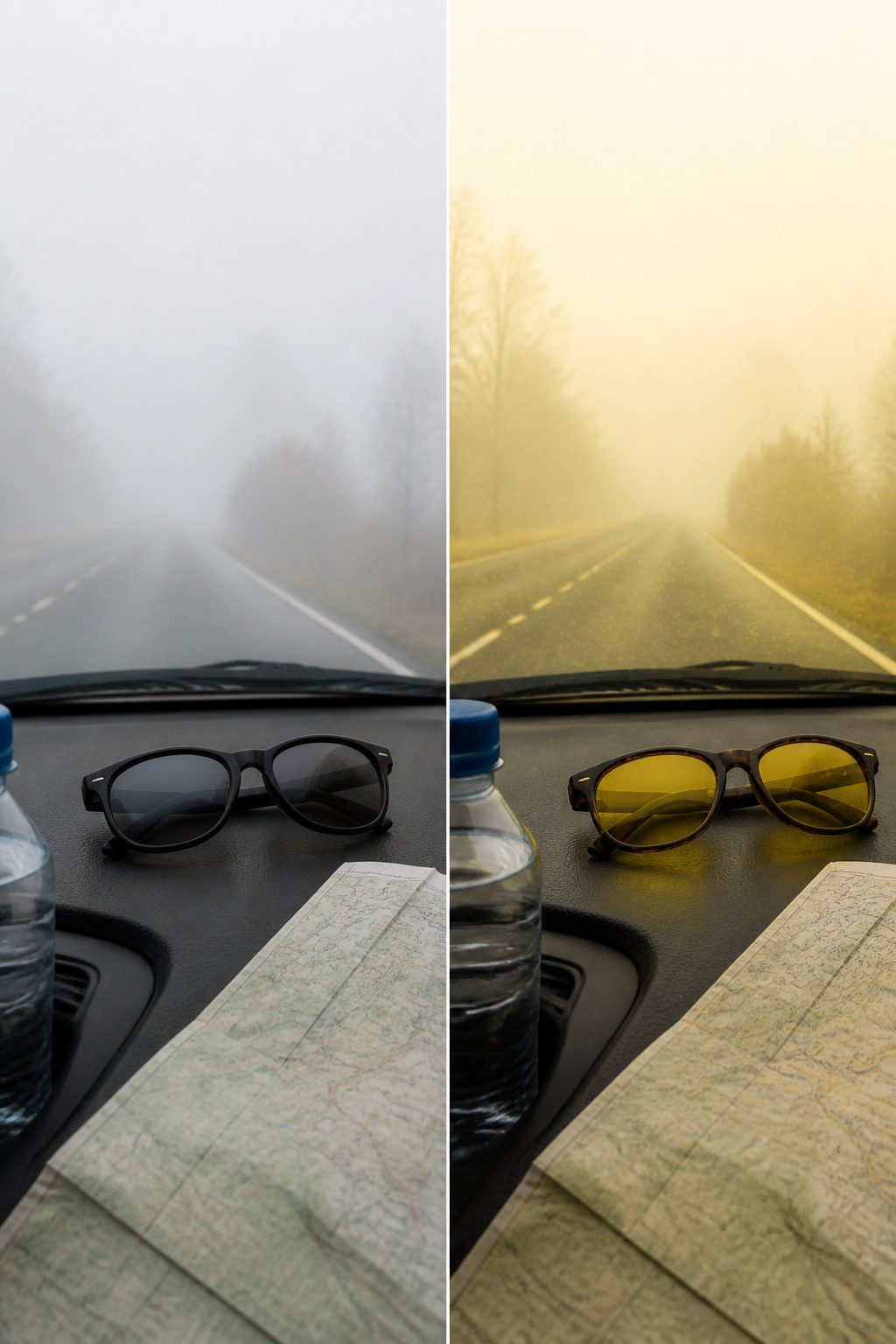
Yellow lenses are supposed to cut the blue light that scatters in fog, and some drivers swear by them. The idea feels right, but the evidence backing it is thin. Most driving safety organizations do not recommend sunglasses of any tint for foggy conditions, since anything that darkens your field of view already works against the problem.
Still, the glasses are cheap enough that trying them is a low-stakes experiment. If you already own a pair, a foggy morning commute is the time to test whether they actually help your eyes pick out lane markings and tail lights sooner. Do not count on them as a safety device; treat them as a personal preference you verify yourself.
The real risk is the false confidence they can create. Someone who buys yellow-tinted glasses specifically for fog may drive faster or follow closer, assuming they have an edge that the data does not confirm. My own rule: if the fog is thick enough that I am reaching for any special aid, I am also reducing speed and opening up following distance regardless of what is on my face.
What the Annual Fog Crash Numbers Mean
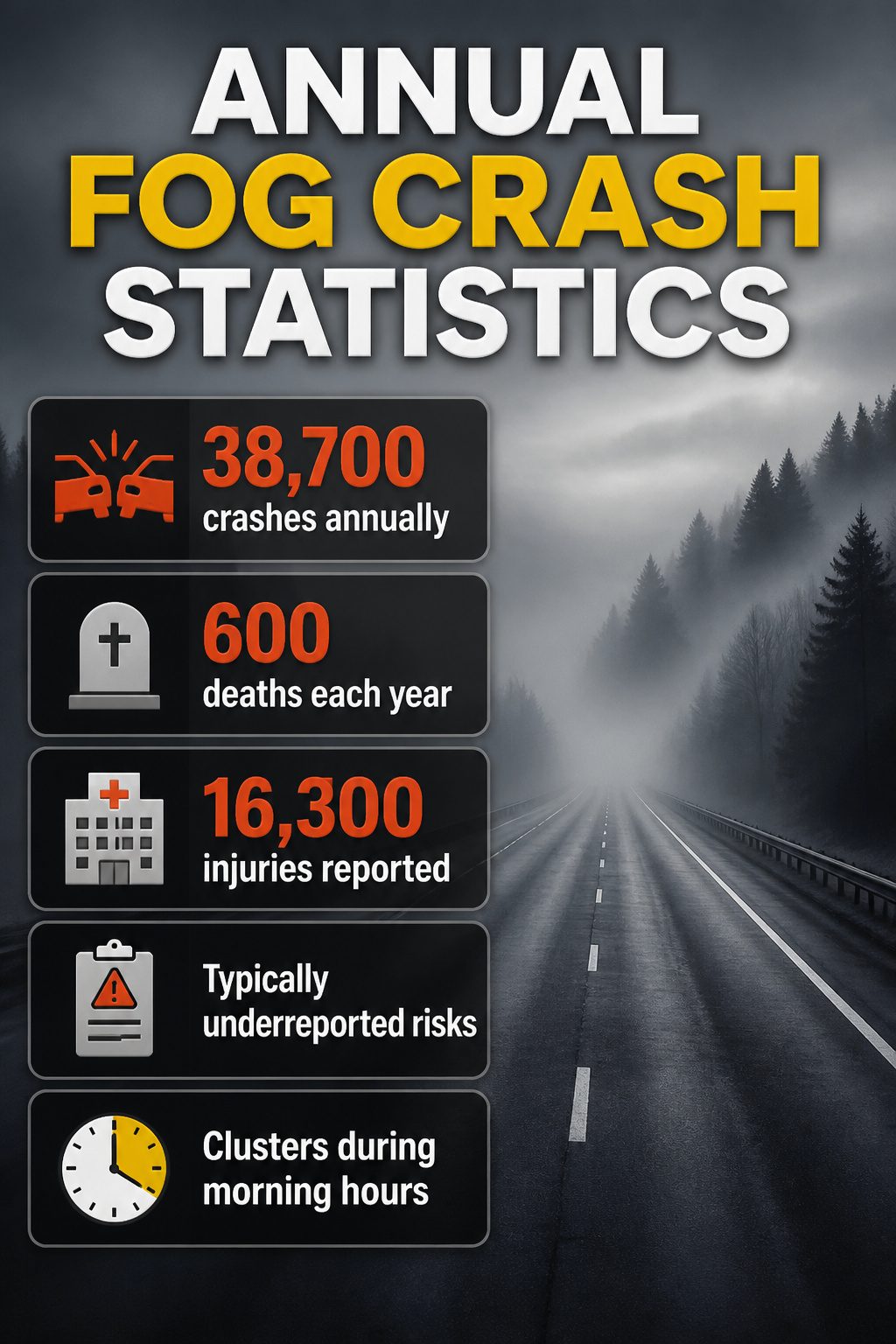
The Federal Highway Administration puts 38,700 crashes, 600 deaths, and 16,300 injuries on the annual tally for low-visibility conditions. Fog does not announce itself the way a thunderstorm does. It pools in valleys, thickens across river crossings, and turns a familiar morning commute into something else entirely before the wipers have made their second pass.
That body count sits higher than most drivers would guess, partly because fog feels manageable until it is not. Ice and snow get the headlines and the school closures. Fog just hangs there, and the advice to slow down and use low beams has been repeated so long it barely registers. The numbers persist because familiarity breeds dismissal. Someone who has driven through a hundred misty mornings without incident will push through the hundred and first, betting the same habits will hold. The crashes cluster in those hours, the ones where visibility drops past the point where reflexes can close the gap.
Frequently Asked Questions
What should I do if visibility is too low?
Pull off the road into a parking lot or rest area, not just the shoulder. Once stopped, turn on your hazard lights and switch your headlights off so approaching drivers do not mistake you for a moving vehicle. Wait belted in your seat until the fog lifts.
Should I use high beams in fog?
No. High beams hit the water droplets and scatter straight back into your eyes, so the brighter you go, the less you see. Stick with low beams and fog lights if your vehicle has them. Your taillights stay lit too, which helps whoever is behind you in the mist.
How can I improve visibility while driving in fog?
Use low-beam headlights and fog lights, and keep your windshield clear with wipers and defrosters working together. The defroster blows dry, warmed air across the inside glass to stop interior condensation, while wipers handle the exterior film of moisture that fog leaves behind.