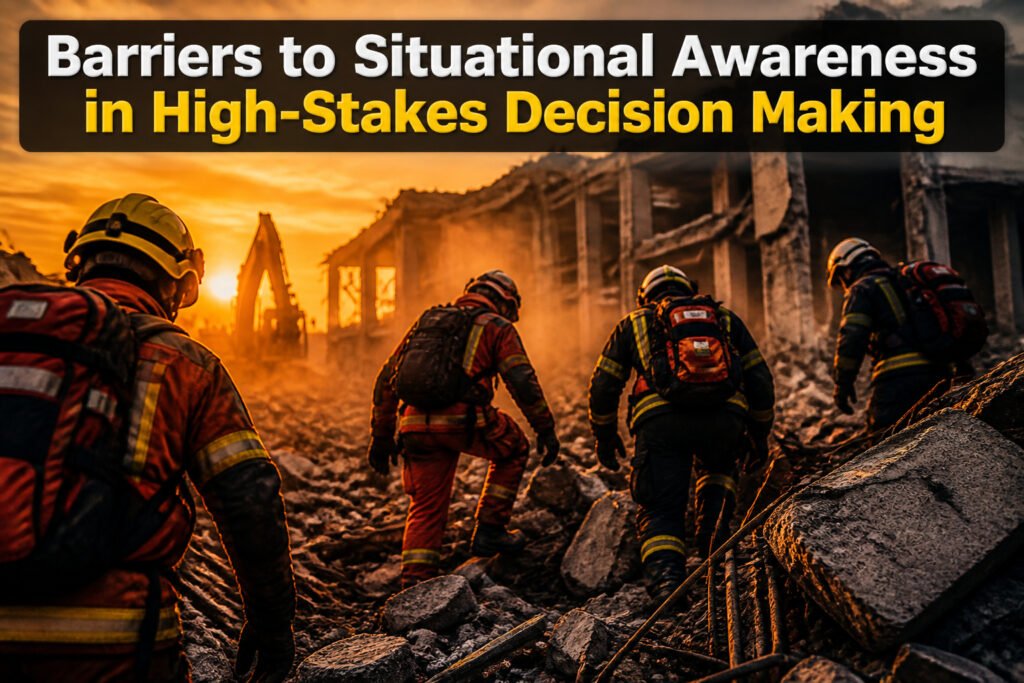
Situational awareness is the ability to perceive, comprehend, and project what is happening around you in real time. It fails most often not because information is missing, but because the human brain filters it out before conscious processing begins. Research on responder near-miss events found that 78% of situational awareness failures trace back to this perception gap: the data was there, and the person never registered it at all. The barriers start forming before boots hit the ground.
Pre-Arrival Lens
The human brain does not arrive at a scene empty. It walks in carrying every similar call from the last ten years, the academy scenarios, the stories swapped at shift change. That pre-arrival lens is the first of the real barriers to situational awareness, and it operates before boots hit the ground.
Dispatch relays a working structure fire with possible entrapment. The mind builds the picture immediately: two-story frame, bedroom search, the layout from three nearly identical runs last winter. The framing is useful until it isn’t. What the lens filters out hurts more than what it admits. A basement extension not mentioned in the address. The second means of egress that this particular structure lacks. The caller’s hesitation about whether anyone is actually home. The brain, already busy confirming its prefabricated scene, drops these threads.
Research on responder near-miss events puts the cost in plain numbers. 78% of situational awareness failures trace back to perception: the information was there, and the responder never registered it at all. Not misinterpretation, not delayed understanding. Simple failure to perceive. The pre-arrival lens accounts for a measurable slice of that gap. Training and experience, the very things meant to prepare us, become the filter that sorts incoming data into expected and discardable before the senses have had their fair shot.
Confirmation Bias
Confirmation bias is the trap of only seeing what you already expect to see. The brain grabs the detail that fits the story it is telling and throws out the rest. In high-stakes work, this pairs hard with the pre-arrival lens: the picture formed before you ever get eyes on scene. Once that first impression locks in, every radio call, every glance at conditions, gets filtered through it. Wrong first impressions become wrong ongoing assessments because the mind refuses to feed them contradictory data.
The cost shows up in how information gets received. About 17% of failures to understand incoming information trace back to this selective filtering, not to the message itself being unclear. Experience makes it worse, not better. Seasoned responders pattern-match faster, which means they dismiss novelty faster too. The unique severity of what is actually happening gets trimmed to fit the shape of what happened before.
The fix is not to trust your gut less; it is to assign someone the job of arguing against it. One person on the team should carry the contrary view on purpose, especially in the first minutes when the pre-arrival lens is strongest. That built-in friction slows the lock-in enough for real cues to slip through.
Tunneled Senses
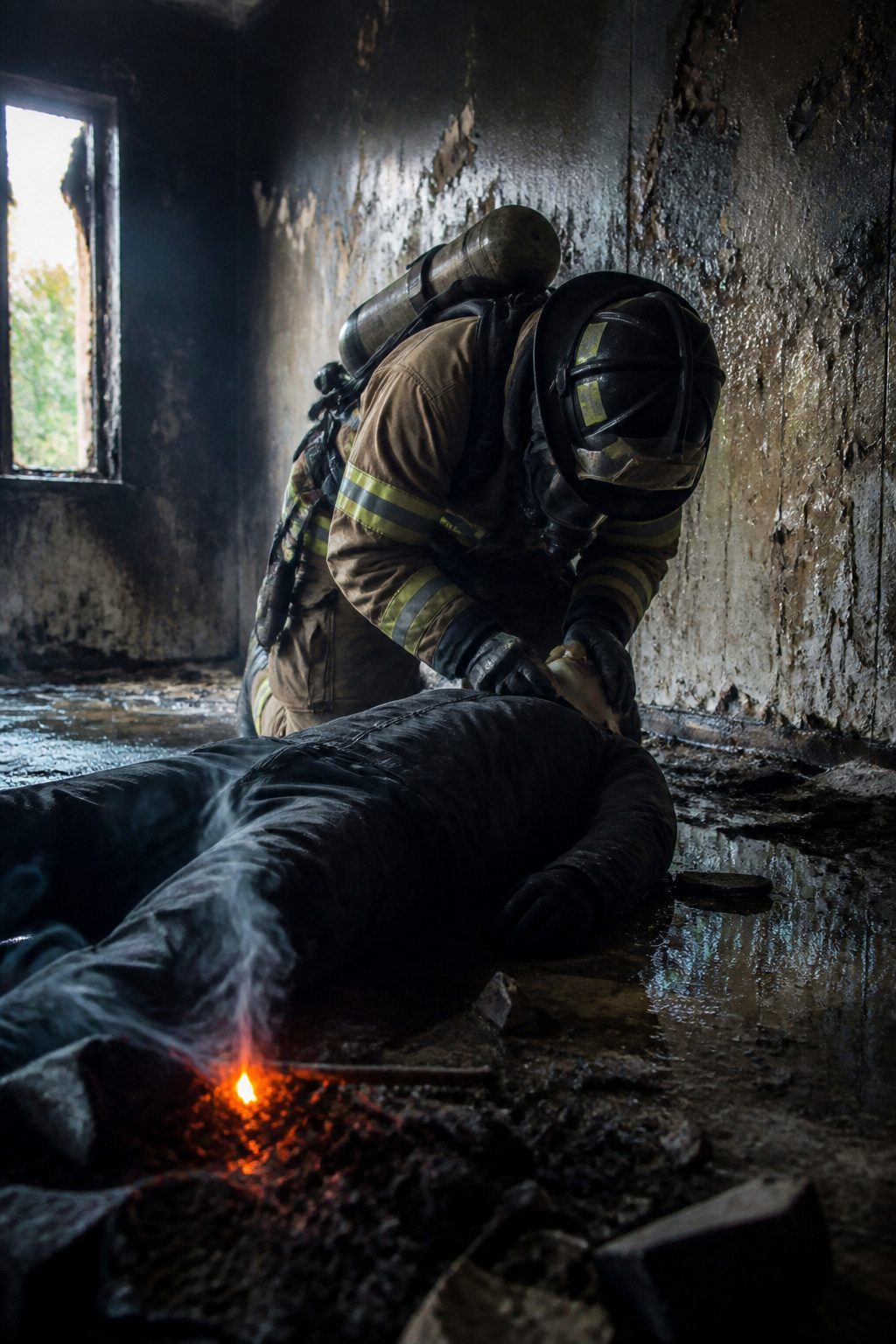
Stress does not merely distract; it physically narrows what the eyes can register, what the ears pick up, what the nose catches. The body floods with cortisol and norepinephrine, and the perceptual field shrinks to a cone of immediate threat. A responder under this chemical load may stare directly at a flicker of electrical fire and miss the smell of burning insulation drifting from the floor below, or focus so hard on a victim’s airway that shouts from the collapsing wall behind them never register at all.
This biological narrowing, often called tunneled senses, is not a failure of will. It is the sympathetic nervous system doing exactly what evolution shaped it to do: prioritize survival over information gathering. The tradeoff is brutal in high-stakes work, where the clue that saves a life sits outside that shrinking cone.
Incident reviews show this pattern repeatedly. Teams fixated on an obvious casualty have walked past secondary devices, missed evacuation orders, or failed to notice their own equipment alarms. The ears still function; the information simply does not reach conscious processing. Training helps only when it specifically rehearses breaking that visual lock, forcing deliberate scans outside the immediate task. Without that habit drilled in, the biology wins.
Task Fixation

Task fixation is a purposeful narrowing of perception to one task or one geographic area, and it is different from task saturation in a way that matters for training. Task saturation floods the short-term memory buffer with too much information until things drop out; fixation is the opposite problem, a voluntary lock-on that filters everything else out deliberately.
I have watched this happen in myself during range days. Zeroing a rifle at 100 yards, I spent forty minutes chasing a one-inch group while the wind shifted, clouds built, and a squall line moved in from the west. The steel targets I had not yet hung were still in the truck bed, unsecured. I noticed none of it until rain hit the optic. The task was performed correctly; the environment changed around me and I missed every cue.
Fixation costs are specific and predictable. A responder securing one entry point misses the secondary threat developing at the opposite corner of the structure. A driver troubleshooting one engine warning light does not register that the exit they needed has passed. The fix is not to care less about the task; it is to build in deliberate environmental scans at intervals, even if that means pausing the work. Thirty seconds every few minutes, eyes off the immediate problem, is enough to break the lock without losing the thread.
Task Saturation

Task saturation hits when the incoming demands outrun the brain’s ability to sort them, and none of them end up getting full attention. The average person can only hold about seven pieces of unrelated information in short-term memory at once; cross that line and the buffer starts dropping things, especially under stress, when the brain does a poor job of deciding what matters most.
This is not the same as fixation. Fixation locks attention on one thing too deeply, filtering out everything else. Saturation is the opposite problem: the field of view stays wide, but nothing in it gets processed. A responder tracking seven simultaneous radio channels, instrument readings, and team movements has not narrowed focus; the volume itself has overwhelmed the channel. The result looks similar from the outside, missed cues and delayed decisions, but the fix differs. Breaking fixation requires pulling back from the single point. Breaking saturation requires reducing the number of active inputs, delegating some to others, or accepting that a few streams will go unmonitored until capacity opens. One is a depth error, the other a breadth error, and confusing the two wastes the corrective move.
Multitasking
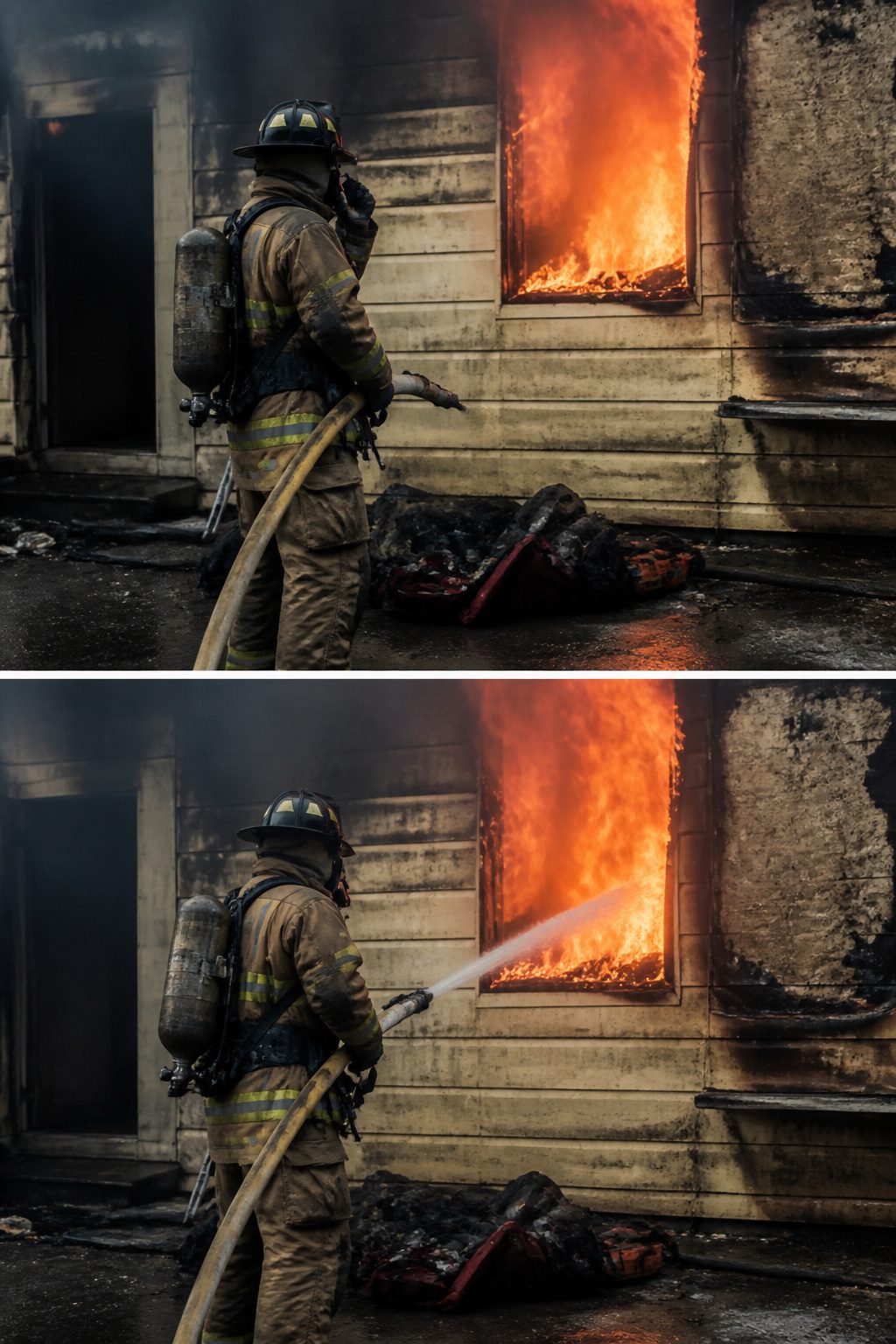
True multitasking is a biological impossibility. The brain performs rapid task-switching instead, and each switch carries a cost in speed, accuracy, and retention. Studies on divided attention show that attempting two demanding tasks simultaneously degrades performance on both more severely than doing either one poorly in isolation. For situational awareness, this means missing cues entirely rather than simply processing them slowly.
The research on attention-demanding tasks is consistent: when cognitive resources split, situational awareness collapses faster than other performance metrics. One study found that drivers using phones missed twice as many roadway hazards as those at the legal blood-alcohol limit, not because reaction time lagged but because the hazards never registered at all. The brain had prioritized the conversation.
In high-stakes environments, the danger is insidious because the multitasker feels productive. Checking a radio frequency while monitoring a threat display, or texting during a critical watch, creates a false sense of coverage. What actually forms is a patchwork of partial snapshots with gaps the operator cannot self-detect. The fix is structural: design protocols that serialize attention, not parallelize it. Single-channel focus wins.
Mission Myopia
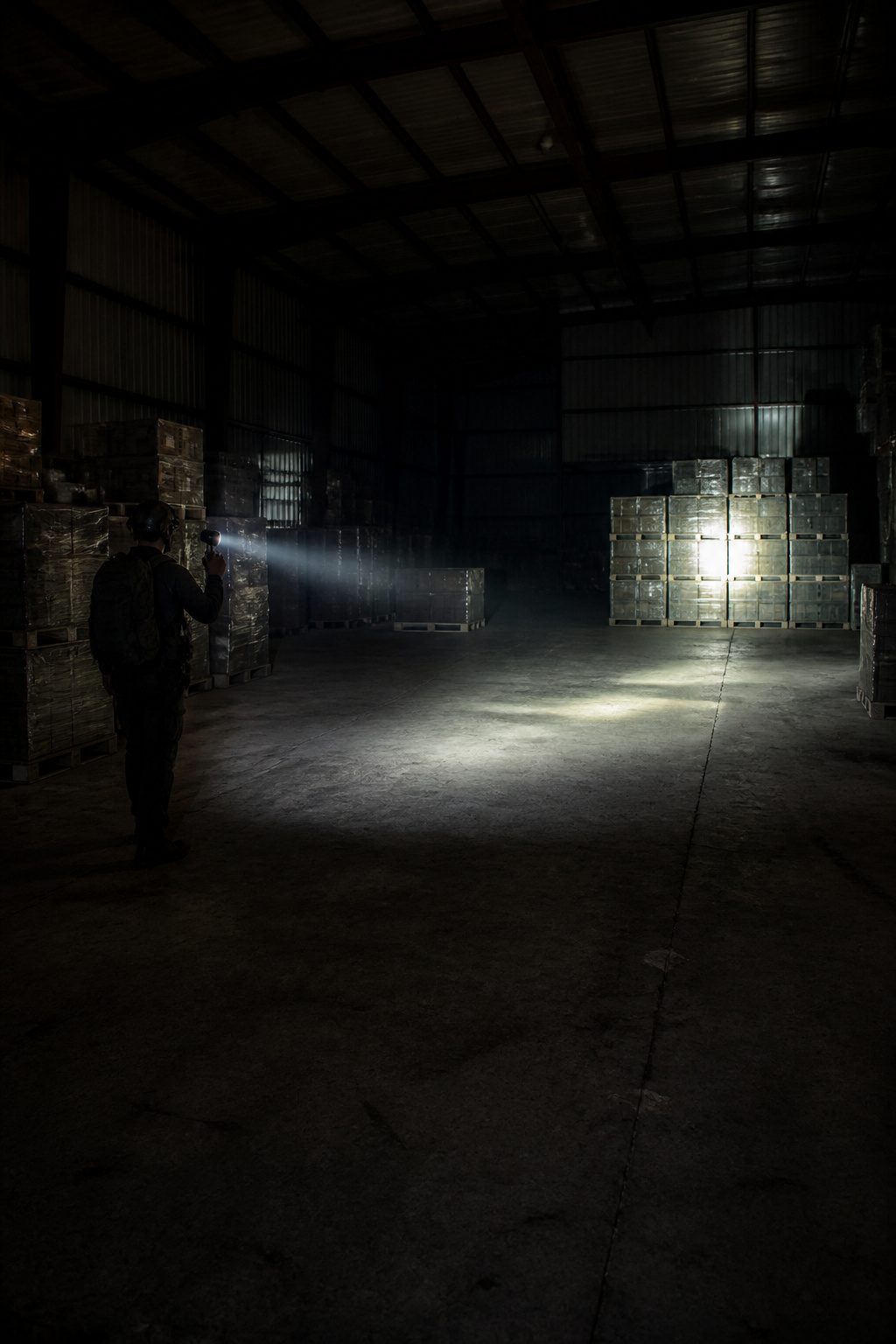
A search team moving room to room in a warehouse district last year missed the second-floor fire that had already breached the stairwell behind them. The objective was clearing the ground floor for a tactical entry; the objective was completed. Three officers were injured evacuating through a window they had not planned to need.
Mission myopia is what happens when the goal itself becomes the blindfold. The condition shows up reliably in two environments: extended search operations where each cleared room feels like progress, and dynamic entries where speed of execution is the measured performance. In both cases, the brain captures peripheral cues, sometimes comprehends them, and then overrides the warning because it does not serve the immediate mission. Endsley’s three-level model of situational awareness, perception to comprehension to projection, breaks at the second or third level when the mission narrative is strong enough.
The hazard sits low on the safeguard hierarchy. Training and simulation help, but effectiveness degrades over time and simulations rarely reproduce the emotional weight of a live objective. The stronger fix is structural: building in role rotation or dedicated perimeter observers who carry no share of the primary task. Their only job is watching what the mission is not asking them to watch.
Urgency
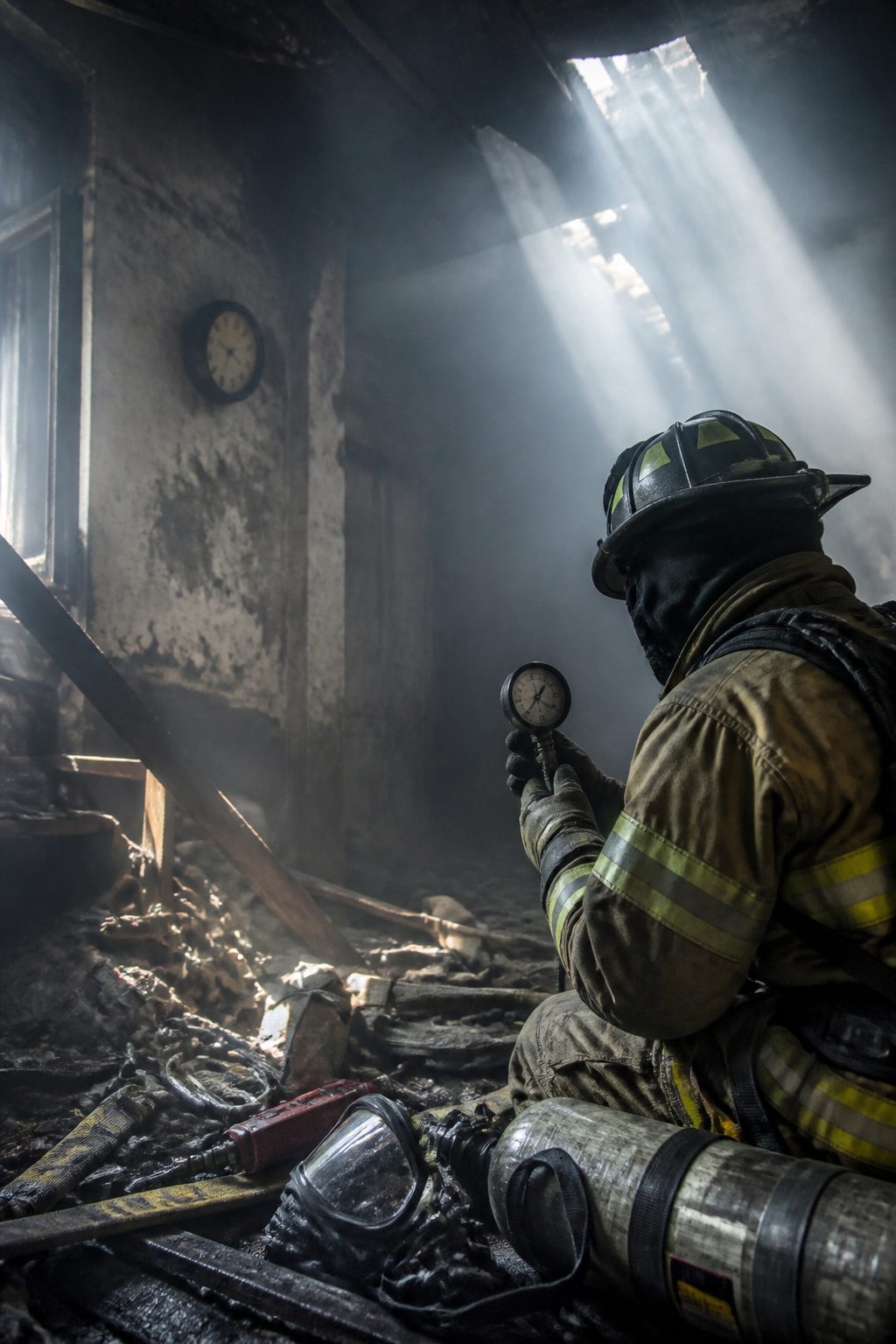
The pressure to act fast during a critical event often triggers errors of perception, judgment, and action. Incident responders feeling this urgency skip vital steps or make snap decisions based on incomplete data. Scanning behavior collapses first, with peripheral cues dropping out of awareness as the mind locks onto whatever seems most immediately threatening. Verification steps disappear next; a single confirming detail feels like enough when seconds appear to count. The push toward premature commitment follows naturally, a choice half-seen and half-understood getting locked in before the full picture develops.
Excessive stress narrows focus into tunnel vision. Surroundings become harder to interpret accurately, and sound decisions in high-pressure situations slip further out of reach. The demand for speed comes from two directions: external pressure from the situation itself, or internal pressure the responder generates by assuming faster equals better. Both produce the same degradation. Training and simulation help manage this, as does deliberate attention to breathing and physical self-care, but recognition remains the first move. The moment urgency arrives, awareness is already under attack.
Time Distortion
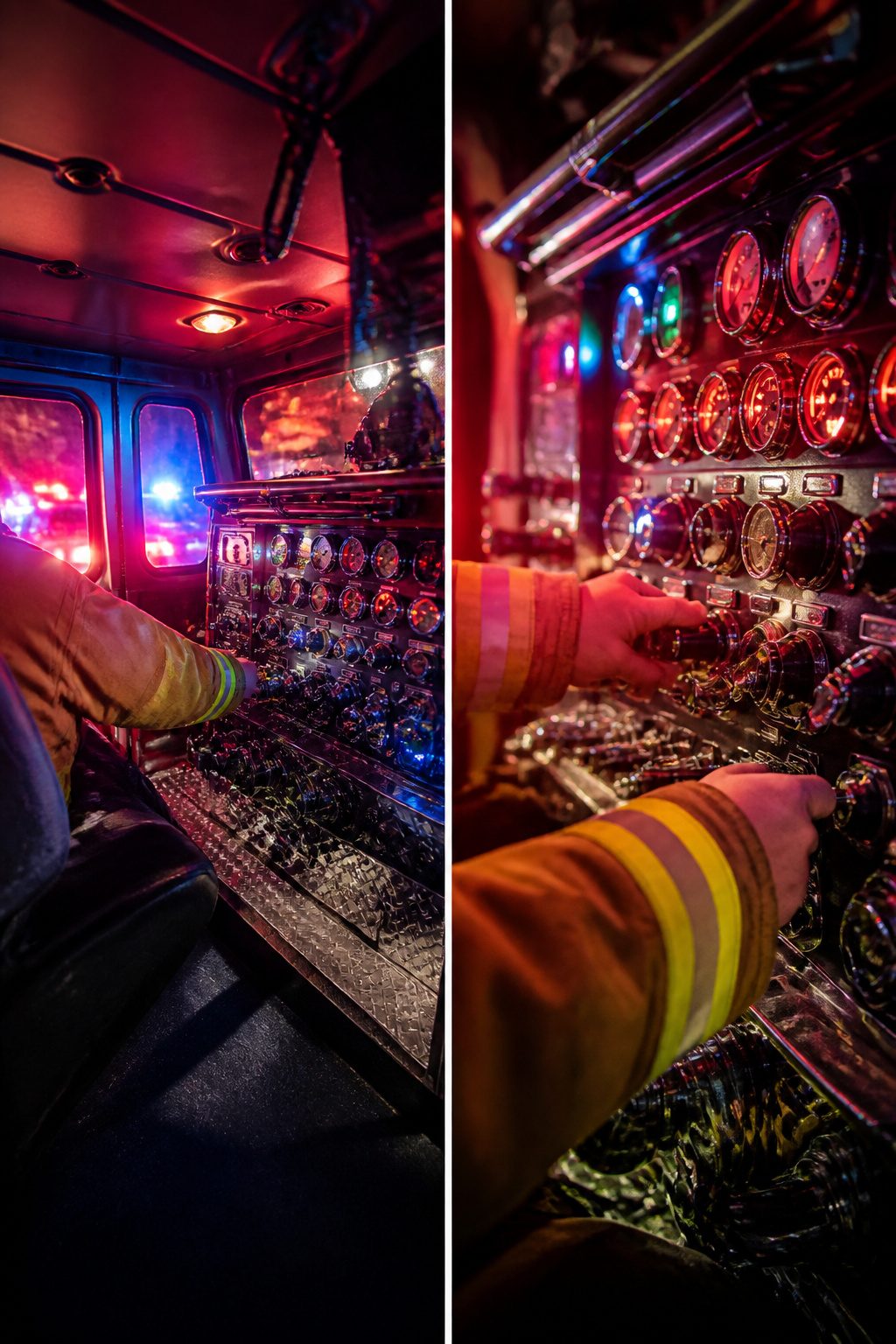
The clock on the wall said three minutes had passed since the alarm sounded. The crew chief swore it had been thirty seconds, maybe forty. Operating longer than safety permits is the specific warning that keeps surfacing in after-action reviews, because distorted time perception in high-stress events routinely tricks teams into believing they still have margin when they do not.
Stress compresses some intervals and stretches others without pattern. The five-second rush of an incoming threat feels like a held breath; the twenty minutes spent managing its aftermath feel like two. A firefighter in one documented case remained inside a structure thirteen minutes past the calculated safe limit, later insisting the entry had lasted "maybe six, seven minutes at most." No alarm on his gear had sounded. His internal clock simply failed him.
Breathing techniques and simulation training help, but only if they are practiced before the event. The body does not consult the mind about whether its time estimate is trustworthy. When stress hormones spike, the amygdala overrides the prefrontal cortex’s bookkeeping, and experienced crews fall prey just as often as rookies. The difference is that veterans usually have more exit triggers built into their routines: hard time limits, partner check-ins, secondary alarms that do not depend on anyone’s sense of duration.
Without those external anchors, the distortion wins.
Over Confidence
Repeated success plants a dangerous seed. The operator who has completed a hundred similar evacuations stops scanning for what is different about the hundred-and-first. Performance data from high-stakes fields shows a 5% projection failure rate directly traceable to this assumption of continued success, and the kicker is that overconfidence itself masks the degradation. The same pattern appears in emergency medicine, where experienced crews miss subtle changes in a patient’s status because the last fifty calls looked identical at first glance.
The trap feeds on itself. Early wins build a reputation for competence, which reduces the external checks, which lets assumptions harden into habit. By the time a mistake surfaces, the operator has usually misread multiple cues that a newer, more vigilant observer would have caught. The degradation is visible to others before the overconfident individual notices anything wrong.
Countering this means building in deliberate disruption. Rotating team roles, requiring verbal confirmation of anomalies even when they seem obvious, and keeping logs of near-misses all force the experienced hand to stay in observation mode rather than autopilot. The hardest part is admitting that expertise itself can become one of the barriers to situational awareness.
Complacency
Complacency creeps in where danger shows up rarely but hits hard. Five decades of near-miss reviews point to the same pattern: responders stop scanning, stop listening, stop registering what their hands and ears already know. The guard drops. Not because someone decides to slack off, but because nothing has gone wrong for so long that wrong starts to feel impossible.
This is not overconfidence. Overconfidence inflates what you think you can handle; complacency simply lets your attention drift elsewhere. A firefighter with twenty uneventful warehouse walk-throughs may not believe he is invincible, but the alarm panel’s flicker fails to register because his eyes are on the locker room clock, not the readout. The self-assessment stays modest. The vigilance does not.
Diane Vaughan’s "normalization of deviance" runs on the same track. Small anomalies repeat, nothing breaks, and each repetition makes the next one easier to ignore. The O-ring seal that held last launch holds the next one too, until it does not. Complacency is the individual version of that institutional story: the mind learns to file the warning sign under "handled," and the filing happens below conscious choice. Routine checks, new challenges, continuous learning, these are the counterweights, but they work only if someone spots the drift before the drift becomes the new normal.
Peer Pressure
Social conformity can override what your eyes are actually telling you. In a group setting, the pressure to align with the prevailing interpretation runs quiet and deep: a responder may register the subtle cue that something is off, then file it away unsaid because the room has already settled on a different story. The unspoken hierarchy makes this worse. Junior members, the ones positioned closest to the raw data of an incident, often spot anomalies first. Their rank, however, imposes a second filter before words reach air. The knowledge that speaking up means contradicting someone more experienced, more credentialed, or simply louder, keeps critical observations internal. I have watched this mechanism operate in training environments where the scenario designer planted an obvious trap, and watched it work just as effectively in debriefs where participants admitted they "knew better" but could not overcome the inertia of group consensus. The barrier is not disagreement itself; it is the absence of a channel that lets the junior voice register as signal rather than noise.
Short Term Memory Overload
Working memory holds about seven unrelated items at once, a ceiling that does not budge no matter how urgent the incident becomes. Once complexity pushes past that hard limit, something drops out, and the person making decisions rarely notices which fact vanished.
Chunking helps. Grouping incoming data into patterns, a radio call into "patient status" rather than five separate numbers, can shrink three or four raw items into one slot. External aids stretch the buffer further. A notepad, a running log, a whiteboard sketch of the room layout; each offloads detail so the mind keeps working on relationships rather than storage.
The compensation is partial at best. Chunking takes time the incident may not grant, and external aids fail when reaching for them steals attention from a changing scene. I have watched experienced people, sure they were tracking everything, miss a critical update because the eighth item arrived and the first one left without fanfare.
Confabulation

The brain hates a gap. Under stress, it fills missing pieces with details that feel true, complete, and utterly wrong. Psychologists call this confabulation, and it is one of the quietest destroyers of situational awareness because the person doing it usually believes their own account.
Memory does not record like video. It reconstructs, pulling from expectation, pattern, and what "must have" happened. Add adrenaline, time pressure, or threat, and the reconstruction gets aggressive. A responder remembers a door they never checked. A pilot remembers a clearance they never received. The detail is specific, confidently delivered, and false.
After-action reports become contaminated the moment someone with a filled-in gap speaks first. The plausible detail spreads. Others incorporate it, consciously or not, and the shared understanding of the incident drifts from what actually occurred. I have watched debriefs where three people agreed on a sequence that the recorder contradicted, and none of them were lying. They had built the same bridge across the same gap.
The damage compounds in evolving incidents. A team acts on a contaminated account, making the next decision from fiction. The fix is not willpower; it is procedure. Separate witnesses before debrief. Record in real time when possible. Treat early certainty, especially your own, as a warning flag rather than proof.
Distractions
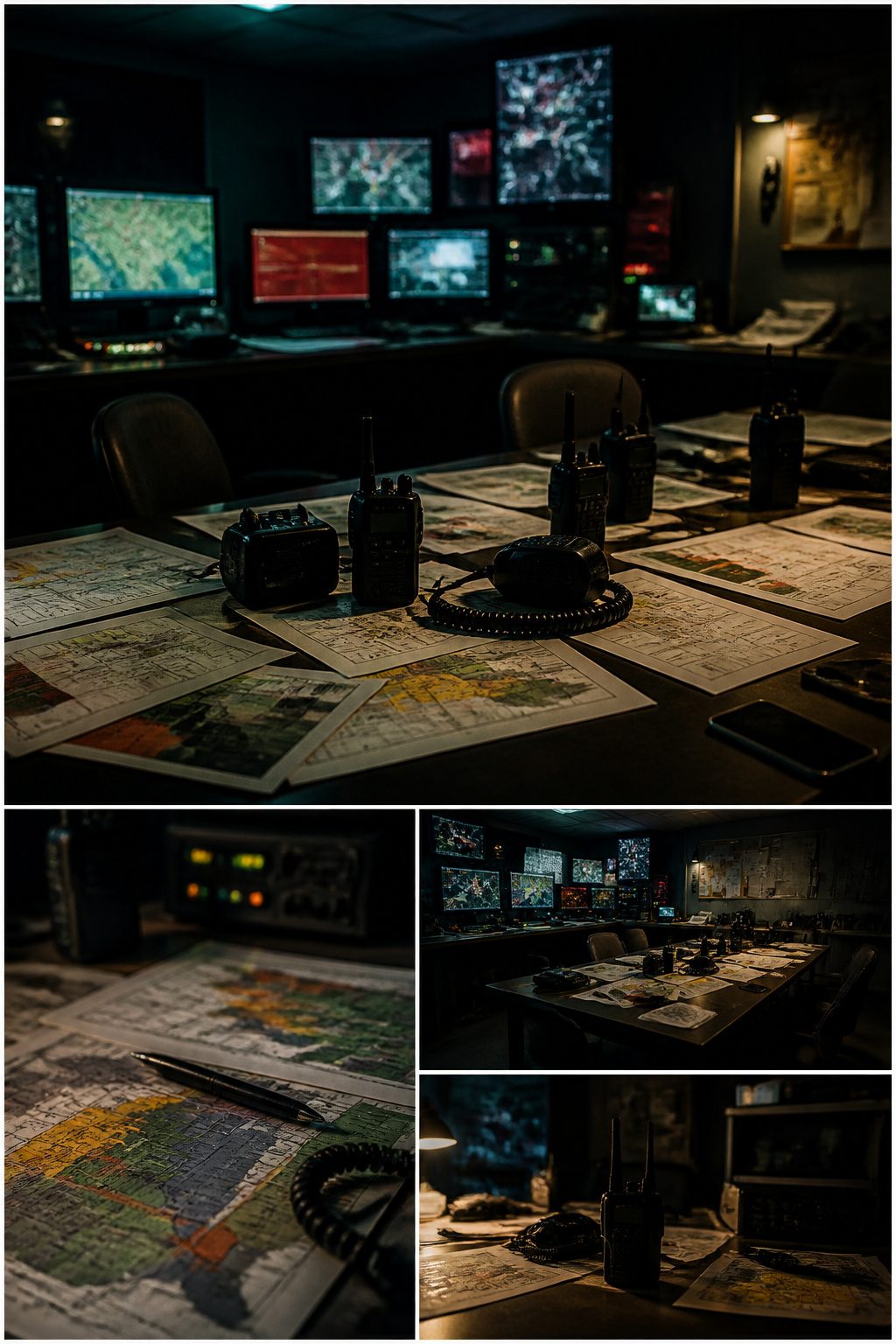
A radio crackling with traffic updates sits three feet from your elbow, and somehow the phone in your pocket buzzes harder. Both carry information you chose to need, yet either one can pull your eyes off the road, the patient, or the developing situation in front of you. Too much data without awareness just builds noise. I have watched a screen full of metrics blink while the actual problem walked past unnoticed.
Environmental interruptions are only half the fight. Self-generated ones, the urge to check a message or scroll a feed, fracture attention just as cleanly. By the 2020s, artificial intelligence and machine learning had begun filtering streams to reduce that load, supporting awareness rather than replacing it. The technology works only when you let it filter, though. A responder fixed on one server or one entry point still misses what falls outside that view, no matter how smart the dashboard.
Cognitive Load
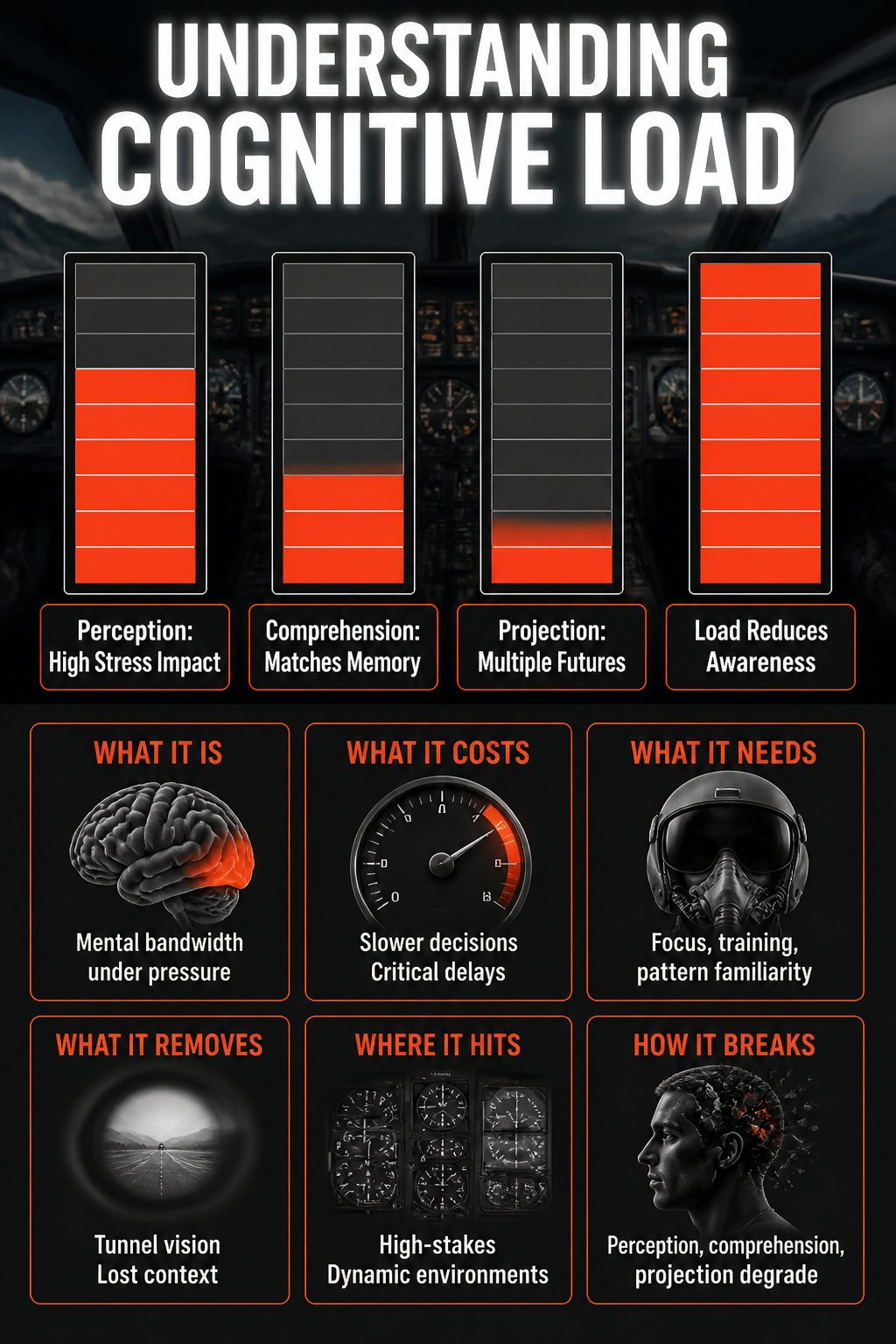
Stress, complexity, and novelty do not attack situational awareness one barrier at a time. They pool into a single reservoir of cognitive load, and that load is what degrades perception, comprehension, and projection, the three levels that define the concept. The mechanism matters because it explains why so many individual barriers feel different in the moment yet produce the same failure.
A pilot in a novel emergency may still perceive the instruments correctly. The gauges register. But comprehension lags because the pattern does not match memory, and projection collapses entirely when the mind stalls between too many possible futures. I have watched this in training footage from military and medical contexts: the hands know where to reach, but the story those hands are supposed to tell goes quiet. Endsley’s three levels are not sequential steps to climb. They are bandwidth allocations, and cognitive load steals from all three at once.
Complexity multiplies the elements demanding attention. Novelty removes the shortcuts of pattern recognition. Stress narrows the aperture further, sometimes to literal tunnel vision. The result is not missing one cue but missing the assembly of cues, the quiet narrative that tells you what happens next. This is why the same person who performs smoothly in rehearsal can freeze in the live event. The environment changed just enough to push total load past the threshold where all three levels operate together.
Information Silos

Teams closest to an incident often carry the most accurate, up-to-date picture of what is happening, yet that picture rarely travels far. Physical separation plays a part: responders at the epicenter may lack working radios, stable networks, or even the hands free to type a message. But the deeper problem is structural. Organizations build their operations around separate functions, each with its own tools, protocols, and chain of command. Information flows upward through one silo and stops, never crossing to another that needs it.
Cultural habits reinforce the walls. A security team that spots a network failure may assume operations has its own monitoring. Operations, seeing flight monitors go dark, may not loop in security until frustration spills into public view. The result is a fragmented operational picture where no single decision-maker sees enough to act with confidence. Incident management assumes regular, accurate information flow. When silos block that flow, the people with the best knowledge are the last ones consulted.
Common Operating Picture
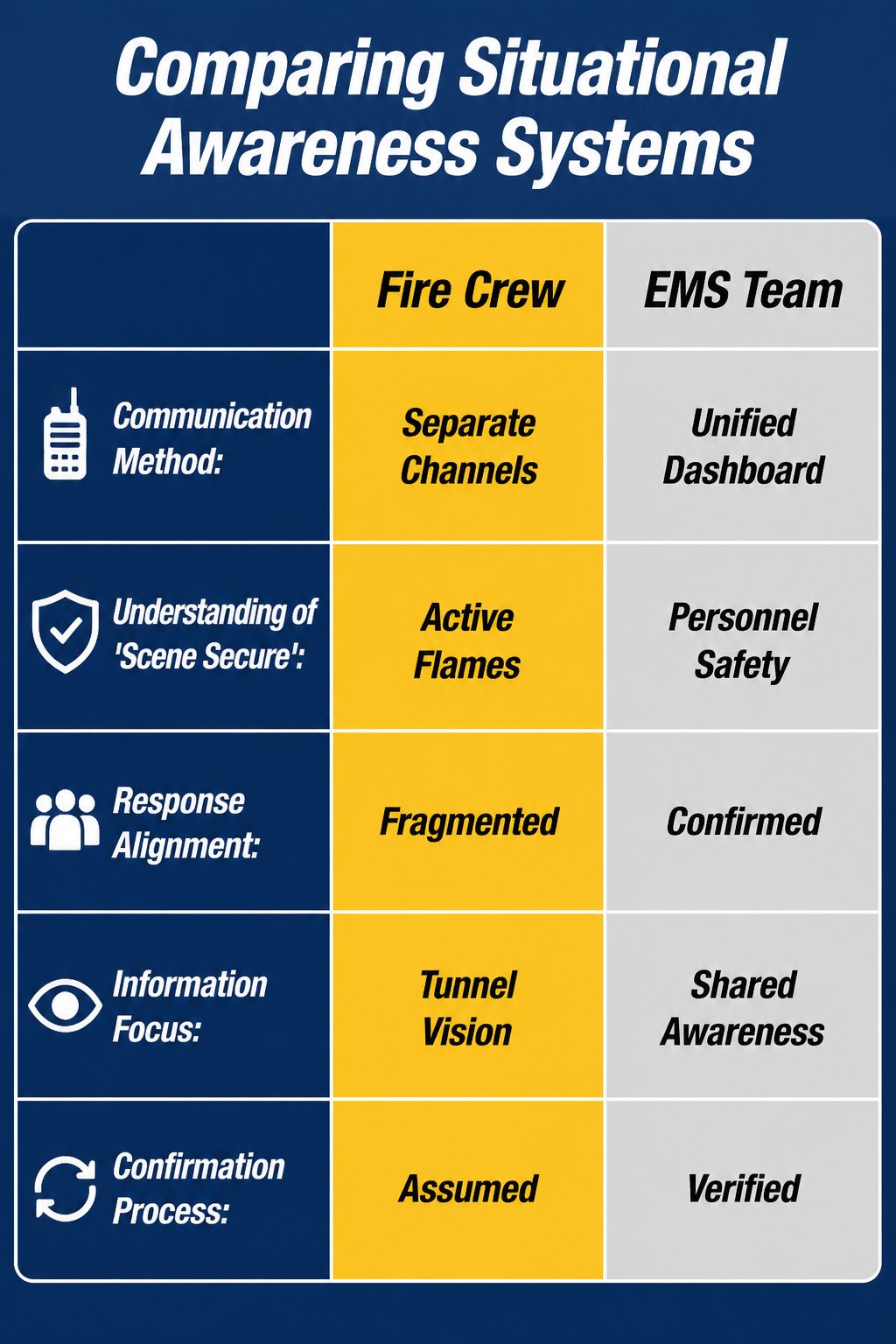
A genuine common operating picture means every responder sees the same consolidated data, not that they assume they do. During a multi-agency incident last year, the fire crew on the east side and the EMS team on the west both reported "scene secure" into their respective channels. Neither heard the other. Two hours passed before anyone realized their definitions differed: the firefighters meant no active flames, while EMS meant no incoming threats to personnel. The COP existed on paper, not in practice.
Tools that consolidate observations into a single accessible platform close this gap. Without them, each team builds a private model from fragmentary reports. The result is parallel independent actions, each logically consistent internally and each wrong about what the others are doing. Tunnel vision compounds the problem; a responder focused on a single server or entry point will filter incoming information through that narrow frame, discarding cues that do not fit.
Training helps, but its effectiveness degrades over time and simulation cannot cover every scenario. The stronger fix sits higher in the safeguard hierarchy: remove the fragmentation by design. Shared dashboards, cross-audible channels, and explicit confirmation loops turn assumed alignment into verified understanding.
Training and Simulation
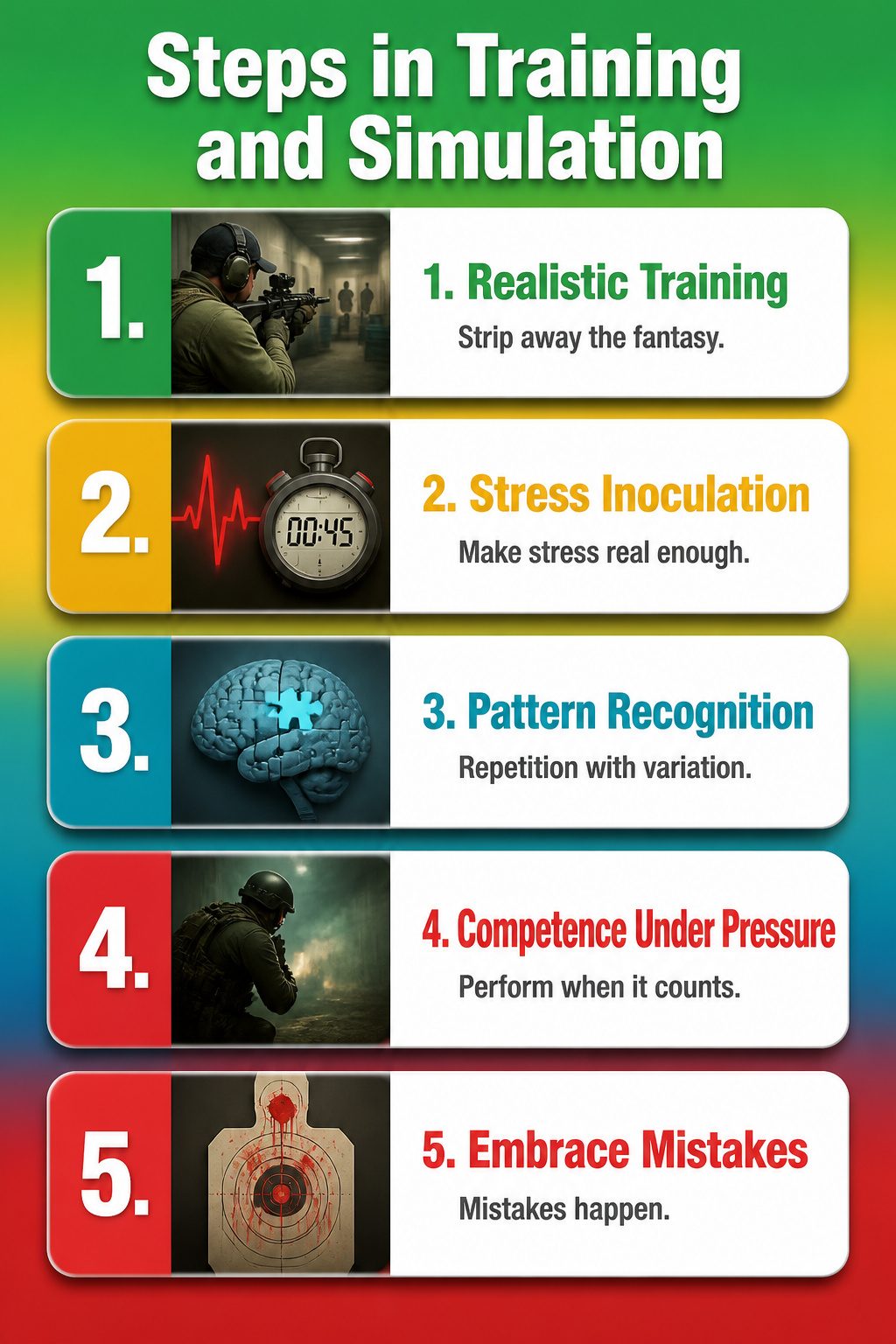
Realistic training strips away the fantasy of how you’ll perform and replaces it with something far more useful: proof of what actually happens to your mind under pressure. I learned this the hard way during my first force-on-force simulation, when the tunnel vision hit so hard I walked straight past a second threat my partner had to engage. The scenario wasn’t even that complex. Two rooms, three role-players, and I had rehearsed the sequence mentally a dozen times that morning. The body does not care about your mental rehearsal.
Stress inoculation only works when the stress is real enough to matter. Heart rate up, time pressure on, consequences that sting. That sting can be as simple as a paint round to the thigh or as formal as a debrief where your mistakes get picked apart in front of peers. What matters is that the brain registers the event as genuinely costly, which is what builds the emotional memory that later says "slow down, look around" when live stakes are higher.
Pattern recognition follows repetition with variation. Running the same scenario twice teaches muscle memory; running ten versions with shifting details teaches the eye to spot what is actually wrong instead of what you expect to be wrong. The cognitive capacity this frees is not minor. When responses to common problems are practiced to automaticity, the working memory you would have spent on "what do I do" becomes available for "what is actually happening here." That shift is the difference between reacting to a situation and reading it accurately while it unfolds.
The mistake most programs make is stopping at competence in the drill. Competence under controlled conditions is not the goal. The goal is reliable performance when the drill breaks, when the unexpected arrives, when your own physiology works against clear thinking. Simulation worth the time and ammunition pushes past the point of comfort into the space where mistakes happen, because that is where the real preparation lives.
Frequently Asked Questions
What are the barriers to situational awareness?
The barriers include pre-arrival lens, confirmation bias, tunneled senses, task fixation, task saturation, multitasking, mission myopia, urgency, time distortion, overconfidence, complacency, peer pressure, short-term memory overload, confabulation, distractions, and cognitive load. Research on responder near-miss events shows 78% of situational awareness failures trace back to perception: the information was there, and the responder never registered it at all.
How can situational awareness be improved?
Situational awareness improves through training and simulation, regular environmental scans every thirty seconds, prioritizing tasks to reduce input volume, using external aids like notepads or whiteboards, building in contrary viewpoints on teams, and designing protocols that serialize attention rather than parallelize it. Breathing techniques and hard time limits also help counter time distortion under stress.