The Emergency Preparedness merit badge is one of two required alternatives for Eagle Scouts, built on top of the First Aid merit badge and focused on how entire systems respond to crises rather than individual injuries. You cannot begin it until First Aid is fully complete; no exceptions. The badge breaks every emergency into five phases, prevention through recovery, and asks Scouts to chart ten scenarios from an official list of 21 that runs from stovetop fires to tsunamis.
Emergency Situations

The emergency preparedness merit badge breaks every crisis into five phases you have to think through. Prevention keeps the emergency from starting. Protection limits your exposure once it does. Mitigation reduces the damage. Response is what you do in the first minutes. Recovery is how you rebuild afterward.
My counselor had me build a chart covering ten situations from the official list, five of them mandatory. The list runs to 21 scenarios total: home fires from stovetops or ovens, home fires from flammable liquids, gas leaks, food poisoning, automobile crashes, vehicles stalled in desert conditions, vehicles trapped in blizzards, backcountry injuries, boating or water accidents, toxic chemical spills, nuclear power plant emergencies, fire or explosion in a public place, violence in a public place, wildland fires, avalanches, earthquakes, tsunamis, major flooding or flash floods, hurricanes with power outage, tornadoes, and lightning storms.
Here is how five of those situations map across the five phases:
| Emergency | Prevention | Protection | Mitigation | Response | Recovery |
|---|---|---|---|---|---|
| Home stovetop/oven fire | Stay in kitchen while cooking; keep towels away from burner | Keep a lid within reach; know the nearest exit | Small fire: lid over pan; turn off burner if safe | Leave and call 911 if fire spreads; never use water on grease | Inspect kitchen before cooking again; replace damaged equipment |
| Gas leak | Store propane tanks properly; check connections | Leave area immediately; do not use light switches or electronics | Shut off outdoor tank valve if safe to reach | Call gas company or 911 from outside; keep flames away | Do not return until officials clear the building |
| Vehicle stalled in desert | Carry extra water; keep phone charged | Use vehicle shade; avoid sun exposure | Stay with vehicle; signal with bright items | Conserve water; limit daytime activity | Arrange tow or rescue; restock supplies before next trip |
| Vehicle trapped in blizzard | Keep winter kit in vehicle; check weather | Stay inside vehicle; run engine briefly for heat | Clear exhaust pipe of snow; crack window slightly | Use hazard lights; signal for help | Run engine only in short bursts to conserve fuel; wait for plow |
| Earthquake | Secure heavy furniture; know gas shutoff | Drop, cover, and hold on; avoid windows | Check for injuries; shut off gas if you smell it | Do not use elevators; be ready for aftershocks | Inspect home for damage; document for insurance |
The point is not to memorize 105 separate answers. The framework trains you to ask the same questions every time: what stops this, what limits my risk, what cuts the damage, what do I do now, and what comes after.
Planning for Family Emergencies

The family meeting is where the emergency preparedness merit badge starts to feel real. My own household sat down after dinner one evening and talked through two scenarios: staying put and getting out fast. Shelter-in-place means picking the safest room, usually an interior space with few windows. Evacuation means agreeing on a meeting spot outside, something we could find in the dark or through smoke.
The fire escape plan came next. We drew a floor plan showing two ways out of every room, then walked it twice. The safe meeting place sits at the far end of the driveway, well clear of the house and any garage doors. Practicing it mattered more than the drawing; the first run-through showed my daughter that her window screen pops out easier from the inside than she thought.
For the family disaster kit, we used the checklist from the merit badge pamphlet. A three-day supply of water and nonperishable food forms the base, plus a first aid kit, flashlight with extra batteries, and copies of important documents in a waterproof container. We keep part of the kit near the front exit for quick evacuation, and we check expiration dates twice a year. The batteries go stale in a closet faster than you expect.
Preventing Accidents and Emergencies

Requirement 3 for the emergency preparedness merit badge gives you two paths, and only one needs to get done. The first option is a home safety inspection using a checklist from the official pamphlet or one your counselor approves. An adult has to come along, which sounds like a formality until you’re crawling through a basement pointing out how the water heater’s venting looks wrong and actually need someone who can reach the shutoff valve.
The second option asks for five emergency prevention plans for family activities outside the home. Picnics, movies, beach trips, visiting relatives, ball games, worship services, concerts. Each plan needs the full cycle: hazards you spotted, how to prevent them, protect from them, mitigate them, respond to them, recover from them, and why each action makes sense. That "why" trips people up. It is not enough to write "bring a first aid kit." You have to explain what injury you are packing for and how having gauze changes the outcome.
The pamphlet’s checklist makes the first option faster if your house is already reasonably maintained. The five activity plans take longer but teach more. A scout in my son’s troop chose the beach outing, the movie theater, a road trip to his grandmother’s, a concert, and a baseball game. He found the baseball game the hardest because stadium crowds create hazards that do not exist in an empty parking lot, and the "recover" step for a crowd crush looks different than for a sprained ankle.
Pick whichever fits your schedule and the adult you can actually schedule. The merit badge counselor signs off on either one.
Dangerous Situations
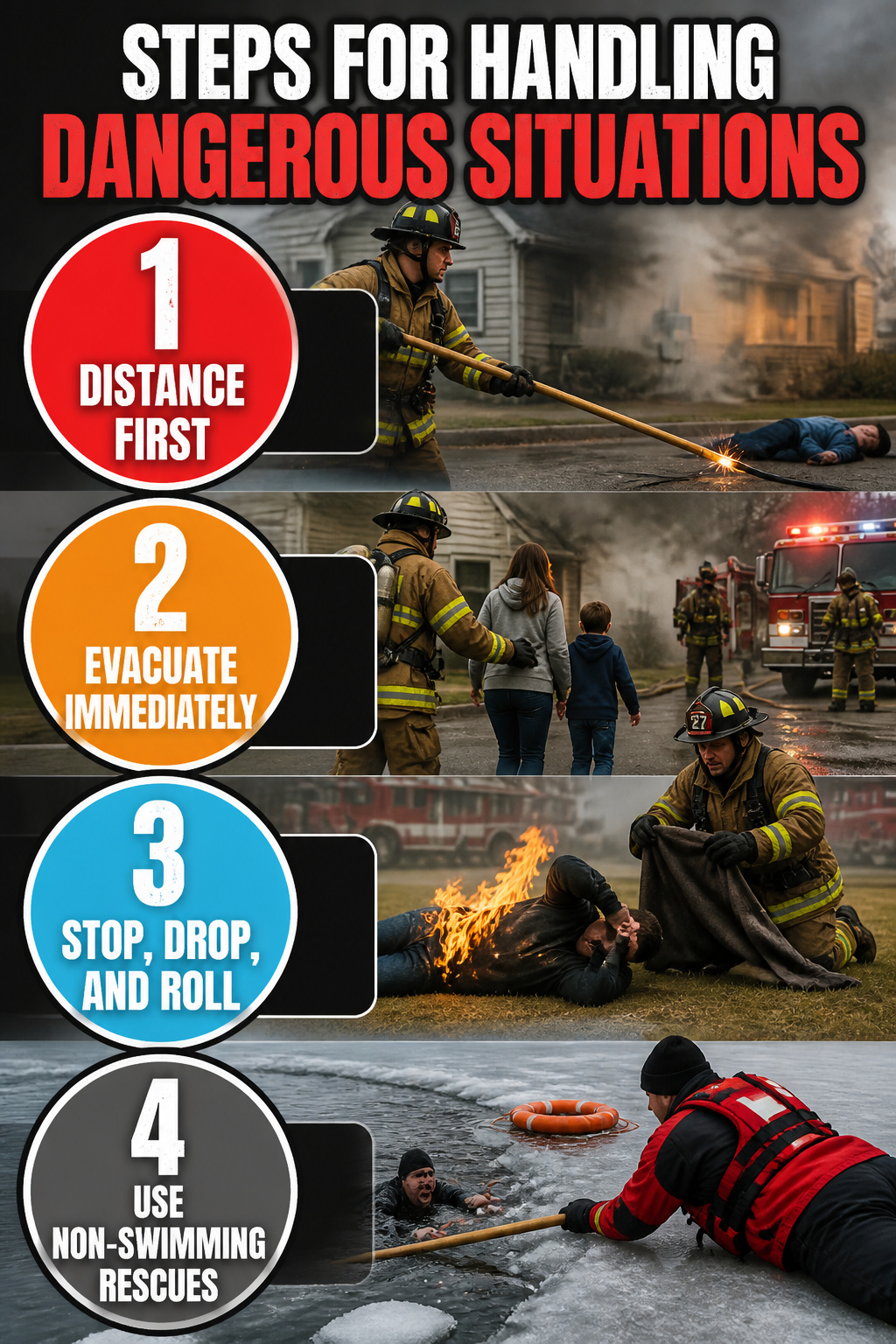
- A live household electric wire demands distance first. Shut off power at the breaker box if you can reach it without crossing the hazard zone. If not, use a dry wooden or plastic object to move the wire, standing on a dry surface yourself. Never touch the person or the wire directly; electricity travels through a body into yours. Call 911 immediately and keep others back.
- Carbon monoxide in a structure means evacuation, not rescue. Get everyone out, including yourself, then call emergency services from outside. Re-entering to open windows or find the source wastes seconds you do not have and exposes you to the same poison.
- Clothes on fire: stop, drop, and roll. Shout the instruction so the person hears it over their own panic. A blanket or coat can smother flames if rolling alone is not working, but do not wrap them while they are still standing.
- For drowning, nonswimming rescues keep you dry. Extend a pole, branch, or towel for the person to grab. Throw a flotation device if one is available. On ice, lie flat to distribute your weight and crawl, or better, push the object from shore. Entering the water or walking on the ice puts two people in need of rescue instead of one.
Signaling for Help

Three environments, three sets of rules. Rescue aircraft or drones spot you from altitude and speed, so motion and contrast beat detail every time. A signal mirror flashes across miles of terrain; three fires or three of anything arranged in a triangle mark a distress pattern search pilots are trained to recognize. Ground crews move slower and read closer. Bright fabric tied to a tree, tracks kicked into snow, or a whistle blast every minute carries farther than a voice. On water, the game changes again. An overturned hull is already a visible target, but dye markers, a flag waved from an oar, or six short horn blasts followed by one long one tell searchers you are alive and waiting. The merit badge wants you to demonstrate each, not just name them. Practice the mirror until you can hit a target without fumbling. Know the three-blast signal by muscle, not memory.
Moving an Injured Person

Two ways to transport an injured person out of a remote area using improvised stretchers sit at the heart of requirement 7 for the emergency preparedness merit badge, and both need to work without exhausting the rescuers.
The first approach most troops learn starts with two poles, roughly six to eight feet long, and a blanket or tarp lashed between them. Scout staves work if the trail is wide enough, but downed saplings stripped of branches are what you actually find in the field. The trick is keeping the poles parallel: a diamond lashing at each end, then the blanket folded into a sling and secured with clove hitches every foot or so. Without that spacing, the victim drops through the middle or the poles pinch inward.
The second method swaps the blanket for a lattice of rope or webbing woven between the poles. This one takes longer to build but carries better across uneven ground because the injured person’s weight distributes across more points. Paracord works; so does stripped bark in a real pinch, though it stretches and needs retightening.
Both setups need a bearer at each end and one on each side on rough terrain. The merit badge requirement specifies doing this with another person, so practice the handoff: rescuers switch positions without setting the stretcher down, which matters more than it sounds when the trail runs uphill. Padding under the head and immobilizing any suspected fracture come before movement, every time.
NIMS and ICS

The National Incident Management System, created by the Department of Homeland Security, gives every responding group, local to federal, the same playbook so they can actually coordinate instead of stepping on each other. Incident Command System sits inside NIMS and handles the scene itself. An Incident Commander runs the show, Logistics handles equipment, Medical treats injuries, and Communications keeps information moving accurately between teams. ICS works the same whether the emergency fills a city block or a county, which matters when your troop gets called out.
Community disaster management leans on this structure because emergencies do not respect office hours or jurisdiction lines. Your local emergency management director plans, trains, and coordinates these responses before anything happens. A Scout troop plugs in at the volunteer level, the place where ICS often needs bodies more than it needs specialists. Scouts can run messenger service when radios fail, manage crowd and traffic control, distribute supplies, or help with feeding and shelter operations. The key is showing up trained and following the chain of command rather than freelancing. My advice: find that director, learn the local plan, and practice it before the real thing.
Emergency Service

A Scout troop’s emergency role breaks down into four practical jobs: crowd and traffic control, messenger service during an incident, collection and distribution, and group feeding with shelter and sanitation. Each demands specific training and safety protocols that a counselor will walk through with you.
The written mobilization plan matters more than most scouts expect. If your troop already has one, present it and explain your part in making it work. If not, build one from scratch, covering how leaders get contacted, where the troop assembles, and who handles what.
The personal emergency service pack gets inspected against a checklist, either from the merit badge pamphlet or one your counselor approves. Know every item’s purpose cold.
For the participation requirement, any real emergency service project or practice exercise with a troop, community agency, camp, or school qualifies. Review what you learned with your counselor afterward. The sources do not specify example projects, so the exact shape of your service will depend on what your local troop or community has available when you work on the badge.
First Aid Merit Badge

First Aid must be earned before you can finish Emergency Preparedness. That requirement sits at the top of the badge, and the BSA means it literally: no partial workarounds, no doing both side by side and hoping the counselor signs off anyway. I have seen a Scout show up to his Emergency Preparedness board with everything else checked off, only to learn his First Aid merit badge was still two requirements short. The counselor sent him back to finish it before they would even open the Emergency Preparedness book.
Both badges are required for Eagle, so most Scouts knock out First Aid early, often at summer camp or during a troop skills weekend. That timing works in your favor, since Emergency Preparedness builds directly on the patient assessment, wound care, and shock treatment you will have already practiced. The overlap is real, but the sequence is fixed: First Aid first, then Emergency Preparedness after.
Careers in Emergency Services

Requirement 10 gives you three paths, and only one needs to check the box. The interview route meant sitting down with our county’s emergency services coordinator, a civil servant whose whole job revolves around disaster management. I asked how he landed in that chair and what his days actually look like when the phones start ringing. The conversation ran about forty minutes, and the part that stuck with me was how much of the work happens in quiet months: mapping vulnerabilities, updating mutual-aid agreements, running drills that half the participants sleepwalk through. You do not need to shadow a response in progress for this to count. The requirement is the interview and the discussion with your counselor afterward, including whether the career interests you at all. Saying no is a valid answer.
The other two options let you research three emergency-services careers in depth, picking one to trace through training, certification costs, salary prospects, and advancement ladders, or apply your preparedness skills to a hobby or healthy-lifestyle pursuit, figuring out what additional training and organizational ties would deepen it. Any of the three satisfies the badge. The interview just happens to be the fastest if you can get twenty minutes on someone’s calendar.
What the Badge Covers

The Emergency Preparedness merit badge sits alongside Lifesaving as one of two options Eagle Scouts must earn, a requirement that signals how seriously BSA takes crisis readiness. Scouts who choose this path build directly on their First Aid training, moving past treating injuries to understanding how emergencies unfold and how systems respond.
The badge works through five phases: Prevention, Protection, Mitigation, Response, and Recovery. Each phase gets applied to real scenarios like fires, floods, accidents, and power outages, with Scouts documenting their thinking and defending their choices to a counselor. That structure forces a shift from memorizing steps to understanding why one course of action beats another when time is short and risk is high.
What separates this badge from pure first aid training is the systems thinking. Scouts study how communities coordinate disaster relief, practice safe response techniques, and learn to help without becoming casualties themselves. The requirement to create home emergency plans and explain the reasoning behind them means a Scout carries the work past the troop meeting into actual family preparedness.
How Families Actually Use the Plan

Family meetings about emergency plans usually fall apart for one reason: somebody turns it into a lecture. The scout sitting there with a chart from requirement 1(b) already did the thinking. What works is when that scout asks the actual questions, like which room has the fewest windows for sheltering in place, or whether the front door deadbolt sticks when you turn it hard. My own family ran the fire escape drill twice before we noticed the hallway smoke detector had been chirping for three weeks. The floor plan with two escape routes per room looks clean on paper, but the test is a blind walk-through at 10 p.m. with the lights off.
The meeting place outside matters more than most families treat it. A neighbor’s driveway works only if that neighbor knows you picked it, and if the tree you chose is still standing after the ice storm you have not had yet. The merit badge asks for a map with a safe meeting place, but safe means visible from the street for firefighters, far enough from the house that a collapsing porch does not reach it, and memorable enough that a six-year-old who just crawled out a window finds it without thinking. The checklist in the pamphlet covers the disaster kit, but the kit sits in the closet unless the family meeting made someone responsible for grabbing it. In my experience, that person should be whoever is closest to the door, not whoever packed it.
Home Hazards Scouts Miss

Home safety inspections for the emergency preparedness merit badge tend to repeat the same obvious checks while missing what actually injures people. The checklist from the pamphlet covers smoke alarms and blocked exits, but Scouts often treat it as a scavenger hunt rather than a living review of how the family actually moves through the space.
- Extension cords run under rugs create a fire risk Scouts notice but rarely flag as urgent, since the hazard hides in plain sight during a quick walkthrough.
- Cluttered hallways get checked off when the path is technically clear at that moment, not whether the household keeps it clear during busy mornings when someone might trip carrying laundry.
- Family activity plans for requirement 4b usually list generic hazards like "sunburn at the beach" without tying them to the specific route, the parking situation, or how young children in the group behave when separated from adults.
- Fire escape plans drawn for requirement 3b often show two exits from each bedroom but omit where the family actually gathers once outside, which matters more than the arrows on the page.
- Scouts inspecting with a parent sometimes skip the garage or basement because the adult assumes those spaces were already checked, creating a gap where chemicals and fuel sit unexamined.
The prevention requirement rewards Scouts who return to their own checklist a week later and find what shifted since the first pass.
When You Cannot Reach the Victim

The first rule of rescue is that a dead rescuer helps nobody. Standing water, downed power lines, unstable structures, or toxic air each create a boundary you do not cross without the right gear and training. The safety boundary is the distance where you stop being a helper and start being the next victim.
Judging go versus no-go comes down to one question: can you reach the person without joining them in danger? If the answer is no, your job shifts to containment, not contact. Block the area, call for specialists, and keep others from following your instinct to rush in. The hardest part is accepting that waiting is the correct action.
In my own training, the scenarios that stuck were the ones where hesitation felt wrong but saved lives. A scout practicing this merit badge needs to recognize that same pressure and build the habit of pausing to assess. The badge requirement is not about heroism; it is about responding to dangerous situations effectively, which sometimes means doing nothing except keeping the scene from getting worse.
Signals That Work and Signals That Do Not

A pilot scanning from altitude picks up motion and contrast, not detail. Three large, evenly spaced ground signals read as intentional; one small fire reads as a campfire. That distinction decides whether anyone turns the aircraft.
Smoke color matters more than smoke volume. Green brush throws white smoke. A signal fire needs rubber or oil to throw black plumes against snow or green canopy. Without that contrast, the column blends into haze.
Mirrors work only when the sun angle and the searcher’s position line up. Most of the day they do not. A mirror flash also tells the pilot nothing about distress versus a hunter signaling a friend. Ground panels, laid flat in an open area, stay visible as the sun moves and read clearly as distress from above.
Sound travels poorly to aircraft. A whistle or gunshot at altitude is wind noise. Ground searchers hear it fine. The wrong signal for the wrong searcher wastes hours and energy.
For the emergency preparedness merit badge, the requirement is to show you understand which tool fits which scenario. Ground rescue: sound, bright color, movement. Air rescue: large geometric patterns, high contrast, sustained smoke. Using both at once covers either possibility.
Stretcher Materials That Hold

Pine poles lashed into an A-frame will carry more than you expect, but only if the lashings sit below the level of the bed so the poles do not roll against the cordage. A pair of scouts can move roughly 160 pounds across open ground this way, though the frame flexes enough that the injured person will feel every bump unless you pad the poles with jackets or sleeping bags first. The requirement calls for two good ways, so the second option matters: a blanket between two scouts becomes a hammock stretcher when each grips a rolled edge, but the blanket must be wool or a tight synthetic weave. A loose weave or anything with stretch will sag the victim toward the ground between steps, which costs energy and risks dragging them against rocks or roots. In practice, the blanket method works for shorter distances or lighter individuals, and it fails outright on slopes where the lower handler ends up carrying most of the weight. For either method, the injured person’s head should ride slightly uphill when terrain allows, and both carriers need to match pace on rough ground so the bed does not twist. The merit badge specifically emphasizes conserving rescuer energy while protecting the injured person, which is why the A-frame wins for distance and the blanket serves when poles are not available or time is short.
How a Troop Fits Into Real Response

The gap between what a troop wants to do in an emergency and what incident command will let them do is where most Scouts hit a wall during the emergency preparedness merit badge. I watched this play out at a county exercise in 2019, where our troop stood ready with radios and first aid kits only to spend six hours directing traffic because nobody had checked us in through the Logistics Team.
NIMS runs on assigned roles, not goodwill. The Incident Commander oversees the response, the Communications Team handles information flow, and the Medical Team treats injuries. A troop slots in only where pre-arranged agreements exist. Without a memorandum of understanding with local emergency management, crowd control and messenger service are typically the only doors open to uniformed youth, and even those require adult supervision and safety briefings.
The merit badge requirements map this out clearly. Scouts must discuss what their troop should be prepared to do: crowd and traffic control, messenger service, collection and distribution, group feeding, shelter, and sanitation. Each carries specific training needs and limits. A troop that shows up unannounced expecting to run shelter operations will get turned away, or worse, become part of the problem.
The written mobilization plan exists partly to prevent this. It forces the conversation with community leaders about where Scouts actually fit, what ICS role accepts them, and which duties are off-limits until age or certification thresholds are met.
What Changes the Requirements

The Emergency Preparedness merit badge requirements shifted in 2016, and that change still catches people. Requirement 8b used to be 8c, a renumbering that creates confusion when older counselors or camp paperwork reference the old system. A scout showing up with prerequisites marked against an outdated list can end up doing the wrong homework.
BSA last updated the full requirements in 2023, but the 2016 pamphlet restructure is what most troops reference in practice. Councils interpret the same text differently on two points in particular: whether the home safety inspection needs a specific checklist or any reasonable hazard survey, and how formally the family emergency plan must be documented. Some counselors accept a handwritten floor plan with exit routes; others want the scout to walk them through it verbally with parents present.
The First Aid merit badge sits as a hard prerequisite, not a recommendation. Scouts sometimes try to parallel-track both badges at summer camp, but the rule is clear: no completion until First Aid is earned. The practical workaround, used by troops that run their own programs, is to let a scout do every other requirement and hold the final signoff until the prerequisite badge comes through. Camps with strict prerequisite checks will turn away a scout who shows up without it, so the timing matters more than the sequence.
Frequently Asked Questions
What are the requirements for the Emergency Preparedness merit badge?
The badge has ten requirements: emergency situations, family emergency planning, preventing accidents and emergencies, dangerous situations, signaling for help, moving an injured person, NIMS and ICS, emergency service, earning the First Aid merit badge first, and exploring careers in emergency services. Each requirement asks you to think through the five phases of any crisis: prevention, protection, mitigation, response, and recovery.
How do I prepare a family disaster kit?
Build around a three-day supply of water and nonperishable food, then add a first aid kit, flashlight with extra batteries, and copies of important documents in a waterproof container. Keep part of the kit near your front exit for quick evacuation, and check expiration dates twice a year since batteries go stale faster than you expect.
What should I include in my personal emergency service pack?
Your pack needs a filled water bottle with purification method, 24 hours of food like energy bars or trail mix, a personal first aid kit, a flashlight or headlamp with spare batteries, and a copy of your emergency contact information. A counselor will inspect it against the official BSA checklist or one they approve.