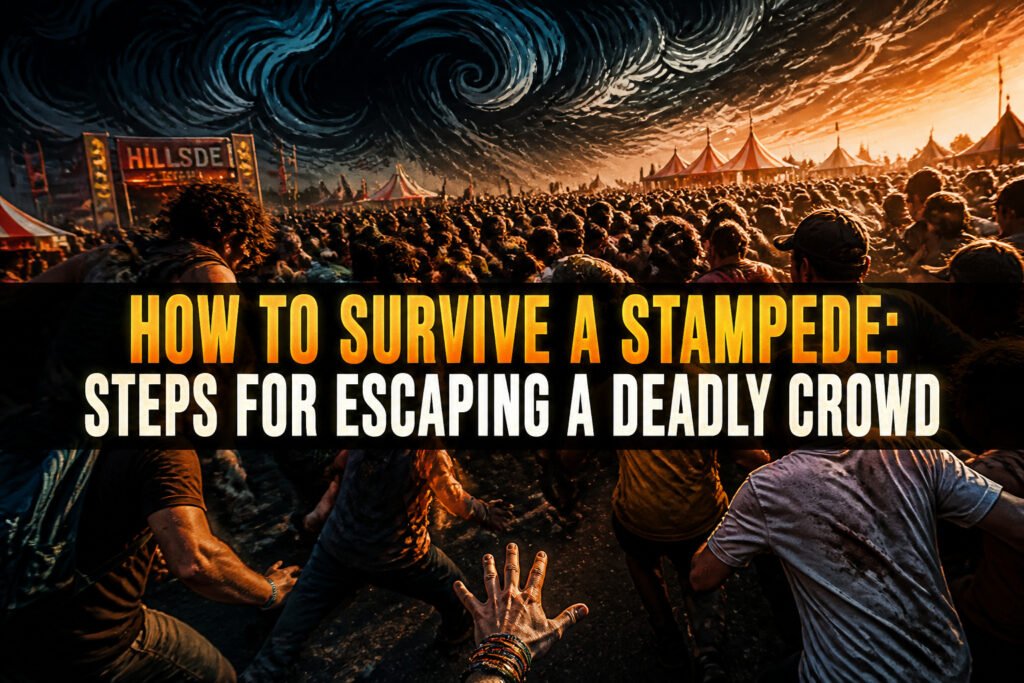
Surviving a stampede costs nothing to learn and everything to forget in the moment. Most people get the timing wrong: they wait for visible danger, for screams or swaying, while the real signal is the instant the crowd stops feeling like a party and starts feeling like a trap. Paul Wertheimer, who has studied these disasters for decades, puts it plainly. Crowds compress before they panic, and by the time you notice the pressure against your ribs, the oxygen is already running out. The hesitation cost is real. Leaving a spot you waited hours for feels like waste, until density steals your ability to breathe entirely.
1. Identify Exits Before You Need Them

The second you walk through the door, scan for every way out. Fire exits, rear doors, windows that open, loading docks. Most people fixate on the entrance they came in through, and that familiarity kills when the crowd turns. Paul Wertheimer, who has studied crowd disasters for decades, notes that the alternative exit nobody is thinking about often clears fastest.
That tightness in your chest, the moment the crowd stops feeling like a party and starts feeling like a trap? That is your signal. Not after the first push, not when the sound changes. Then. Wertheimer puts it plainly: crowds rarely panic, but they do compress, and by the time you notice the swaying it is already too late to move freely. The hesitation cost is real. You waited three hours for this spot near the stage. Leaving now feels like waste. The math changes fast when density steals your ability to breathe, because the cause of death in a crowd crush is lack of oxygen, not trampling. Your lungs need room to expand, and that space disappears before the situation looks dire.
2. Stay Calm When the Crowd Turns

The moment a crowd turns is quieter than movies suggest. No screaming score, just pressure building against your ribs and the sudden realization that your feet are not fully under your control anymore. That is the moment to drop your shoulders and slow your breathing, because panic burns oxygen fast and above six persons per square meter, oxygen becomes the scarce resource that kills.
Compressive asphyxia, not trampling, is what the numbers describe. Chests cannot expand. Diaphragms flatten against the pressure of bodies behind. Each panicked breath tightens the spiral: more struggle, more oxygen demand, less room to draw it in. Calm is not passive here; it is a deliberate conservation strategy. Slow exhalations buy time.
If you feel that people are touching you on both shoulders or on several places on your body at the same time, the density is probably around six or above. If you still have time and can move, get away. That’s an alarm signal.
The alarm is physical before it is mental. Your body registers the density; your job is to keep your head from overriding that signal with frantic motion. Helping the person next to you stay steady, keeping your arms folded boxer-tight to maintain chest space, moving with the flow rather than against it: these acts of composure spread outward. They also keep your breathing shallow and controlled, which keeps you conscious when others are not.
3. Move With the Crowd, Not Against It

The first time I saw crowd turbulence described, it clicked why fighting back feels so right and works so wrong. A packed crowd moves like water under pressure: push one neighbor, they push theirs, the wave hits a wall or another wave, and the force doubles back on you. The physics are relentless. Resisting exhausts you fast and adds energy to a system that does not need more.
Walking at the same speed as the crowd keeps your legs under you and your lungs working. Move diagonally with the flow and you drift toward the edges where pressure drops, rather than getting funneled into chokepoints like doorways. The CDC recommends a boxer stance, hands up at chest height, not to fight but to guard the few centimeters of space your ribs need to expand.
Yelling wastes air you may need. Pushing wastes strength you do not have. The people who survive are the ones who keep their feet, keep their breath, and keep inching sideways until the density thins.
4. Protect Your Breathing Space

Arms up near the chest, folded like a boxer, is the single move that buys room to keep breathing when the pressure builds. The danger point starts at above six persons per square meter. Below that, bodies might brush you; above it, the crowd becomes a vice. At eight, injuries or worse become likely.
The real killer in a stampede is not trampling. It is compression asphyxia: the weight of bodies packed so tight that lungs cannot expand enough to draw air. Fainting follows, then the crowd holds you upright while you suffocate. Keeping your arms folded in front of your chest creates a rigid cage against your ribs, a pocket of space that the pressure cannot fully collapse. Without that space, the chest wall has no room to move.
If shoulders press against you from both sides at once, you are already at or past that six-person threshold. That sensation is your signal. The arms-up position is not comfortable and it does not look natural, but it keeps the airway open when everything else is closing in.
5. Avoid Choke Points

Doorways, hallways, and bridges look like escape routes in a panicked crowd, but they are exactly where the force multiplies. I learned this reading crowd-safety breakdowns: the pressure does not stay constant. It builds exponentially as more bodies pack toward any restriction.
Six people per square meter is the line where things turn dangerous. Below that, you are uncomfortable but mobile. Cross it, and the crowd becomes a fluid with nowhere to go. You feel it when shoulders touch yours on both sides at once. That density is your signal to move, not toward the nearest opening, but away from any pinch point.
Poor venue design creates these traps before the crowd ever arrives. A narrow gate between sections, a fence line forcing a funnel, a concession stand blocking half an exit. The architecture turns dense into deadly. The safest position is usually the wider space, even if it means a longer path out. Compressive asphyxia, not trampling, kills most people in these events. The pressure against your chest builds where the corridor tightens, and the oxygen simply runs out.
6. If You Fall, Protect Your Head

Staying upright is the only thing that matters until it isn’t. The moment your feet leave the ground in a dense crowd, the game changes completely.
If you go down and the press of bodies makes standing impossible, curl onto your side and tuck into a tight fetal position. Arms come up over your head, hands laced behind your neck or skull, elbows drawn in to shield your face and temples. This does two things: it keeps your ribcage from expanding directly into the force coming from above, and it protects the organs that sit shallow in your torso, the ones a misplaced boot or knee will find first.
The fetal curl also creates a smaller profile. A body flat on its back presents the whole chest to the load; a body curled presents the curve of the spine and the outside of one thigh, both of which can take more abuse without stopping the heart or collapsing the lungs. Your arms, wrapped over your head, sacrifice themselves so your brain doesn’t have to.
This is last-resort territory. Every second on the ground is borrowed time. But when borrowing is all you have, the fetal position is the only loan with decent terms.
7. Find Stable Cover When Possible

Stable cover is a secondary move, not a primary escape plan. The core techniques, moving with the flow and guarding your breathing space, come first because they work anywhere. Cover only matters when a solid structure happens to be within reach and the crowd itself is the only threat.
Indoors, a side hallway or closet can break the pressure. Outside, a tree you can climb or a vehicle you can mount may put you above the crush line. The key word is immovable. A doorway is not safe; the crowd compresses from multiple directions and creates a bottleneck where no one moves. Temporary structures, event equipment, or anything built for show rather than load will collapse under crowd force and trigger worse panic. If you cannot reach something clearly anchored and strong enough to part the flow, this option does not exist for you. Most of the time, it does not.
8. Use the Accordion Method to Escape

The accordion method only works if you can feel the crowd’s rhythm. A surge hits, your body compresses forward, and then, for a moment, the pressure eases. That lull is the opening. Move diagonally, two or three steps between pockets of people, before the next wave closes the gap. Sideways travel is nearly impossible against the flow, but diagonal cuts across it, using the brief stillness to slide toward the periphery where density thins and choke points like doorways become avoidable.
Reading about this convinced me less than watching footage of how crowd waves actually propagate: the surge is collective, but the lull is individual. You have to sense your own window, not the group’s. The technique is advanced because panic obliterates that perception. Calm assessment, in those seconds, matters more than strength or speed.
Crowd Crush vs. Stampede

Most deadly crowd incidents that get called stampedes are actually crowd crushes, and knowing which one you are in changes how you survive.
A stampede means people are running away from something: gunfire, a fire, a bridge swaying. The danger comes from feet and falling. A crowd crush is the opposite. People are packed so tight they cannot move their arms or breathe, sometimes while pressing toward a stage, a gate, or a narrow street. The 2010 Phnom Penh bridge collapse started as a stampede when the structure swayed and panic set in. The 2024 event in India was not a stampede at all. Organizers planned for 80,000 people; more than 250,000 arrived. No one was fleeing. They were squeezed until they could not expand their chests to breathe.
Between 1980 and 2022, an estimated 440 crowd surge incidents caused more than 13,700 deaths. Police counts in Seoul were too low for the crowd size, but the real failure was density management, not panic. Rational behavior would not have saved anyone. The space itself was the threat.
How Crowds Become Deadly

Between 1980 and 2022, 440 crowd surge incidents killed more than 13,700 people and injured another 27,000. The numbers keep climbing. On October 29, 2022, a Halloween celebration in Seoul’s Itaewon district left 159 dead and 196 injured when the crowd packed a narrow downhill alley. In July 2024, a religious gathering in northern India killed 121 when devotees surged toward a Hindu guru; organizers planned for 80,000 attendees, but over 250,000 arrived. January 2025 saw 30 dead at India’s Maha Kumbh festival when pilgrims rushed to bathe in sacred waters.
Most fatal crowd events share the same failures: bottlenecks that trap people, poor crowd control, and overcrowding beyond what the space can hold. Choke points, doorways, hallways, and bridges concentrate force exponentially as more bodies press toward them. Venue design matters as much as crowd size; poorly placed barriers, blocked exits, or unclear pathways turn congestion into compression.
The actual cause of death is usually not trampling. Compressive asphyxia kills when the press of bodies against your chest makes breathing impossible, even while you remain upright. A firecracker sparked panic among 30,000 soccer fans in Turin in June 2017, causing more than 1,500 injuries, but the deadliest events often involve no panic at all. People do not run; they simply cannot leave.
What to Do Before and After

A few practical habits make the main techniques easier to execute when pressure rises.
- Leave the moment you feel uncomfortable. Most people wait too long because they have invested time or traveled far to get where they are. That hesitation is what traps them. The swaying and shuffling start before the real danger does; your cue to move is the feeling itself, not a confirmed threat.
- Scan for alternate exits as soon as you arrive. The door you entered through feels familiar, so the crowd will head there by default. A side or rear exit that looked farther away when empty often clears faster when density spikes.
- Conserve energy by not pushing against the flow or yelling. Sound gets swallowed in dense crowds anyway. Sign language works better: point, wave, catch someone’s eye. A hand raised for help should be taken; grip it to keep that person upright.
- Keep hands at chest height, boxer-style. This protects your ribs and maintains space to maneuver.
- Crowd-surfing is a last resort, not a plan. It only works if others around you are still composed enough to pass you along.
Frequently Asked Questions
What should I do if I feel uncomfortable in a crowd?
Leave immediately. That tightness in your chest is your signal to move, not after the first push or when the sound changes, but then. Most people wait too long because they invested time or traveled far, and that hesitation traps them. The swaying and shuffling start before real danger does; your cue to go is the feeling itself, not a confirmed threat.
How can I protect myself if I fall in a crowd?
Curl onto your side in a tight fetal position, arms laced over your head to shield your face and temples, elbows drawn in. This protects your ribcage from direct pressure and keeps shallow organs from misplaced feet or knees. Every second on the ground is borrowed time, but the fetal curl is the only position that gives you decent odds until the crowd lets up.
What is the difference between a crowd crush and a stampede?
A stampede means people are running away from something like gunfire or fire, and the danger comes from feet and falling. A crowd crush is the opposite: people packed so tight they cannot move their arms or breathe, sometimes while pressing toward a stage or gate. Most deadly crowd incidents called stampedes are actually crowd crushes, and knowing which one you are in changes how you survive.