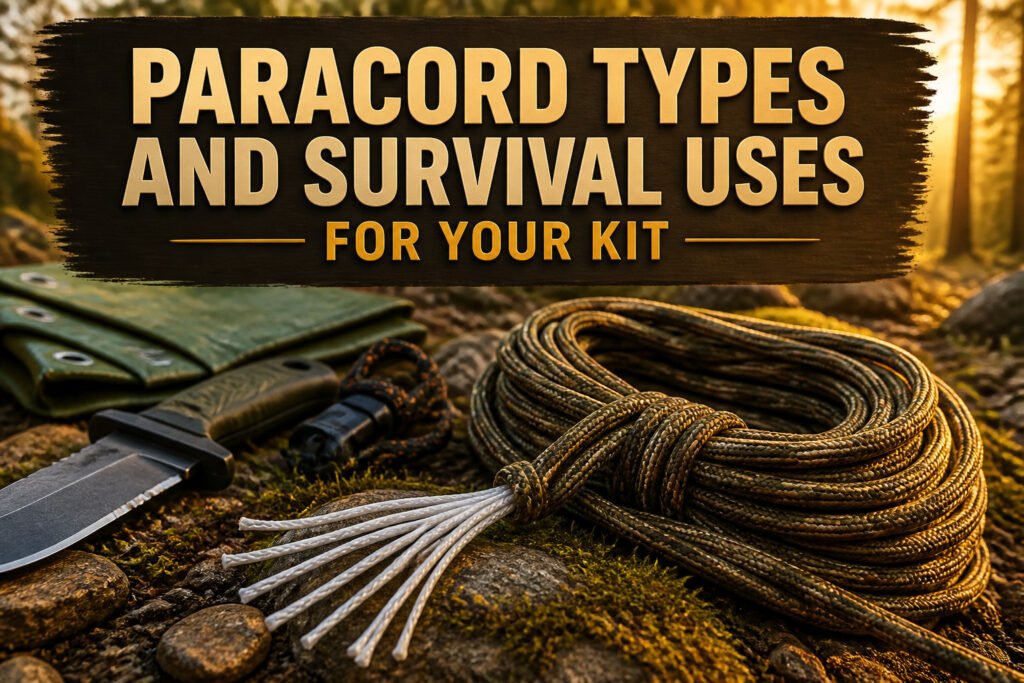
The only paracord worth carrying in a survival kit is Type III 550 cord, and the condition that makes it true is that you actually break it down when you need to. Seven inner yarns at roughly 35 pounds each let you rig shelter lines or snares without burning the whole hank on one job. I learned the hard way that Type I sheaths saw through at toggle points in wind, and Type IV’s 750-pound bulk stays buried in the pack until you are winching loads across a river.
1. Type I and Type II Paracord
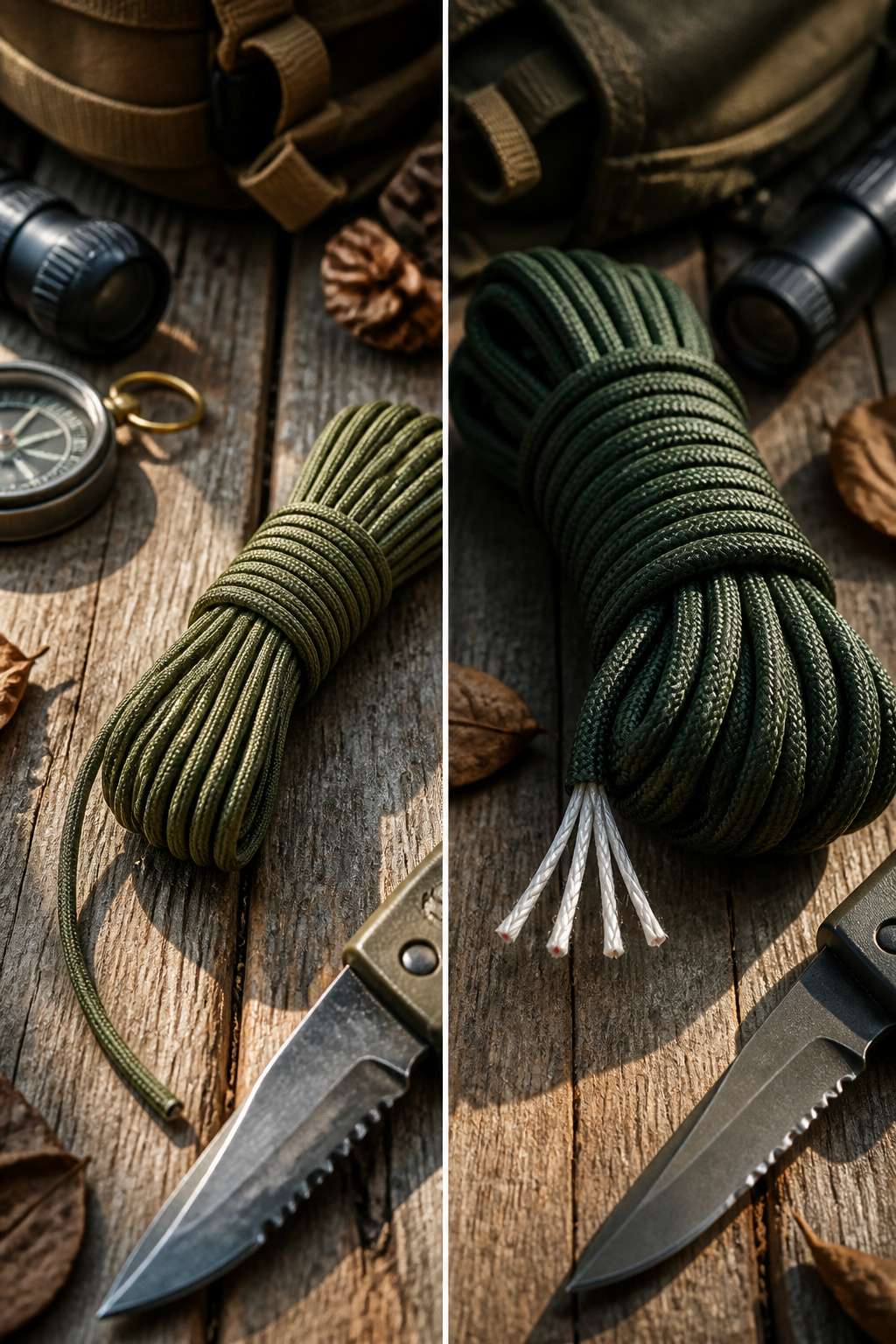
Type I and Type II paracord sit at opposite ends of the usefulness spectrum for a survival kit paracord stash, and the gap between them matters more than the numbers suggest on paper.
Type I clocks in at 95 pounds minimum breaking strength with a single core yarn. That is fishing line territory with a nicer sheath. A few years back I rigged a tarp ridge line with the stuff on an overnight that turned windy; by morning the sheath had sawed through at the toggle point and the core pulled free like a single strand of dental floss. It works for dummy cord on a knife or wrapping a tool handle, but 95-pound cord is not holding shelter weight when you need it to.
Type II jumps to 400 pounds with four to seven core yarns. The jump sounds dramatic, and it is, until you handle both side by side. The Type II sheath feels fuller, grips knots better, and the multiple cores mean one nicked strand does not total the line. I have used it for lashing a pack frame and for guy lines on a three-season tarp where wind load stays moderate. It packs smaller than Type III and lighter by enough grams that you notice it on a long day hike.
For a vehicle kit or base camp bag where ounces do not matter, neither of these is my first reach. Type II earns its spot in a daypack or pocket kit where bulk is the enemy and the jobs stay small: replacement boot laces, a quick gear tether, temporary zipper pull. Type I has left my rotation entirely. The weight savings over Type II are grams, not ounces, and the failure mode is too sudden to trust.
2. Type III Paracord

Type III paracord, the 550 cord, is what most experienced builders reach for first. The 550-pound minimum breaking strength comes from seven to nine inner yarns, each one a twisted bundle that can be pulled out and used on its own. The woven nylon sheath accounts for roughly 250 pounds of that rating, while the inner strands split the rest at about 35 pounds apiece, and each of those strands can unwind further into two smaller filaments.
This became the default for survival kit paracord because the military spec’d it that way, and the testing behind that spec is serious enough that private manufacturers still benchmark against it. Nylon handles the load better than polyester, and the all-nylon construction means the sheath and core bond together under stress rather than working against each other.
The seven to nine core yarns matter most when you actually need to break the cord down. A single inner strand at roughly 35 pounds is enough for shelter guy lines, snare wire, or emergency fishing line without burning your full cord. I have never needed the full 550 pounds in a real bind, but the rating buys peace of mind when I’m rigging a tarp ridgeline in wind or lowering a pack down a short drop. Lighter cord gambles on conditions you cannot control; heavier Type IV at 750 pounds adds bulk most kits do not need. The 550 rating sits where the weight trade-off actually pays off.
3. Type IV Paracord

Type IV paracord carries a 750-pound minimum breaking strength with eleven core yarns inside the nylon sheath, a jump from Type III’s seven. That extra bulk and cost buys genuine capability for hoisting, hauling, or improvised rescue rigging where failure is not an option. Most people building a survival kit paracord supply do not need it. Standard Type III handles shelters, snares, and gear repair at roughly half the price per hundred-foot hank. The gap runs about $8–$12 more for Type IV in most online stores, and the added weight sits in your pack unused unless your scenario genuinely calls for moving heavy loads with a single line. I have carried it on backcountry trips where river crossings involved winching packs across a current; the peace of mind was real, but on three-day hikes without such obstacles, the spool stayed buried and the expense felt like insurance against a risk I had engineered away with better route planning. For flat terrain or vehicle-based kits, the money buys more Type III length or a better knife. Save the 750-pound stuff for alpine routes, swiftwater zones, or any kit where you might actually need to lift a person.
4. Military-Spec Paracord

All-nylon construction with seven three-ply yarns is what separates military-spec paracord from the commercial spools that look identical on the shelf. The seven inner strands, each twisted from three individual yarns, share the load evenly and grip one another under tension in a way that polyester blends simply do not. When the cord gets wet, nylon bonds to nylon; a sheath that is part polyester will slip against its own core, and the strength you paid for shrinks before you even put weight on it.
I used to assume the "mil-spec" label meant something uniform until I started looking for cord that actually carried a National Stock Number. Only sixteen manufacturers have ever held that approval, and just three remain current. One of them supplies 5col Survival Supply in Durham, North Carolina, whose Type III cord sits under NSN 4020-00-262-2147. The yellow marker strand inside is not decoration; it is the government’s fingerprint for that manufacturer’s tested batch, and it is the only way to confirm the cord passed military lab checks for strength, splice count, and weathering rather than just being built to the same drawing.
Commercial cord with a nylon sheath and polyester core will hold a static load in dry conditions. The problem arrives when you need to trust it for a river crossing, a tarp ridgeline in three days of rain, or any situation where the materials need to act as one solid column. Polyester and nylon do not bond. Under shock load or sustained soak, they separate slightly, stress localizes, and the failure point arrives without warning.
5. Commercial-Spec Paracord

Polyester blends in commercial-spec cord create a bonding problem that does not show up until you are depending on it. The inner strands may be polyester while the sheath is nylon, or the mix runs the other way, and those two plastics will not fuse under heat or friction the way nylon bonds to nylon. I learned this the hard way with a cheap hank from a hardware store bin, no brand name on the label, trying to splice a broken guyline in wind. The sheath melted to a gummy mess while the core stayed stiff and separate, leaving a joint that looked right and held nothing.
Nylon outperforms polyester in cut resistance too. In blade tests, most cords ride up a ramped edge without nicking, but polyester jackets snag more often, pulling fibers rather than deflecting. The savings on commercial-spec runs about a third less per foot, which adds up across a hundred-foot hank until you replace it twice.
One honest upside: polyester takes UV better. After a year on a weathering board, the polyester cords faded less than the nylon. Sun exposure is the one place the blend wins. For a line left up permanently, that matters. For a survival kit paracord meant to pull, bind, and splice under stress, the mixed construction costs more in reliability than it saves in price.
6. Wilderness First Aid and Fishing Uses

The inner strands of 550 cord pull out to seven nylon yarns, each rated around 35-pound tensile strength, and each of those splits again into two finer strands. That 35-pound figure is light for any fish you’d actually want to eat, but it works in a pinch for panfish or as a leader material when you need stealth over muscle. The outer sheath alone holds about 250 pounds, so the full cord still works for bank lines or trotlines where the fish does the fighting against the whole line, not just the gut.
For first aid, the full cord handles tourniquets and splint ties; the inner strands step down to emergency suture or thread. A shoulder sling is the obvious move, though on a rocky creek trip a few seasons back, the real need turned out to be a thumb splint after a slip on wet stone. Two sticks, a boot insole for rigidity, and a few half hitches with the outer sheath did the job for the hike out. The cord bit into the wrist after twenty minutes; padding underneath would have helped, and now a six-inch loop of fleece lives in that kit as a buffer strip. The inner strands never got used that day, but knowing the 35-pound rating per yarn is what lets me leave the dedicated monofilament at home when ounces matter.
7. Shelter, Snares, and Tripwires

A ridge line for a tarp shelter is where paracord either earns its spot or fails in the rain. I learned this the hard way with a cheap braided cord that held fine in dry testing but slipped to the ground once the nylon soaked up water and the knot relaxed. A taut-line hitch, tensioned hard, will hold in 550 paracord through a storm; the same knot in slick poly rope walked loose on me inside two hours.
For a basic A-frame lean-to, the sources mention lashing branches together, but they do not give a length. My rule of thumb from reading around: thirty feet minimum for the ridge and two guy-outs, and that assumes you are not cutting from a longer hank. The first time I thought twenty feet would do, I had six feet left for snares and nothing to spare for adjusting the pitch.
Tripwires at shin height between trees work better with paracord than with wire because the cord does not glint at dusk. Tying on a metal spoon or a couple of washers gives you a clatter alarm without carrying anything extra. The same cord that rigs your shelter rigs your perimeter; that is the efficiency the small diameter buys you against the 550-pound breaking strength.
8. Gear Repair and Rigging

A bow-drill fire string is one of those survival kit paracord tricks that sounds simpler than it is. The cord wraps around the spindle, and your back-and-forth motion spins it against the fireboard to generate friction heat. Paracord handles the tension fine, but the outer nylon sheath melts and glazes after a few minutes of hard use. The inner strands hold longer, which is why some cord makers now include a flammable core strand specifically for tinder. Even so, the friction reality is this: paracord works in a pinch, yet natural cordage like rawhide or plant fiber outlasts it because it chars rather than melts.
Pack straps and zipper pulls are where the stuff earns its keep daily. A compression-strap buckle snapped on a frame pack outside Taos; the load started shifting on a switchback maybe two miles from camp. The repair was a loop of Type III through the remaining D-ring and around the frame tube, finished with a taut-line hitch that held for the next six miles and the hike out. The backup in the side pocket was a short webbing strap with a buckle, but the paracord did the job without unpacking it.
Bear bags, guy lines, lanyards for knives or fire starters, the same cord handles all of it. The sheath gives grip. The seven inner strands give you smaller line when you need it.
9. Paracord Length for a Survival Kit

A 20-foot coil of survival kit paracord fits in a jacket pocket, and for some jobs that is plenty. The figure comes from what fits, not from what works: twenty feet will handle a snapped bootlace, a quick gear lash, or a temporary tent guyline on calm ground. The 100-foot standard took hold because enough readers tallied their own kits and landed there. That length still weighs next to nothing and disappears into a pack, so the cost of carrying it is only the space of a small fist.
I keep both lengths now. Twenty feet lives in a winter truck kit, coiled and zip-tied so it throws clean without a tangle. A hundred-foot hank rides in my daypack, wound on a spent toilet-paper tube with the end tucked through a slot. The tube costs nothing and the cord pays out one turn at a time.
The trip that settled this was an early spring hike in the White Mountains. A creek crossing had washed out the footbridge. Twenty feet of paracord let me rig a hand line across, but 100 feet would have let me anchor both banks and still have working length left for the actual crossing. I made do by uncoiling the whole 20, using it, and walking the rest of the day with wet boots. The tube-wound hundred-footer went into the pack that evening.
Brands Worth Buying

Atwood Rope Mfg out of Ohio delivers $10 to $12 for 100 feet of made-in-USA cord, which is where I start most of my kits. The catch is the core construction: seven inner strands, but only two braids each instead of the military-spec three. Those braids run thicker, so strength and abrasion resistance hold up fine in practice, yet fully broken down you get about 25 percent less usable string length than true MILSPEC. For lashings and ridgelines that rarely matters; for fishing line or thread it might.
TITAN SurvivorCord runs closer to $35 for the same 100-foot hank, which stings until you pull it apart. The integrated fishing line, fire-starting tinder strand, and conductive copper wire turn one hank into half a survival kit by itself. I keep a length in my truck bag for exactly that reason: fewer small items to track, and the cord itself still tests at 550-pound tensile strength.
Between them sits 5col, less talked about but a solid middle option for straightforward 550 type III without the gadget strands. Where Atwood saves money and TITAN packs in features, 5col just ships consistent military-style cord that knots cleanly and does not fuzz out after weather exposure.
The disappointment in my own buying has been off-brand "survivor cord" that arrived with a waxy fire strand that would not take a spark and fishing line rated for panfish at best. Stick to named manufacturers; the $8 saved disappears fast when the tinder strand fails at dusk in cold rain.
Simple Paracord Projects

Paracord bracelets look tactical, but the real value is having ten to twelve feet of cord that does not tangle in a pack. The Cobra weave is the one most people recognize, and it is the only project I have actually finished start to finish. That first attempt took about forty minutes, most of it spent re-threading mistakes where the pattern went lopsided. The finished bracelet sat on a carabiner for eight months before a tarp ridge line failed on a windy campout and I unraveled the whole thing in the dark. The cord worked, though the melted ends had to be cut off and the inner strands were a pain to separate with cold fingers.
Leftover scraps from that project and a few failed key fobs became wraps for flashlight handles and knife sheaths, which turned out to be more useful than the bracelet itself. A kit wrap around a water bottle or tin keeps thirty to fifty feet immediately accessible without knots to untie, and the wrap itself gives grip.
How to Test Paracord Before Trusting It
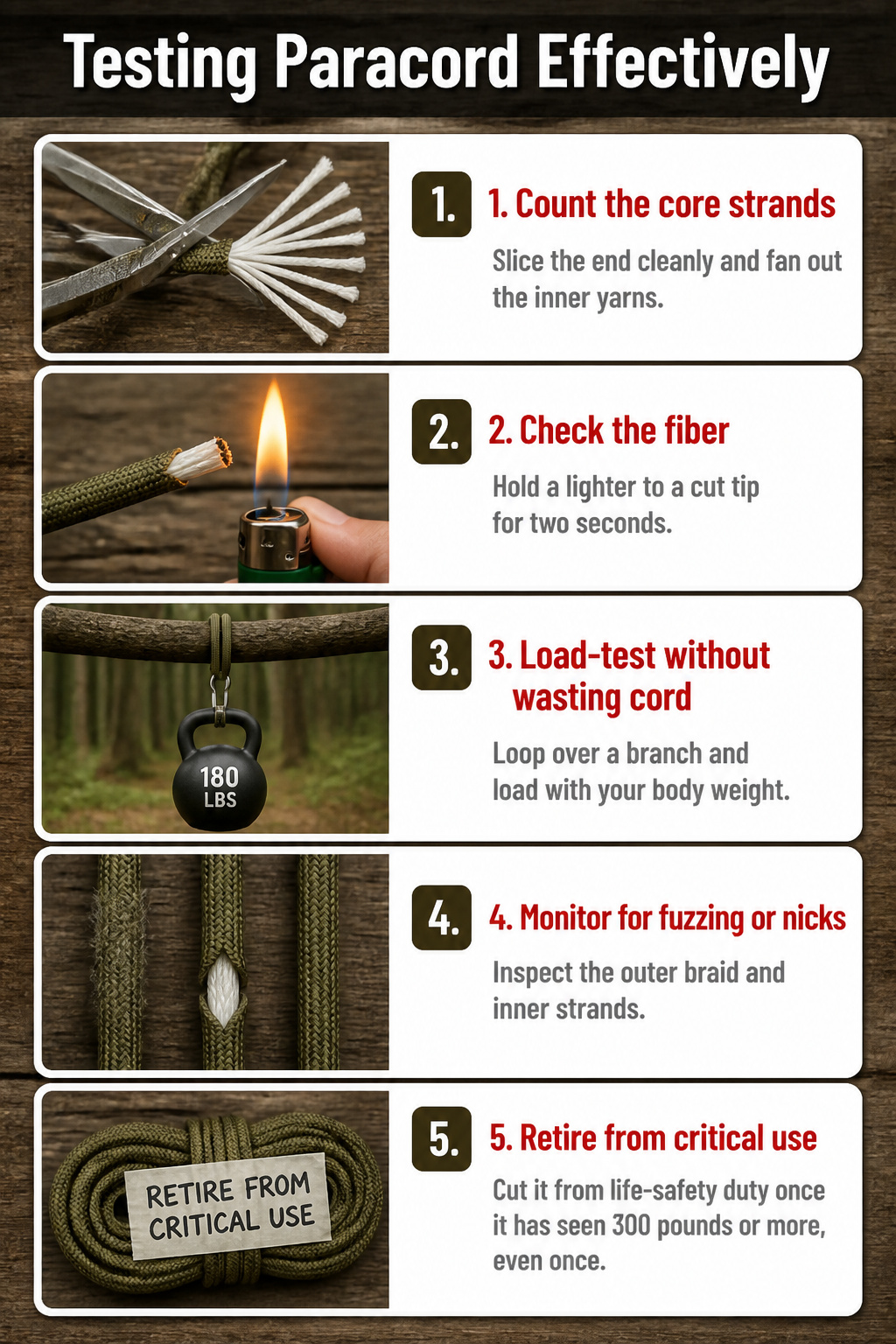
Three quick checks separate cord worth carrying from cord that only looks right.
1. Count the core strands. Slice the end cleanly and fan out the inner yarns. Mil-spec Type III should show seven strands, each three-ply. Commercial cord sometimes carries the same count with single- or double-ply, which still works for most jobs but does not braid or unravel into as many usable pieces.
2. Check the fiber. Nylon and polyester do not bond. A mixed-construction cord frays faster and resists melting into a clean end. Hold a lighter to a cut tip for two seconds. Nylon fuses to a hard, clear bead; polyester chars and stays soft. For a survival kit paracord, 100% nylon handles wet loads better and grips knots more reliably.
3. Load-test without wasting cord. A six-inch offcut, looped over a branch and loaded with your body weight, tells most of the story. I had a batch from a bulk spool that showed seven cores, passed the burn test, then stretched 15% and held a permanent hourglass shape under 180 pounds. The outer braid had slipped, the cores had bunched, and the cord was done. That was the failure to watch for: not snapping, but deformation that turns a line into a weak rubber band.
Retire cord from critical use when the outer braid shows fuzzing, any inner strand is nicked, or it has held a shock load near its rated limit. For Type III, cut it from life-safety duty once it has seen 300 pounds or more, even once.
Frequently Asked Questions
What are the uses for paracord?
Paracord handles wilderness first aid like slings and splints, fishing line and bank lines, shelter ridge lines and guy-outs, snares and tripwires, gear repair such as pack straps and zipper pulls, fire-starting bow drills, and bear bag hangs. The inner strands of 550 cord break down to roughly 35-pound line for smaller jobs, while the full cord holds 550 pounds for heavier loads.
How much paracord do I need for a survival kit?
Carry at least 20 feet for pocket or vehicle kits, which covers boot laces, quick lashes, and short guy lines. A 100-foot hank is the practical standard for a daypack or bug-out bag; it lets you rig a hand line across a creek, anchor both banks, and still have working length left for shelter or repairs. The hundred-foot coil weighs next to nothing and packs to about the size of a fist.