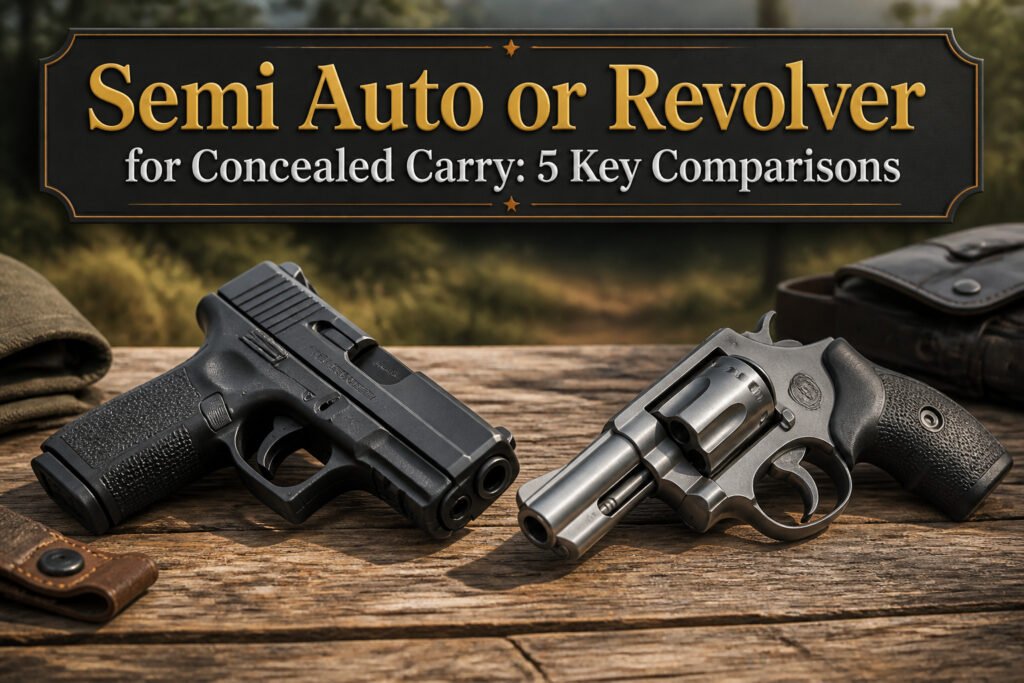
The semi-automatic wins for concealed carry in 2026, but only if you will practice enough to make the reload automatic under stress. That condition trips up most buyers. The revolver’s 10-pound double-action trigger and five-minute cleaning cycle matter more if the gun spends more time in your holster than at the range, and the 333 rule data says three shots end most fights anyway.
Reliability

A revolver’s cylinder turns, the round lines up, and the hammer falls. That is the entire firing cycle. Fewer moving parts means fewer points where something can go wrong, and in the middle of a high-stress moment that simplicity matters. A semi-automatic, by contrast, depends on the slide cycling correctly, the magazine feeding smoothly, and the ammunition generating enough recoil to operate the action. Any one of those links can fail.
Revolvers are generally considered more reliable because of that mechanical simplicity. A misfire in a revolver means pulling the trigger again to advance to the next round. In a semi-automatic, clearing a stoppage requires racking the slide, a fine motor skill that deteriorates fast under adrenaline.
Modern semi-autos have closed much of that gap. Feed ramps, extractor geometry, and magazine design have all improved to the point where quality pistols run thousands of rounds without issue. Ammunition sensitivity still exists, though. Light loads may not cycle the action reliably, and some bullet profiles that perform well in revolvers can hang up on the way into the chamber. The choice comes down to whether you trust complexity that has been refined, or simplicity that never needed refining.
Capacity
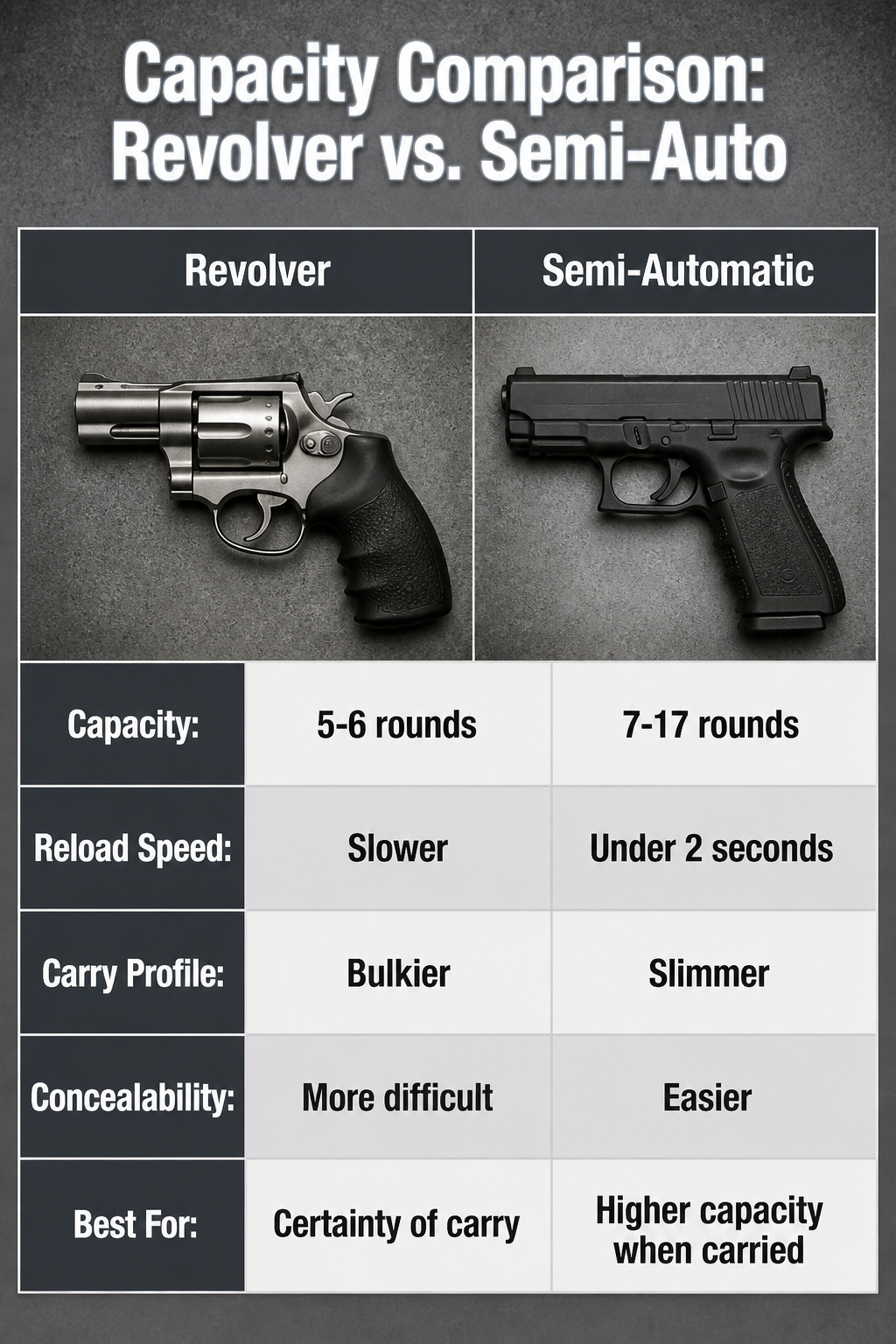
Most revolvers in common carry calibers hold five to six rounds in the cylinder, though small-caliber .22 models can stretch to eight or even twelve. Semi-automatic pistols start around five or six rounds in the smallest large-caliber models and run up to fifteen or twenty in a full-size magazine, with most compact concealed-carry options falling in the 7–17 round range.
That gap sounds dramatic, and for some carriers it matters a lot. A higher count means more chances to solve a problem before reloading becomes the bottleneck. But the cylinder’s width costs concealability, and the trade is not always what it first appears. The slimmer semi-auto profile that hides better against the body also happens to pack those extra rounds into a flatter package.
What convinced me, reading through the comparisons, is that capacity matters most when it is paired with how likely you are to actually carry the gun daily. A fifteen-round pistol left at home because it prints through your shirt does not beat a five-round revolver actually on your hip. The revolver’s lower count becomes a real limit if multiple threats appear or shots miss under stress, yet most defensive gun uses end within a handful of rounds. Two ways to play this: carry the higher-capacity semi-auto that conceals well enough for your body and wardrobe, or accept the revolver’s limit and build your decision around the certainty that it will be there when you reach for it.
Reload Speed

A fresh magazine drops into a semi-automatic in under two seconds once the motion is drilled, and shaving that to under one second is not some competition-only trick. The sources put it at a few hours of practice to get there, which squares with what most classes actually look like: by round count fifty or so, the fumble is gone and the reload is automatic.
Revolvers ask more. The cylinder has to swing out, the empties have to clear, and even with moon clips or speed strips the rounds feed one cluster at a time rather than in a single push. Only the most practiced wheelgun shooters match a semi-auto shooter of moderate skill, and that gap matters in training scenarios where the timer does not care about tradition. The semi-auto’s edge is not just the raw seconds; it is the forgiveness of a simpler motion under stress, when fine motor control is the first thing to go.
Two seconds versus four or five is the practical spread, and in a defensive class that difference shows up on every scored run.
Ease of Use

A first-time shooter picking up a revolver has maybe three things to figure out: swing the cylinder open, load rounds, thumb the hammer or pull the trigger. No slide to rack, no magazine release, no failure drill to memorize. That simplicity is why wheelguns still get recommended for beginners, and the long, smooth double-action trigger pull sits around 10 pounds, which acts as its own safety mechanism. The hammer can be cocked for single-action mode, dropping that pull closer to 5 pounds, though the double-action stroke is what you want to master first.
Semi-automatics ask more of you upfront. Slide releases, magazine catches, manual safeties on some models, plus the mental map of what to do when the gun goes click instead of bang. The learning curve is steeper. Once that familiarity sets in, though, the semi-auto tends to fit the hand more naturally and comes back on target faster between shots. Experienced shooters usually find it easier to shoot accurately. Novices can get confounded by that heavy double-action revolver pull, where the semi-auto’s trigger action is generally simpler to learn.
Under stress, fewer controls can mean fewer things to forget. But the controls you do learn well become automatic either way. The real divide is what kind of learner you are: someone who wants to be competent this afternoon, or someone willing to put in weekends to reach something smoother on the far side.
Maintenance

Cleaning a revolver takes about five minutes. Pop the cylinder open, run a patch through the barrel, wipe down the exposed surfaces, and the work is done. No small parts scatter across the table, no recoil spring fights you, no magazine needs attention. For someone carrying daily, that simplicity matters on a Tuesday night when you remember the gun is still wearing Saturday’s lint.
Semi-automatics break down further. Even a basic striker-fired model separates into frame, slide, barrel, and recoil spring at minimum. A 1911 can disassemble into more than fifty parts. Magazines carry their own maintenance burden: springs stay compressed when loaded, and over months or years they can lose temper and cause feeding failures. Revolvers avoid this entirely. No springs sit under tension. Leave one in a drawer for a decade, and it fires the same as the day you set it down.
The tradeoff shows up in how often you actually clean. A semi-auto carried daily collects debris in its slide rails and magazine well. Skip a cleaning, and you are betting the mechanism stays clear. A revolver forgives more neglect, though the cylinder gap and larger openings do let in more dirt than a hammerless semi-auto’s tight tolerances. For the person who wants a gun that works with minimal fuss, the revolver’s edge in upkeep is real and lasting.
Weight and Carry Comfort

Nine ounces does not sound like much until you pin it to your hip for fourteen hours. The average revolver weighs in at 31.7 ounces, while the typical semi-auto runs closer to 22.5. That gap matters by lunch. A heavier gun drags on the waistband, demands a stiffer belt, and works its way into your lower back when you sit.
The cylinder is the culprit. Revolvers carry that bulk out to the sides, which spreads pressure across a wider footprint inside the waistband but also prints more obviously under a light shirt. Semi-autos sit flatter, slide closer to the body, and let you get away with a softer holster and lighter clips. For summer carry under a tucked polo, the slimmer profile wins most days.
Holster choice splits along the same line. A revolver’s weight wants a pancake-style rig with wide loops to distribute load; a minimalist kydex shell on a single clip starts to feel like a mistake by mid-afternoon. Clothing follows: the revolver carrier often needs a size up in pants, not for the barrel but for the cylinder width and the rig required to hold it. The semi-auto carrier can sometimes skip that step.
Recoil and Shooting Feel

The slide on a semi-automatic pistol soaks up a chunk of the energy that would otherwise hit your hand. That mechanical absorption makes follow-up shots flatter and, for most people, less punishing over a long practice session. The tradeoff is the racking motion needed to chamber that first round, which can feel stiff or awkward if grip strength is limited.
Revolvers, especially the lightweight snub-nosed models often chosen for concealed carry, send more of the recoil straight into the palm. There is no slide to buffer the kick. A compact .38 Special in an aluminum or polymer frame can snap hard enough to loosen a new shooter’s grip and slow practice to a crawl. Less practice means slower skill building, and flinching becomes a real risk.
Experienced shooters generally find semi-autos easier to shoot well, while the double-action trigger pull of a revolver can frustrate novices trying to learn precision. If the gun beats your hand and the trigger confounds your press, the range bag stays home. That matters more than any spec sheet.
Customization Options

Semi-automatics pull ahead fast once you start looking at what can be changed. Grips, sights, weapon-mounted lights, lasers, rail accessories, ported barrels, milled slides for optics: the aftermarket is deep enough that you can rebuild the same pistol five times over without repeating a combination. Revolvers stay closer to factory form. Grips, sights, maybe a trigger job or engraving, and you have mostly exhausted the catalog.
For concealed carry specifically, that gap matters less than it looks. A light and night sights help in a defensive situation; everything else is range jewelry. The revolver shooter who practices with stock sights and learns the double-action trigger gets more value than the semi-auto owner who spent the budget on a custom slide but skipped the ammo. The semi-auto still wins on raw flexibility, and the slim single-stack models designed for concealed carry often accept the same upgrades as their full-size cousins. The difference is that a revolver forces you to live with what you bought, while a semi-auto invites you to tinker. That invitation can improve your draw or just empty your wallet.
The 333 Rule and What It Means for Your Choice

The 333 rule says most defensive shootings happen at 3 yards, with 3 shots fired, in under 3 seconds. That number gets passed around in training circles as a shorthand for how fast and ugly these things actually are.
At that distance and speed, a revolver’s simplicity starts looking like a real advantage. There is no slide to rack, no safety to remember, and a misfire means pulling the trigger again rather than clearing a jam under adrenal stress. The five or six rounds in the cylinder line up pretty well with the statistical reality that three shots usually ends the fight.
But statistics describe averages, not guarantees. Multiple assailants exist, and accuracy under pressure drops hard; the rounds you need might exceed the average. Semi-automatics carry 7 to 17 rounds depending on model, and that capacity functions as insurance against the encounter that does not follow the pattern. Some carriers look at the 333 data and choose the revolver’s point-and-click reliability. Others look at the same number and figure the spare magazine in their pocket costs nothing extra for the outlier scenario.
Revolvers and Semi-Autos at a Glance

Choosing between a semi auto or revolver for concealed carry comes down to which compromises you can live with. The table below lays out the hard numbers and trade-offs that matter most in a defensive situation.
| Attribute | Revolver | Semi-Automatic |
|---|---|---|
| Capacity | 5–6 rounds | 7–17 rounds |
| Reload Speed | Slower; speed strips or moon clips help | Under 2 seconds with practice; under 1 second achievable |
| Reliability | Fewer moving parts, less chance of malfunction | More complex, potential to jam |
| Ease of Use | Point and shoot; fewer controls | More controls and manipulation required |
| Maintenance | Quick cleaning; open cylinder, clean exposed surfaces | Disassembles into 4+ parts; some models 50+ parts |
| Carry Profile | Bulkier cylinder; snub-nosed models available | Slimmer profiles designed for concealment |
| Customization | Fewer accessory options | Lights, lasers, sights widely available |
Revolvers win on mechanical simplicity and minimal maintenance, which matters when you want a gun that just fires every time the trigger moves. Semi-autos win on speed and volume: more rounds, faster reloads, and better concealment in a slimmer package.
Frequently Asked Questions
What is the main difference between a revolver and a semi-auto?
A revolver uses a rotating cylinder to hold ammunition and mechanically align each round for firing. A semi-automatic uses slide movement and recoil spring tension to chamber the next round automatically after firing.
Are revolvers more reliable than semi-autos?
Revolvers are generally considered more reliable because of their mechanical simplicity. Fewer moving parts means fewer points where something can go wrong, and a misfire only requires pulling the trigger again to advance to the next round. Modern semi-autos have closed much of that gap through improved feed ramps, extractor geometry, and magazine design.
How many rounds does a revolver hold?
Most revolvers in common carry calibers hold five to six rounds in the cylinder. Small-caliber .22 models can stretch to eight or even twelve rounds.
How many rounds does a semi-auto hold?
Semi-automatic pistols start around five or six rounds in the smallest large-caliber models and run up to fifteen or twenty in a full-size magazine. Most compact concealed-carry options fall in the 7–17 round range.
Which handgun is easier to maintain?
Revolvers are easier to maintain because they have fewer parts and do not rely on magazines. Cleaning takes about five minutes: pop the cylinder open, run a patch through the barrel, and wipe down exposed surfaces. Semi-automatics break down further into frame, slide, barrel, and recoil spring at minimum, and magazines carry their own maintenance burden with springs that can lose temper over time.