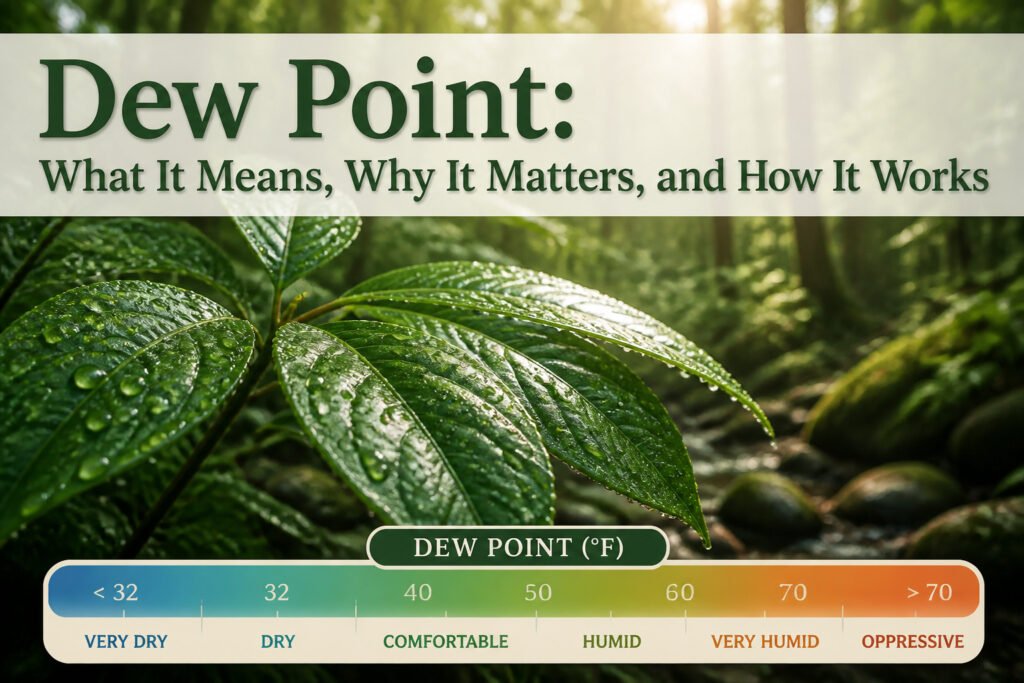
The dew point is the temperature at which air becomes saturated with water vapor and condensation begins. Unlike relative humidity, it does not shift when the thermometer moves, which makes it the honest number for judging how sticky the air actually feels. A summer afternoon at 75°F with 50% relative humidity can carry the same dew point as 85°F at 30%, even though the two percentage readings look nothing alike.
What Dew Point Means
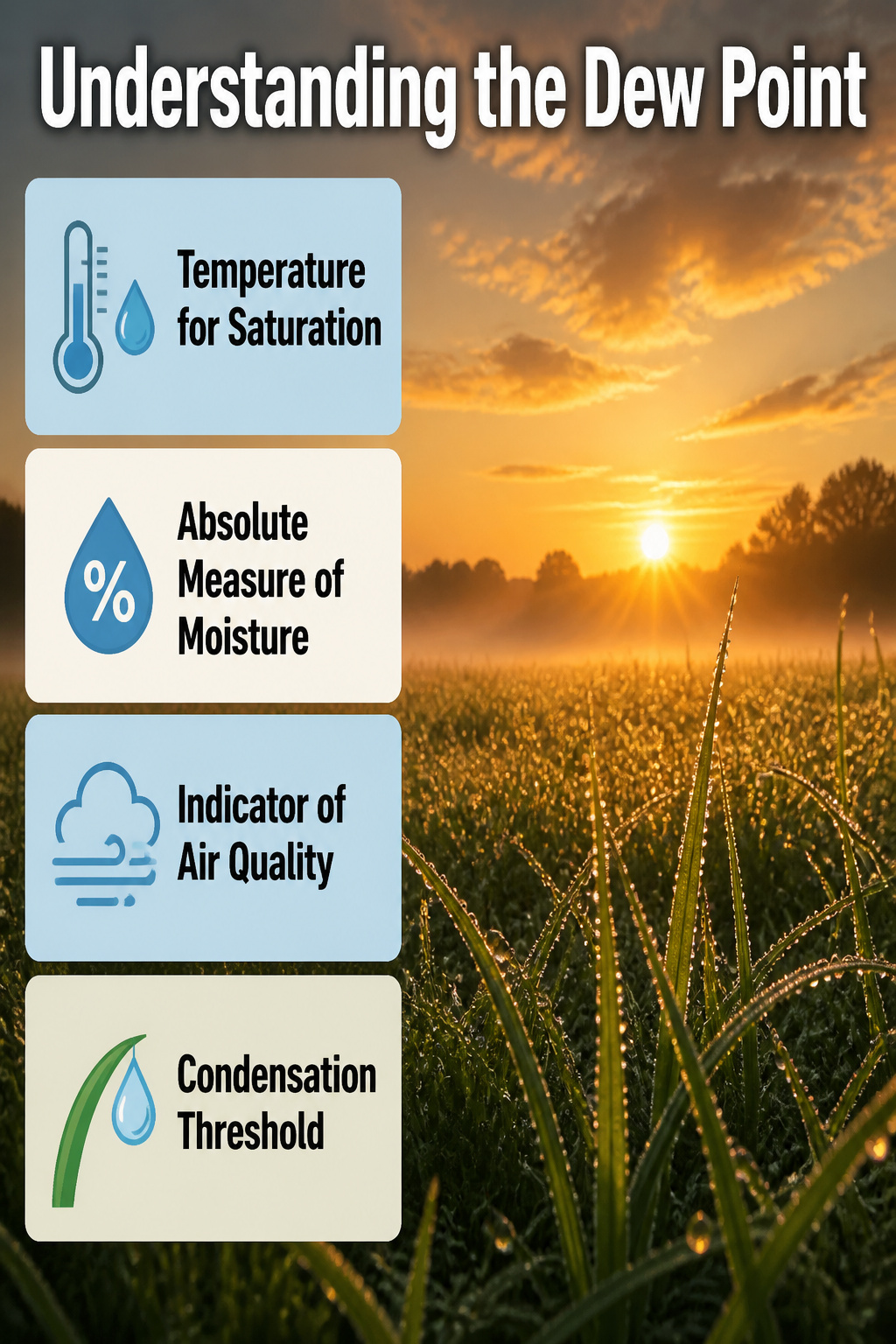
The dew point is the temperature at which air becomes saturated with water vapor and condensation begins. Unlike relative humidity, which shifts with the temperature, the dew point is an absolute measure of how much moisture is actually in the atmosphere. A higher dew point means more water vapor hanging in the air, period.
Saturation is the key idea here. Warm air can hold more water vapor than cold air, but the dew point tells you the ceiling for the current conditions. When air cools to that specific temperature, the water vapor has nowhere else to go; it condenses into liquid droplets. That is when you see fog forming, or dew collecting on grass, or that film of moisture on a cold beer can pulled from the cooler.
The closer the dew point gets to the actual air temperature, the closer the air is to giving up its moisture as condensation. Once the two numbers match, the air is fully saturated. Cooling past that point does not make the air "more saturated"; it simply forces more vapor to condense out.
Why Dew Point Beats Relative Humidity

Relative humidity tricks people because it shifts with the thermometer while the actual moisture in the air stays put. The dew point does not move when temperature does, which makes it the honest number.
A summer afternoon at 75°F with 50% relative humidity can carry the same dew point as 85°F at 30%. The air holds identical water vapor both times; your skin and lungs register the same stickiness, yet the two relative-humidity readings look nothing alike. Someone glancing only at percentage would misread the second day as drier.
The worst confusion hits indoors. If you ventilate a house by comparing outside and inside relative humidity, you will get it wrong half the time. Air warms as it enters, so its relative humidity drops even though the dew point, and the actual moisture load, rose. The right comparison is dew point to dew point; anything else is guessing with a number that changes under your feet.
Dew Point and Frost Point
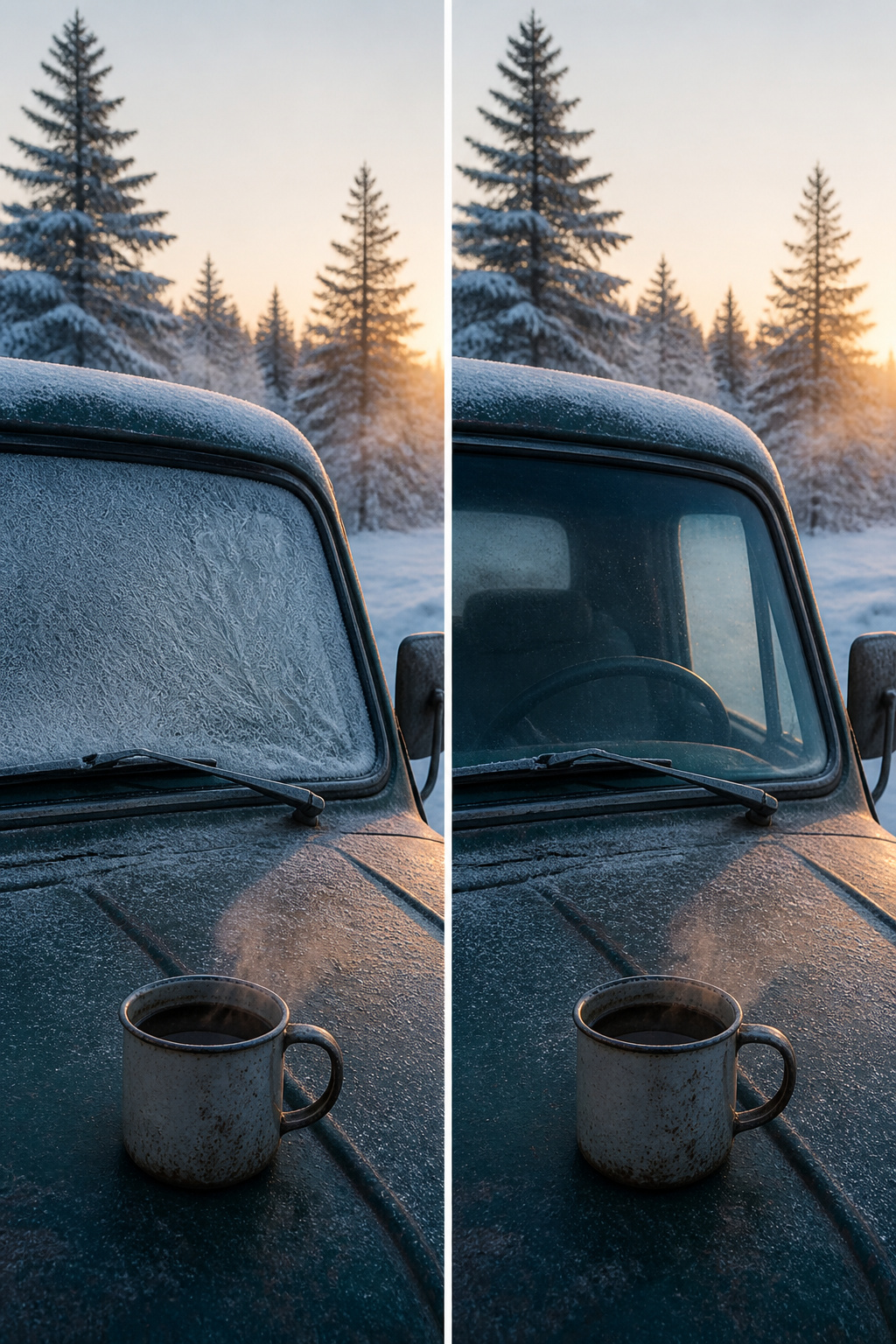
Water vapor can condense into liquid, or it can skip straight to ice. The dew point marks the temperature where vapor becomes liquid dew; the frost point is the slightly higher temperature where vapor deposits as ice crystals without ever passing through a liquid phase. That distinction matters whenever the surface in question sits below freezing.
I learned this the hard way one January morning after assuming the forecast dew point would tell me whether my truck windshield would be merely wet or frozen solid. The air was 28 °F, the dew point 24 °F, and my glass read 22 °F. By the textbook I should have seen dew. Instead I scraped frost, because the glass was cold enough for deposition, not condensation. The frost point, not the dew point, had been the number to watch.
Below 0 °C, surfaces can drop to a temperature where vapor turns directly to ice. The frost point runs higher than the dew point for the same parcel of air because the molecular bonds on an ice surface demand more energy to break than those on supercooled liquid water. In practical terms, a surface near or below freezing can frost over before the air has cooled to its dew point. Checking dew point alone in winter risks the same surprise I met: expecting moisture, finding ice instead.
What Changes the Dew Point
Three things move the dew point, and only one of them is the dew point itself.
Water vapor content is the direct driver. The dew point is essentially a reading of how much moisture is actually in the air. More water molecules in the mix means less cooling is needed before saturation, so the dew point climbs. Dry air, like what comes out of a desiccant dryer, has to be chilled far lower before anything condenses. That is why a summer afternoon at 86 °F with 90% relative humidity carries a dew point near 73 °F, while the same temperature at 10% relative humidity drops the dew point to about 34 °F.
Temperature does not change the dew point directly, but it changes how close you are to hitting it. Warm air expands the bucket; cool air shrinks it. The moisture stays the same, so a falling thermometer brings you nearer saturation even though the dew point number itself sits still. This is why a clear evening can end in fog: the surface cools, the gap closes, condensation begins.
Pressure matters too, especially in compressed-air systems. Squeeze the same water vapor into a smaller volume and the molecules crowd closer. Air at a dew point of –4 °F at ordinary pressure, compressed to roughly 100 psi, can jump to a dew point of 50 °F. The pipeline sees water it never had before. I have watched this surprise people who sized dryers for inlet conditions and forgot what happens downstream.
Dew Point and How It Feels Outside

A dew point below 55°F feels dry and comfortable. That threshold is where most people stop noticing the air at all. Between 55°F and 65°F, the stickiness sets in; evenings feel muggy, sheets cling, and a walk to the mailbox leaves you damp. Above 65°F, the air turns oppressive. Sweat stops working the way it should, because evaporation slows when the gap between air temperature and dew point shrinks. At 70°F or higher, the body struggles to cool itself, and heat advisories often follow for those sensitive to it.
The difference between dry heat and this is not subtle. A 95°F afternoon in Phoenix with a dew point in the 40s feels nothing like 85°F in Houston with the dew point parked at 75°F. One lets you breathe; the other wraps around you like a wet blanket.
OSHA recommends keeping indoor relative humidity between 20% and 60% at temperatures of 68–76°F. That range lines up with a dew point somewhere in the mid-50s, which explains why air-conditioned spaces feel livable even when the outside air does not. Your own threshold shifts some with where you have lived. Someone acclimated to Singapore or Miami tolerates higher dew points than a person coming from a dry climate like Riyadh or a temperate one like London. Most people from temperate zones start feeling uncomfortable above 59°F, and nearly everyone finds 70°F oppressive regardless of origin.
How Dew Point Gets Measured

A chilled mirror sensor cools a polished metal surface until condensation forms, detected photoelectrically when reflected light dims. This direct method hits precision within ±0.1 °C for lab-grade units, ±0.5 °C for most field models, and serves as the calibration standard other sensors get checked against.
The classic psychrometer pairs two thermometers: one dry, one wrapped in wet wick. Evaporation pulls heat from the wet bulb, and the gap between readings translates to dew point through charts or built-in calculation. Sling psychrometers still show up in HVAC work where battery-free reliability matters.
Capacitive sensors dominate home weather stations and building controls. A thin polymer film shifts electrical properties with humidity, and onboard chips convert that to dew point without any moving parts or chilled surfaces to maintain.
Industrial gas drying and semiconductor clean rooms lean on chilled mirror units for trace moisture measurement. The mirror can use semiconductor cooling, liquid nitrogen, or high-pressure air depending on how low the dew point runs. For most of us checking a backyard station or a humidifier’s output, capacitive is good enough; when a manufacturing process stakes thousands on exact moisture levels, the mirror wins.
Reading the Sky With Dew Point

A clear evening in late October, temperature dropping toward 40°F, and the dew point sitting at 38°F: that two-degree spread tells you frost is likely by morning. The closer the air temperature gets to the dew point, the less room the atmosphere has to hold moisture invisible, and once they meet, condensation becomes inevitable. Dew on the grass, a filmy fog in the hollows, or a white crust of frost if the mercury slips below freezing: the dew point draws the line between each.
Pilots learn this early. Carburetor icing happens when moist air chills to the dew point inside the venturi, ice forms on the throttle plate, and power bleeds away without warning. Fog forms the same way, whole airfields going zero-zero when temperature and dew point marry within a degree or two. The National Weather Service uses that spread to forecast ceiling heights: a tight gap means low clouds or fog, a wide one promises clear skies. Last winter I watched a forecast flip from rain to snow when the incoming air mass showed a dew point of 20°F against a surface temperature of 36°F; the column had to cool twenty degrees before precipitation could form, and by then snow was the only option.
Dew Point Numbers for Daily Life

Living in a place with real seasons, you notice the dew point even when you do not check it. A morning at 50°F feels crisp and open; the same afternoon at 67°F leaves you sweating through a light shirt.
Here is how the numbers land in practice:
| Dew Point | How It Feels | What to Expect |
|---|---|---|
| Below 55°F | Comfortable | Dry air, easy breathing, sweat evaporates quickly |
| 55–60°F | Noticeable | Slight humidity, still manageable for most |
| 60–65°F | Humid | Sticky, especially with any exertion |
| 65–70°F | Oppressive | Heavy air, sweating less effective |
| Above 70°F | Miserable | Dangerous for prolonged activity, heat advisories common |
Your own threshold shifts with what you are used to. Someone from Miami handles 65°F differently than someone from Phoenix.
The extremes are worth knowing. The highest recorded dew point on Earth hit 95°F in Dhahran, Saudi Arabia; at that level, the human body can barely cool itself. On the other end, compressed air systems run far drier than anything outdoors. A basic compressor without drying delivers air saturated at ambient temperature. Add a refrigerant dryer and you get down to about 41°F. Industrial desiccant systems push to –40°F, and specialized cases reach –112°F for processes that cannot tolerate any moisture at all.
Frequently Asked Questions
What is dew point?
The dew point is the temperature at which air becomes saturated with water vapor and condensation begins. It is an absolute measure of how much moisture is actually in the atmosphere, unlike relative humidity, which changes with temperature. When air cools to the dew point, water vapor condenses into liquid droplets, forming fog, dew, or moisture on cold surfaces.
How does dew point affect comfort?
A dew point below 55°F feels dry and comfortable, while readings between 55°F and 65°F bring noticeable stickiness. Above 65°F the air turns oppressive because sweat evaporates more slowly, and at 70°F or higher the body struggles to cool itself, often triggering heat advisories. Someone from a humid climate like Miami tolerates higher dew points better than someone from a dry climate like Phoenix.
What is the difference between dew point and humidity?
Relative humidity shifts with temperature even when the actual moisture in the air stays the same, which makes it misleading. The dew point does not move when temperature changes, so it gives an honest reading of how much water vapor is present. Two days with very different relative humidity percentages can feel identical if they share the same dew point.