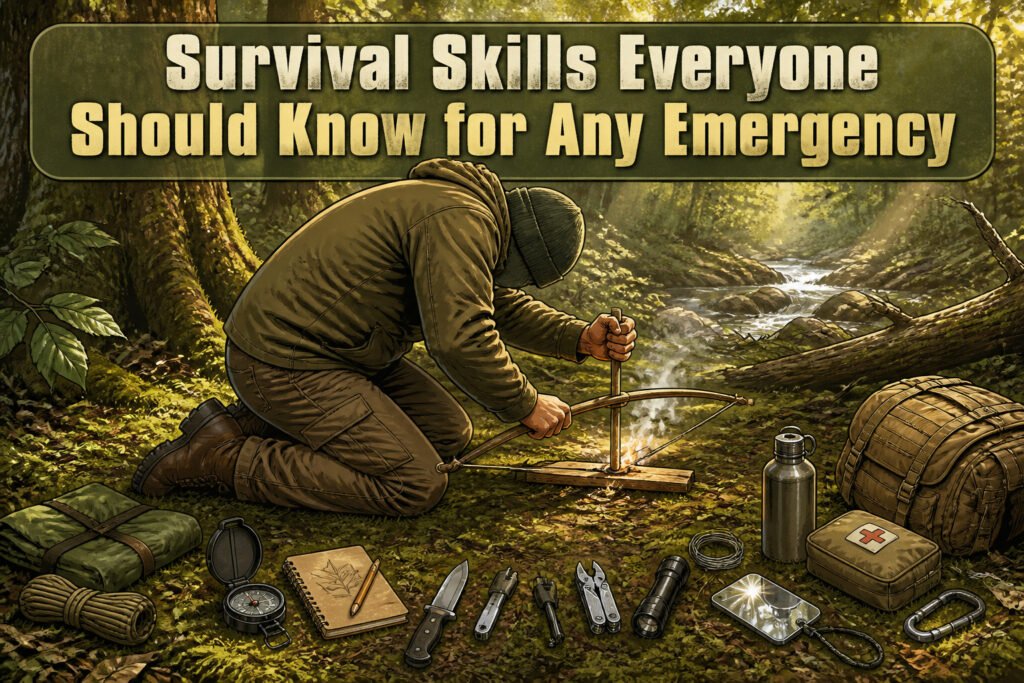
Survival skills span from lighting a fire with a ferro rod to signaling a plane with a mirror flash, but the one that decides your outcome is the skill you practiced before the emergency began. The bow drill I smothered in damp Virginia woods taught me that adrenaline makes your hands stupid; the time to learn is not when you are cold and wet.
1. Fire Making
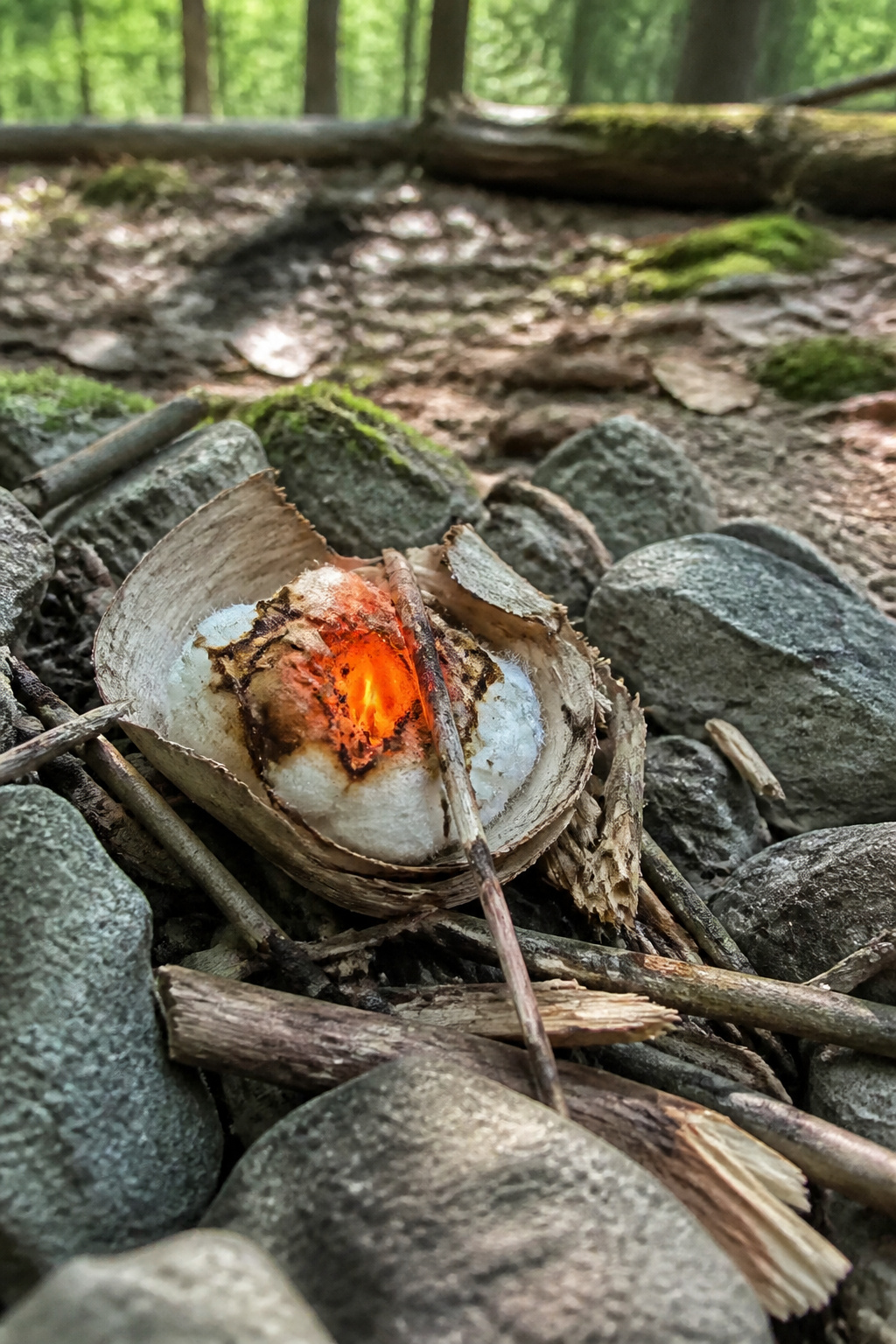
A fire that dies in a gust teaches more than any video. Three years back, I spent forty minutes with a bow drill in damp Virginia woods and produced one coal, which I then smothered by pressing too hard. The tinder bundle sat there, indifferent. Friction fire demands practice until the motion is automatic, because adrenaline makes your hands stupid.
Carry a ferro rod and a waterproof container of dry tinder, not one or the other. Cotton balls in petroleum jelly, char cloth, birch bark: these catch sparks that wet leaves won’t. The tinder starts it, pencil-thick kindling builds it, wrist-sized fuel sustains it. Skip a size and the flame starves.
Location matters as much as the spark itself. Mineral soil or rock, cleared of debris, with a windbreak that still lets air feed the flame. A fire ring of rocks contains it; without that containment, you’re gambling with wildfire.
Water purification ties directly in. A rolling boil for one minute kills pathogens at sea level; the fire you built is now your drinking water. That same flame dries soaked clothes hung close but not scorching, cooks food, signals rescuers with dense smoke from green vegetation added to the coals.
Primitive methods like bow drills or flint and steel are backup skills for when modern tools fail, not party tricks. The time to learn is not when you’re cold and wet.
2. Shelter Building

The Rule of Threes puts shelter at three hours without regulated body temperature, and that number has a way of shrinking fast when the wind picks up. Rain or wet snow pulls heat from the body twenty-five times faster than still air, which is why a garbage bag and some paracord beats a pile of sticks every time until you know what you’re doing.
I spent one October night under a lean-to that looked solid enough at dusk. By midnight the backdraft had pulled every degree of warmth out through the open face, and the ridge pole sagged until wet leaves dumped cold water down my neck. The debris hut I built the next evening, packed hip-deep with dry grasses and sealed at the entrance, kept me comfortable through a frost that hit twenty-eight degrees. Ground insulation matters as much as overhead cover. Rocks ringed around a small fire will store and radiate heat back into the shelter, but only if the frame is tight enough to hold that warmth.
Location kills more shelters than design. A site that looks sheltered at noon becomes a drainage channel by two in the morning, or sits under dead branches the wind takes down. Practice the three builds that cover most emergencies: a 55-gallon drum liner as emergency rain gear and groundsheet, a tarp in A-frame or lean-to configuration with proper knots, and a debris hut from whatever the site offers. Each has failed me at least once. The garbage bag ripped on a spruce stub I did not see. The tarp flapped until I learned to anchor the ridge line before anything else. The debris hut took two hours and left me shaking until I got faster at gathering. Speed comes from repetition, not from watching someone else do it once on video.
3. Water Purification

Finding water solves nothing if it kills you three days later. The rule of threes says most people have about three days without water before dehydration finishes what thirst started, which sounds generous until you are crouched over a stream that looks clear as glass.
That clarity almost cost me a week. Water from a mountain stream in western Montana, cold and running fast, went down easy. Two days later the cramping started. Never confirmed giardia, but the timing and the symptoms matched what the pamphlets warn about, and I have treated every wild source as guilty ever since.
Boiling remains the fallback when gear runs out. One full minute at a rolling boil handles the pathogens, though altitude pushes that number up because water boils cooler the higher you climb. A bandana or t-shirt strains out the grit and the visible junk before it hits the pot. Chemical tablets and portable filters handle the same job when fire is not an option, and in a real pinch a solar still built from a hole, a container, and any sheet of plastic will pull moisture from soil or green vegetation. Slow, yes, but it beats the alternative.
4. Navigation

A paper map and compass belong in every kit, full stop. Batteries die, screens crack, and a 40-foot contour interval on a topo map still tells you whether that ridge ahead is a gentle climb or a wall. I learned this the hard way in the Adirondacks a few years back, where a dead phone left me staring at identical-looking hardwood ridges. The compass bearing that got me out was roughly 270 degrees west, aimed at a stream valley I knew fed into a marked trail. Without that fixed direction, I would have walked in circles; the forest there is dense enough that every gap in the trees looks like a possible path.
Natural signs fill the gaps when tools fail or you need to confirm them. The sun’s arc gives east and west at rise and set, and Polaris still marks north once the sky darkens. In that same trip, moss on tree trunks pointed nowhere useful; the slope’s moisture shadow mattered more than any hemisphere rule. Terrain association proved faster than compass work in open country: ridgelines, valley bends, and water flow all read as plainly as printed symbols once you stop to look. Dead reckoning, counting paces on a known bearing, kept me straight through a fogged-in section where landmarks vanished entirely.
The mistake most people make is starting to move before orienting. Stop first. Match the map to the ground, set your bearing, pick a distant marker, then walk. Panic burns calories and twists ankles; deliberate steps, even slow ones, cover more ground than rushed corrections.
5. First Aid

A sterile gauze pad and a pair of hands willing to hold pressure will do more for a bleeding wound than most of what passes for a first aid kit. The ones stacked on pharmacy shelves lean heavy on adhesive strips and hope, light on the materials that matter when help is hours away. What are survival skills if not the ability to bridge that gap?
My own kit lives in a dry bag in my truck: gauze pads in two sizes, roller bandages, antiseptic wipes, antibiotic ointment, tweezers, scissors, safety pins, pain relief, antihistamines, a triangular bandage for slings, and a thermal blanket I have unwrapped exactly once. That was two winters back, when a friend sliced open his palm splitting firewood at a camp we reached by snowmobile. The gauze went on first, direct pressure for ten minutes while he sat on a stump and I tried not to look at how much blood darkened the snow. The thermal blanket came out after, not for shock but because the temperature was dropping and his hands had gone cold from the blood loss and the stillness. We had him warm and the bleeding controlled before the light failed.
The wipe came later, when we had time to lift the pad and clean the wound properly. Antiseptic on a dirty cut beats infection by days; infection in a backcountry setting turns a manageable injury into an evacuation. I keep the kit stocked by replacing what I use immediately, which means the scissors and safety pins have stayed put for years while the gauze and wipes turn over regularly.
6. Foraging for Food

The first plant I ever learned to identify with any confidence was dandelion. Not the flower, which everyone recognizes, but the basal rosette of leaves hugging the ground in early spring, the hollow stem, the way the leaves run jagged back toward the center. A local forager walked me through it in a park near my house, and the lesson stuck because she made me verify three separate plants against a field guide before either of us would call it certain.
That verification step matters more than most beginners expect. Many poisonous plants closely resemble edible ones, and mistakes prove fatal. The sources I trust now all say the same thing: focus on learning 5 to 10 common edible plants in your region thoroughly, rather than attempting to memorize hundreds. Understand their seasonal availability, growth patterns, and any toxic look-alikes.
For dandelion, that means knowing the greens turn bitter after flowering, that the root can be roasted, and that false dandelion exists but lacks the hollow stem and the single flower per hollow stalk. It also means never eating anything from a lawn treated with chemicals.
If you are inexperienced, avoid fungi and mushrooms entirely. Many species are deadly, and even experienced foragers misidentify them. Start with plants that grow rampantly and have no dangerous near-twin in your area. Build from there, one verified species at a time.
7. Signaling for Help

A signal mirror is the most reliable daylight tool for catching a search aircraft, and the flash can carry for miles if the sun cooperates. The trick is aiming: you need to see the reflection hit your hand first, then guide it toward the target. I carried a glass mirror on a Colorado trip and practiced until I could hit a ridgeline three miles off, though in real use the glare made my eyes water enough that I switched to a polycarbonate backup. Three flashes in a row marks distress, same as three whistle blasts or three fires spaced about 100 metres apart in a triangle.
Smoke works when the sun does not. Green vegetation thrown on a fire makes dark smoke against clear sky; dry material gives white smoke when it is overcast. I have never had to build the full three-fire triangle, but I banked a single smoky signal in open country and the column was visible from a road I could not see.
Sound carries its own problems. A whistle should travel farther than a voice, yet wind, ridgelines, and running water eat the sound. Mine failed once in a canyon where the walls seemed to swallow every blast; the group I was trying to reach never turned around. Now I pack a whistle and mirror together, and I test both before the trip starts.
8. Knot Tying

Three knots handle most cordage needs in the field. The bowline forms a fixed loop that won’t slip or bind under load, which makes it the go-to for rescue work or securing a load that absolutely cannot shift. The taut-line hitch lets you adjust tension and slide the knot along the rope, so guy lines and tent stakes stay tight even as ground softens or wind picks up. The clove hitch ties fast to posts or trees and comes undone just as quickly when morning breaks and you need to move.
Muscle memory matters more than variety. Cold fingers or darkness strips away careful thought, and a poorly tied knot collapses shelters or dumps gear at the worst moment. Practice until your hands know the shape without looking.
9. Mental Preparedness

Panic shuts down the rest of your kit. Three years back, I watched a buddy freeze at a trail junction when the map stopped matching the terrain. Ten minutes of standing still cost him daylight, body heat, and the confidence to trust his compass. The breath-plan-act rhythm pulled him out: one slow inhale, name the real problem out loud, pick the smallest next move.
That rhythm works because it interrupts the loop where fear disguises itself as planning. The sources call this falling to your level of training, not rising to occasion. In my reading, the ones who make it out treat fear as information, not command. They accept the situation fast, break the night into single hours, and build a small routine: check fire, gather wood, drink water, rest.
Without this, your shelter leaks while you stare at it. Your water sits unpurified while you cycle through what-ifs. The skills in the other sections are just inventory until your head assigns them a sequence. Calm is the sequence.
10. Self-Defense

The best self-defense skill has nothing to do with landing a punch. Years back, walking through a parking garage late at night, the sound of footsteps behind me picked up speed. My mistake was freezing, turning to look, making myself an easy mark. Nothing happened that time, but the memory stuck: awareness and distance beat reaction every time.
Now I scan exits and shadows without thinking about it. Crossing the street to avoid a group that feels off costs nothing. The few hours I spent in a basic course focused on breaking holds and creating space to run, not standing my ground. That framing changed how I think about it. Physical techniques matter, but the goal is always escape, not engagement.
What I practice now is simple. Keep phone and keys accessible, not buried in a bag. Notice who is around before I need to. Trust the feeling that something is wrong, even when I cannot name why. Most dangerous situations do not arrive as ambushes; they build from missed signals and pride about ignoring them.
Why Survival Skills Matter

The question "what are survival skills" usually brings to mind wilderness scenarios, but the 2005 London bombings showed how quickly urban environments demand the same mindset. Civilians trapped underground had to find exits through smoke, improvise first aid, and manage panic while systems failed around them. Those capacities translate directly to power outages, winter gridlock, or compromised homes.
Survival skills build self-reliance before emergencies arrive. The American Red Cross puts it plainly:
Survival skills are essential because they equip you with the knowledge and abilities to protect yourself and others in dangerous or unpredictable situations, ensuring safety, security, and confidence in facing adversity.
That confidence is the return on investment. A person who has practiced finding water, building shelter, or staying warm until help arrives does not waste decision-making bandwidth on panic. The same situational awareness that spots risks in backcountry terrain sharpens your read on an urban crowd or a failing infrastructure. These skills compress to everyday utility: assessing whether to stay home during a storm, helping a neighbor, keeping a vehicle kit current.
The Rule of Threes

Three minutes without air, three hours without shelter, three days without water, three weeks without food. That sequence is the Rule of Threes, and it is the first thing that goes through my head when I read about someone getting lost on a day hike that turns into an overnight ordeal. The numbers are not exact biology; they are a stress-tested guideline for what will actually kill you and in what order.
Air is obvious and immediate, so the practical application starts with shelter. Hypothermia in cold, wet conditions can set in well inside that three-hour window, which is why building even a crude debris hut or lean-to ranks above finding water in most scenarios. Water comes next because the body runs on it, and dehydration clouds judgment fast. Food sits at the bottom of the list, a morale booster more than a necessity in the short term, though hunger will make a person careless enough to eat the wrong berry or push too hard for rescue.
The ten skills in this article map directly onto that priority stack. Shelter building, fire making, and the clothing choices that regulate body temperature cover the three-hour threat. Water purification and sourcing address the three-day ceiling. Foraging and signaling for help become relevant once the first two are handled. Mental preparedness underpins all of it, because panic ignores the sequence and sends a person chasing calories when they should be conserving heat.
Skills You Already Use

Skills you already use in ordinary life are survival skills wearing different clothes. The bandaging technique from that kitchen knife slip last year is the same pressure-and-wrap you would use on a backcountry cut. Your phone’s GPS dies in a dead zone, and suddenly the sun-position and backtracking habits from city walks matter more than the app ever did.
Knot tying lives in the same category. A trucker’s hitch securing a couch to a roof rack is a shelter ridge line waiting for a different context. The bowline you learned for boat lines works for snares and rescue loops; the difference is only what you wrap it around.
First aid training pays off first in daily accidents, not wilderness drama. Car wrecks, burns from a grill flare-up, a child’s sprain on a playground. The fifteen minutes before professional help arrives are the same fifteen minutes whether you are five miles from a hospital or fifty.
Frequently Asked Questions
What are survival skills?
Survival skills are techniques that let you sustain yourself, protect against threats, and respond effectively in emergencies. They include fire making, shelter building, water purification, navigation, first aid, foraging, signaling, knot tying, mental preparedness, and self-defense. These same capacities apply whether you’re lost in wilderness or facing urban infrastructure failure.
How do you purify water in the wild?
Boil water for one full minute at a rolling boil to kill pathogens at sea level; add time at altitude where water boils cooler. If you have no fire, chemical tablets, portable filters, or a solar still built from a hole, container, and plastic sheet can all work. Strain out grit through cloth first so you’re not drinking mud.
What should be included in a survival kit?
A survival kit should hold a ferro rod and waterproof dry tinder, a paper map and compass, water purification supplies, first aid materials including gauze and roller bandages, a signal mirror and whistle, cordage for knots, and a 55-gallon drum liner that doubles as emergency rain gear and groundsheet. The article’s author keeps his first aid kit in a dry bag with antiseptic wipes, antibiotic ointment, tweezers, scissors, safety pins, pain relief, antihistamines, a triangular bandage, and a thermal blanket.