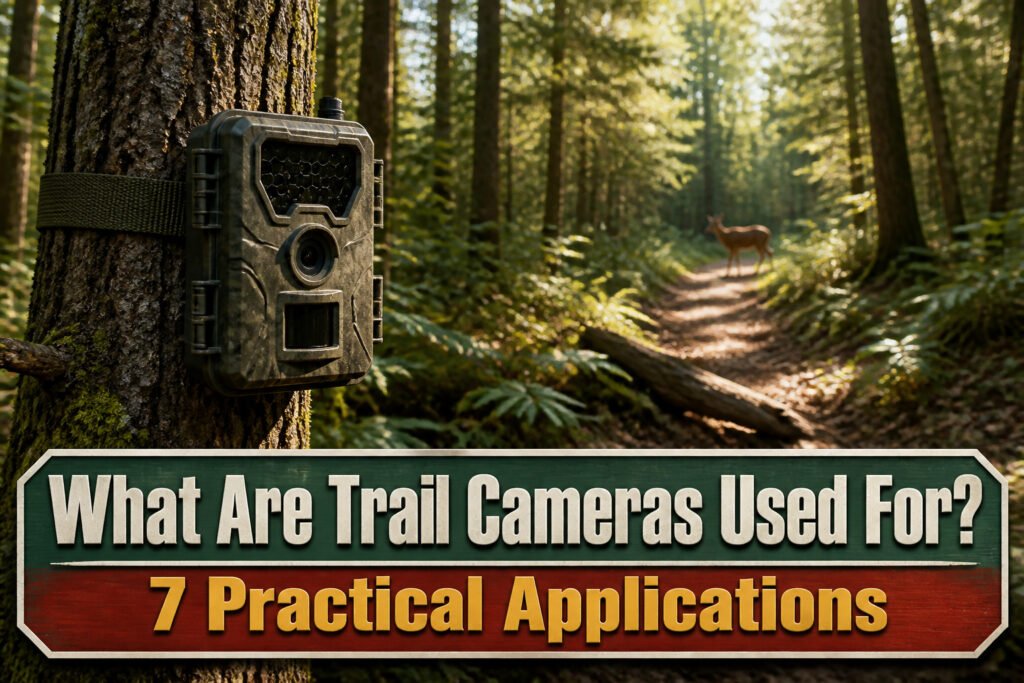
The seven practical trail camera uses all depend on whether you can afford to hike out for an SD card or need images sent to your phone in real time. Cellular models like the Moultrie Edge 4 skip the lag but add a subscription cost, and dead zones leave you pulling cards anyway. That single choice determines how researchers study wolverines in Wyoming, how a Vermont teacher runs a year-long middle school wildlife project, and whether a midnight gate alert reaches you before sunrise.
What Trail Cameras Are Used For
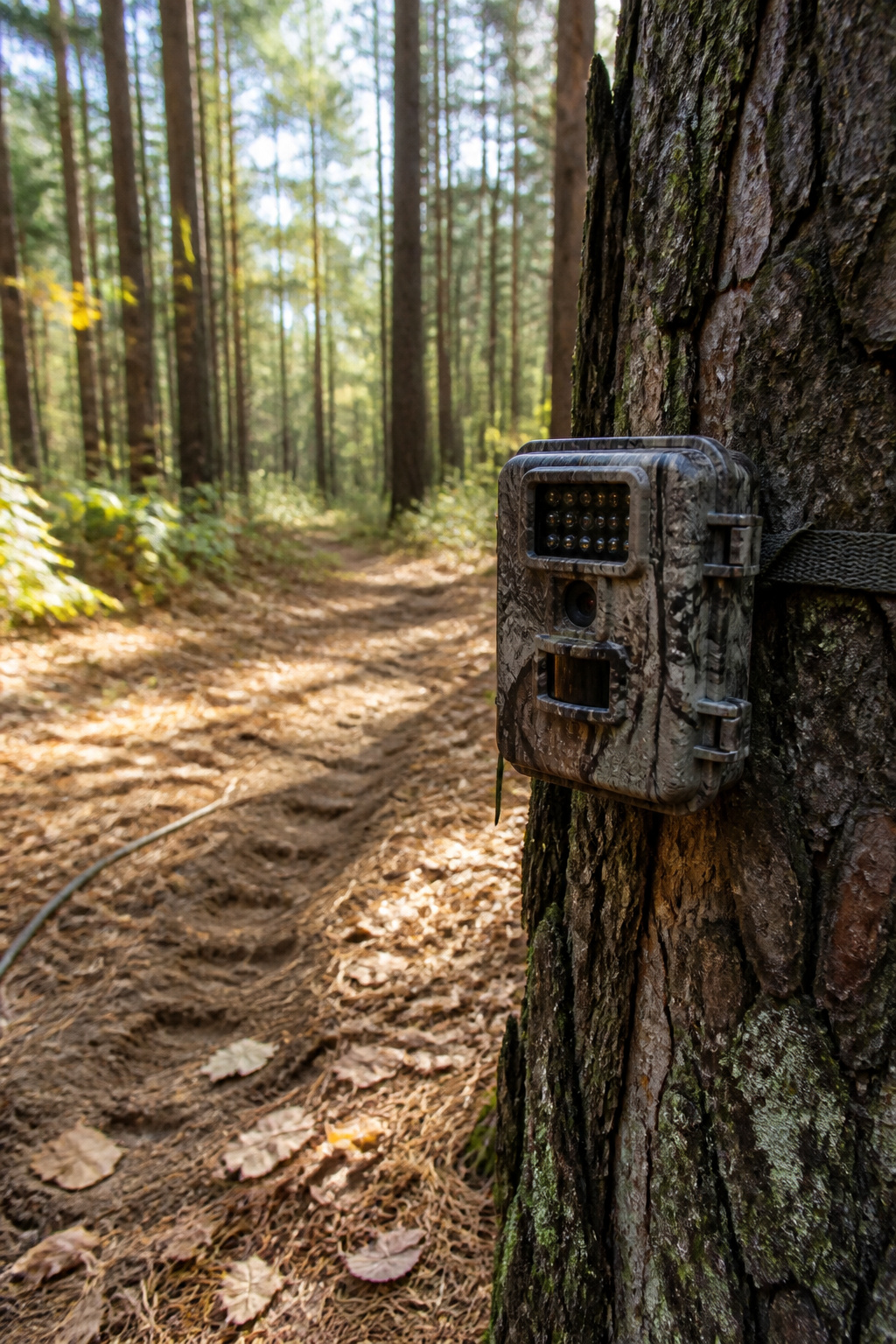
A trail camera is primarily a tool for monitoring wildlife without disturbing it and for sharpening hunting strategy with hard data on movement patterns. The full spread of trail camera uses runs wider than most people first assume.
Wildlife monitoring and hunting strategy sit at the center, but property owners have started using them for security in remote locations where running power lines costs too much or takes too long. Researchers and conservation groups rely on them for population counts and behavior studies that would be impossible to fund if every observation required a human observer sitting in a blind. Land managers use the footage to judge habitat health and plan timber cuts or food plots. Event monitoring covers everything from catching trespassers to documenting trail use on public land. Some nature centers and schools have begun working them into programs so students can see what moves through the woods after dark without the disruption of a class trip tromping through undergrowth.
Wildlife Monitoring

Passive Infrared Sensors, or PIR, make wildlife monitoring possible without you standing in the woods. The sensor reads temperature changes, not light, so a deer walking through at 3 a.m. trips the shutter the same as midday. That heat-detection motion sensing runs on battery power for weeks, and the infrared LED flash that follows fires in wavelengths animals mostly do not see. You get black-and-white night shots without spooking the subject.
Placement matters more than camera price. Food sources like ag fields or food plots draw predictable traffic. Travel routes, creek crossings, soft edges, and terrain funnels carry animals between those points. Bedding areas take patience but show you who lives there, not just who passes through.
Two seasons back I set a camera on a saddle between ridge thickets and a cut cornfield. The unit ran fourteen days on a single set of lithiums. It caught a bobcat at dawn, three does on a trail worn to bare dirt, and a red fox investigating the same stump three separate nights. None of them knew the camera was there. That is the point of the tool: presence without pressure.
Hunting Strategy

Deer do not move at random, and the cameras prove it. Running three units on a forty-acre plot last season, layer one at the oak flat, layer two on the main trail, layer three at the bedding edge, the pattern became clear over six weeks: the buck hit the oak flat at 6:47 AM, give or take eleven minutes, every third day. Only place cameras in layer three zones if you do so months before season opens, paired with an external battery, or you will push him onto the neighbor’s property before you ever sit a stand.
The layering paid off mid-October when the layer two camera caught the same buck using a secondary trail after a north wind shift. Without that middle camera, I would have sat the primary trail the next morning and watched empty woods. Instead, I moved to the pinch point between layer two and three, and the buck came through at 7:12 AM.
The data has a cost. Checking cards too often, especially on layer three, turns educated deer into nocturnal ghosts. I limit pulls to once every two weeks, and only when wind and timing let me enter without leaving scent on the approach path. The cameras that teach you the most are the ones placed where your presence teaches the deer even more.
Property Security
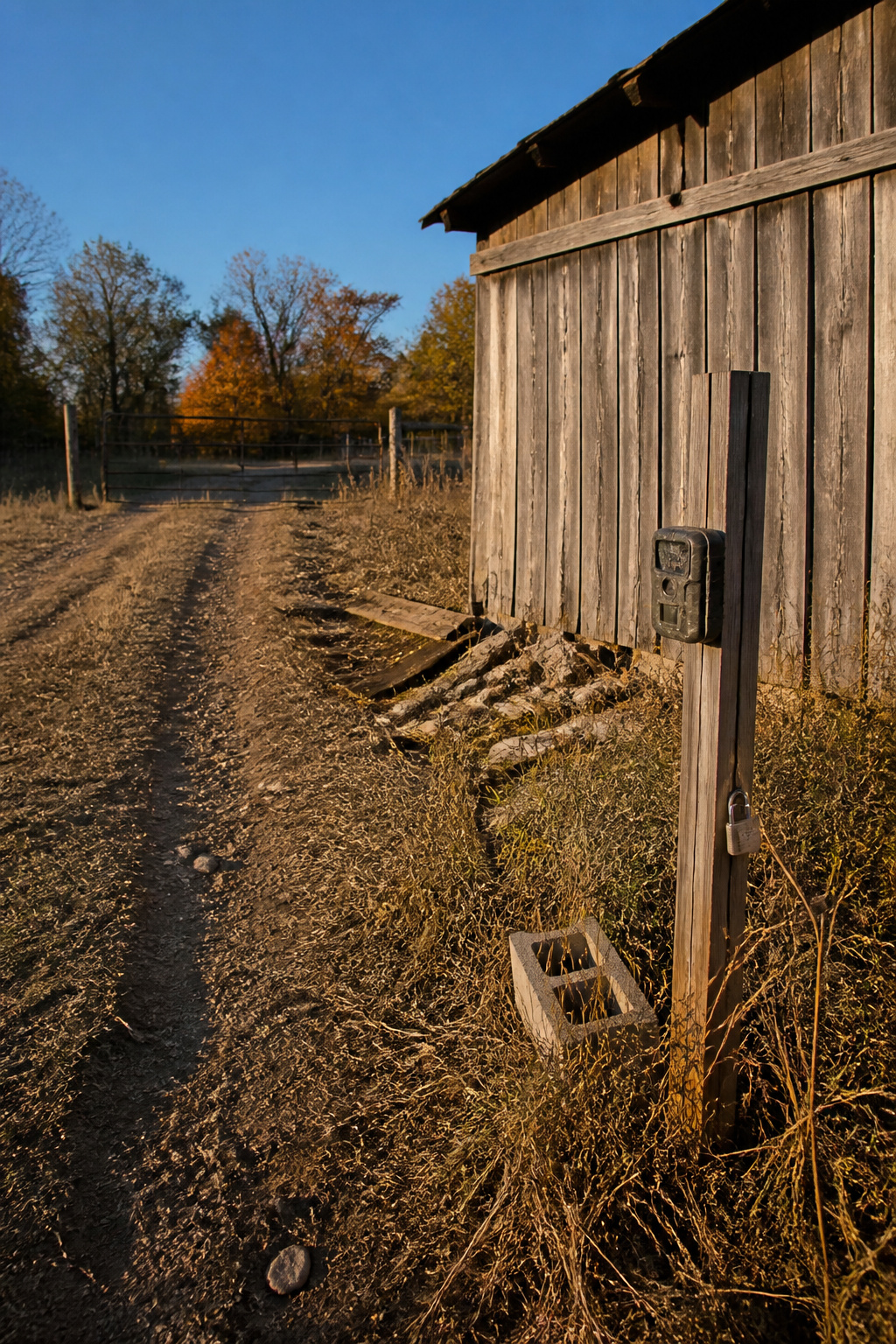
A trail camera aimed at a gate or outbuilding can catch what a fence alone will not. Traditional models store footage on an SD card; you find out about a break-in only after you make the drive and pull the card. Cellular models like the Moultrie Edge 4 skip that lag, sending photos and video straight to your phone over a 4G LTE network. That real-time awareness matters when a gate pops open at 2 a.m., but the service adds a monthly or annual subscription on top of the camera’s price, and dead zones leave you walking out to retrieve the card anyway.
Placement takes judgment. A camera facing a public path or a neighbor’s property line can record people who never set foot on your land. That footage may be legal to capture in many states, but it erodes trust and can violate wiretapping or surveillance statutes depending on audio and local law. My own rule is to angle the lens inward, toward the shed or the gate itself, not the road beyond. Last season a camera on my back field gate picked up tire tracks where none should have been; the timestamp showed midnight, and the cellular alert let me check the outbuilding before sunrise. Nothing was taken, but the lock had been jiggled. A card-only model would have told me that three days too late.
Research and Conservation
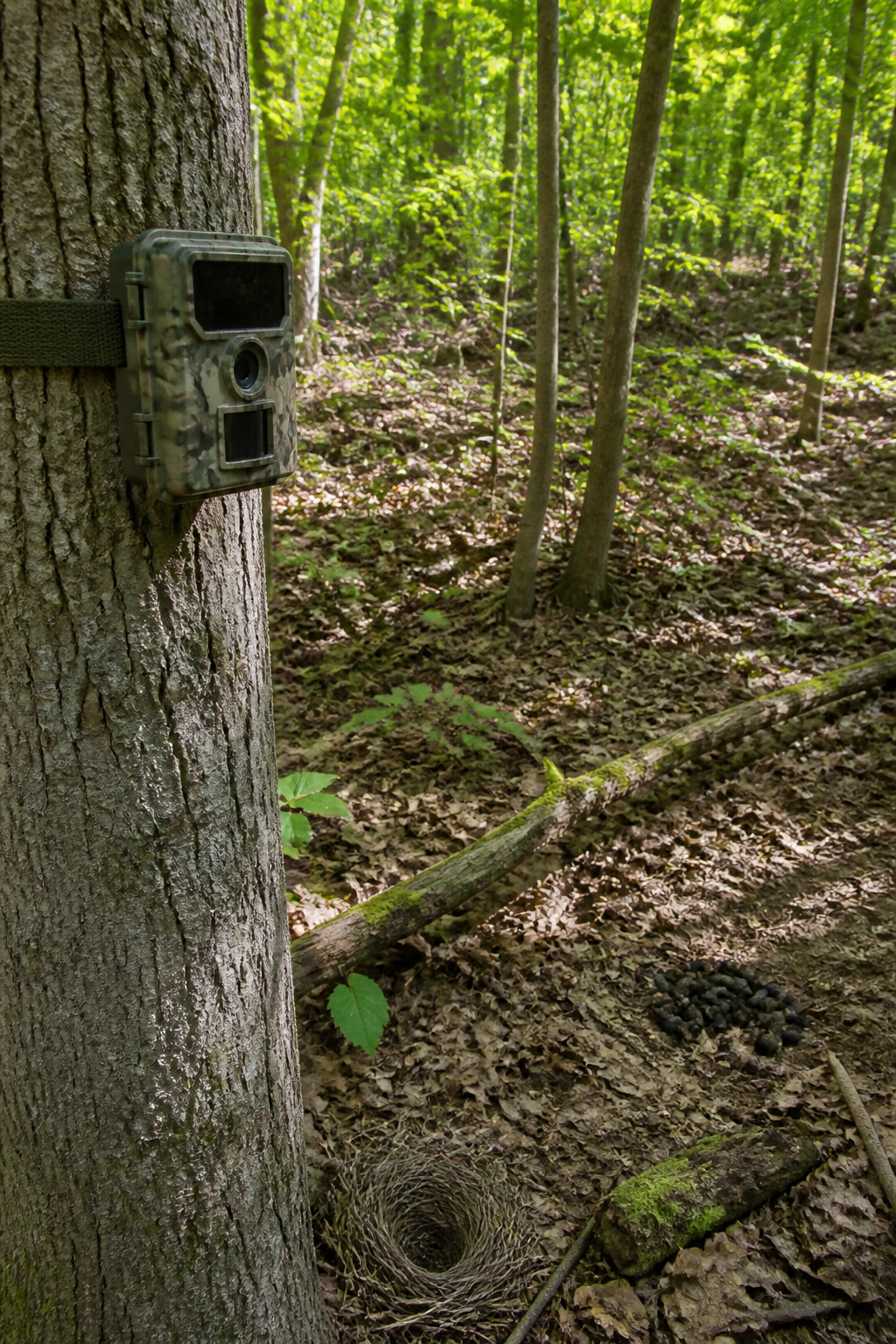
A single camera running three months straight can record more behavioral data than a graduate student collects in two seasons of field observation. That scale is why research programs now treat trail cameras as standard survey equipment, not a convenience add-on.
Population estimates used to mean trapping, collaring, or repeated human presence that altered the behavior being measured. Camera grids remove that distortion. Standardized placement protocols, spacing units at consistent heights and intervals, let one team’s data match another’s across years or across continents. The images feed into mark-recapture models where natural markings, stripe patterns, ear nicks identify individuals without ever handling them.
Cellular transmission changed the equation for sensitive sites. A researcher in Wyoming studying wolverines does not need snowshoe trips to pull SD cards, leaving scent trails that keep the animals corridor-shy for weeks. The camera sends the frame; the human stays out. Reduced disturbance means routines stay natural, and the data reflect what animals actually do, not what they do when avoiding people.
Citizen scientists run smaller grids but add geographic reach. A backyard hedgehog count in Sheffield and a wolf monitoring project in Croatia run on the same hardware, the same open-source analysis platforms. The hedgehog data shaped local green-space policy; the Croatian pack distribution maps redirected highway planning. Neither required a PhD to collect. Both needed cameras that could sit quiet, run cold, and prove what was there.
Habitat Management

Fixed cameras turn habitat work from guesswork into something you can measure. A land manager running a timber cut on a corner of the property wants to know whether deer keep using the edge once the canopy opens. Trail cameras left on the same tree for two full seasons will show that: browse pressure on new growth, or bucks shifting to the thicker cover that remains, or nothing at all, which is also useful.
The same setup tracks food plots without someone driving out to check them. Corn and brassicas draw differently in October than beans and hay do in July, and a camera on a plot through both years builds a record of which plantings actually get used when. Water sources dry up or get dug out; cameras catch which ones animals abandon and which they keep visiting.
Repeated photos from the same fixed point are what make this work. One season’s pictures might show heavy traffic through a saddle. Three seasons might show that traffic dropping as the surrounding brush matures into stem-count cover the deer no longer want to push through. That landowner might choose to hold off on the planned hinge-cut, or move it two hundred yards based on where the cameras show animals actually traveling now.
Event Monitoring
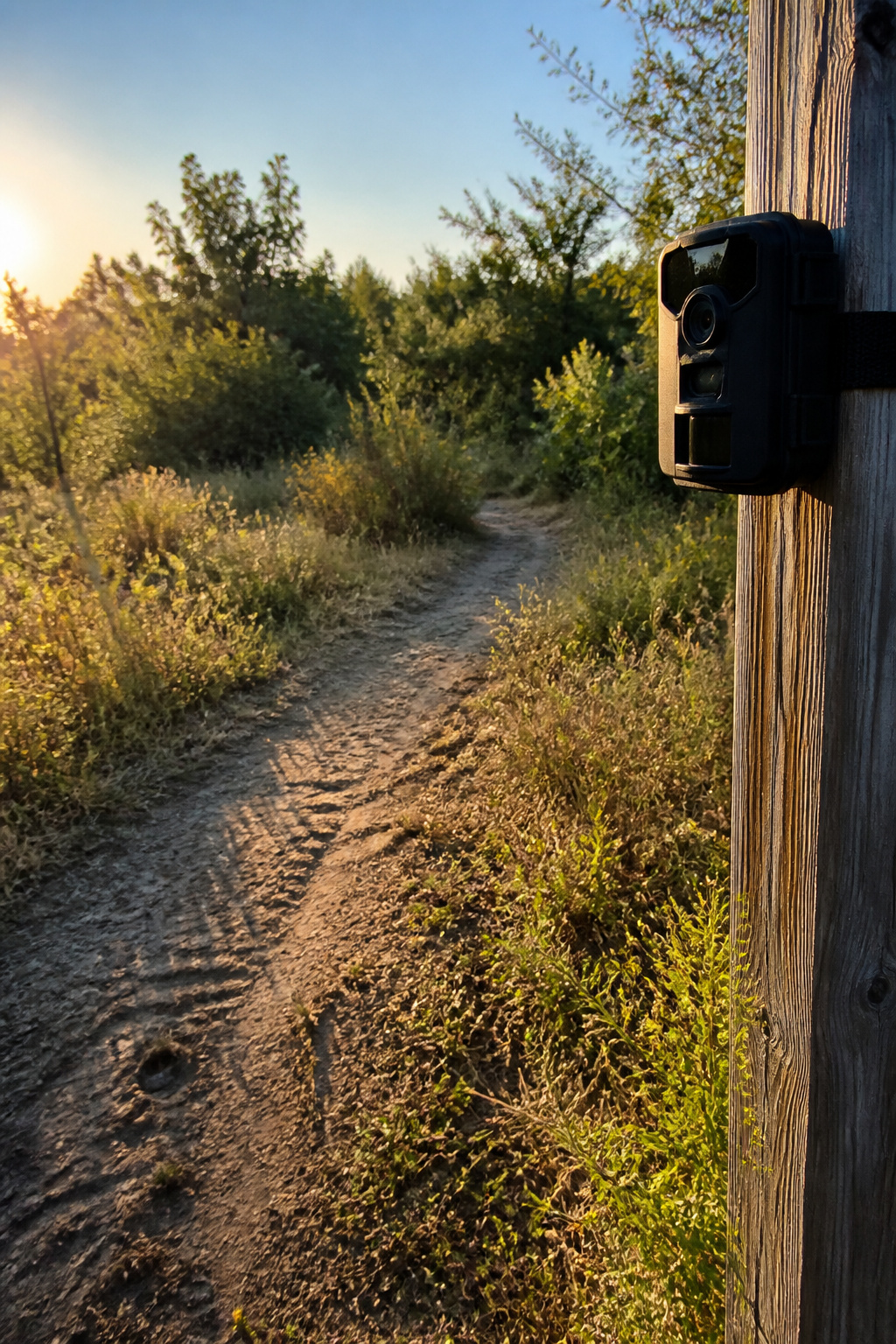
The same motion-activated sensor and infrared flash that catches a buck at 2:00 AM works just as well for counting how many hikers cut a switchback or documenting which dog got into the chicken coop. Placement logic flips: instead of facing a game trail at knee height, you mount higher and wider for human traffic, or drop nearly to ground level to catch a predator’s belly-crawl under a fence.
Last spring, a neighbor lent me his spare camera after something started taking his laying hens. The unit had spent two seasons on a scrape line, programmed for twelve-megapixel stills with a thirty-second delay between shots. For coop duty, that delay was useless; a fox moves fast. We swapped to burst mode, angled the lens down through the hardware cloth, and lost another bird before we got it right. The infrared flash spooked the survivors, so we switched to low-glow and finally caught the culprit: a feral cat, not the coyote we’d expected.
Public land managers run similar repurposing all the time. A camera counting bikes on an unofficial trail needs different bracketing than one documenting elk migration, but the hardware does not care. The mistake is assuming your wildlife settings transfer without testing.
Educational Purposes
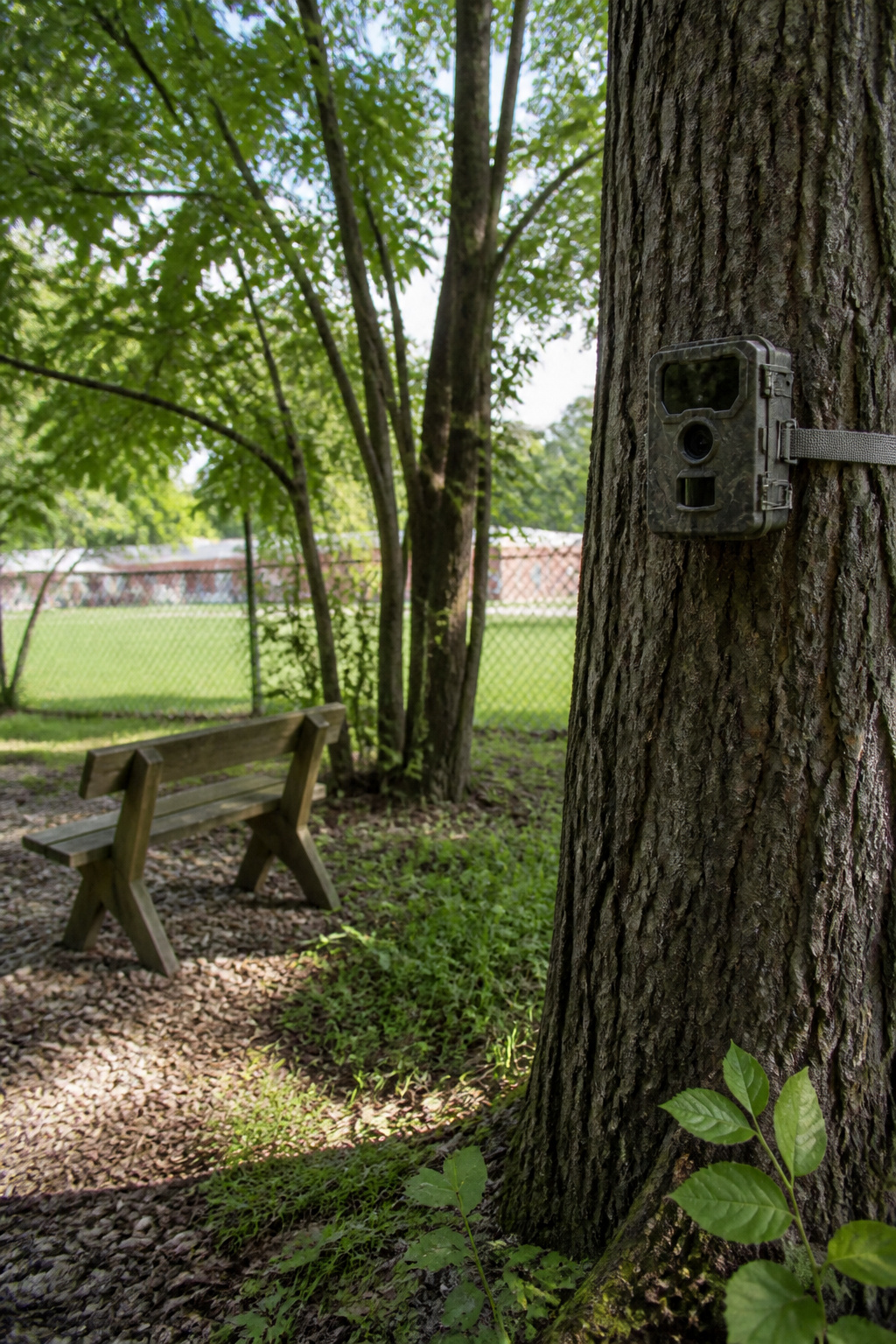
Cellular trail cameras have opened a real window for classrooms and nature centers that was not practical before. A teacher in rural Vermont ran a year-long project where middle schoolers placed cameras on a forest edge and received photos through the Strike Force Wireless app each morning before class. The near real-time feed kept engagement high in a way that monthly SD card collections never did. The program struggled only when the school cheaped out on data plans and images arrived in batches every six hours instead of as triggers happened. For education, the cellular connection matters more than image quality; students watching a doe circle a salt lick at 7:23 AM learn timing and behavior in a way textbooks cannot replicate. Home learners gain the same benefit on a smaller scale, sharing feeds with distant grandparents or cross-referencing timestamps with weather data.
Traditional vs. Cellular Trail Cameras
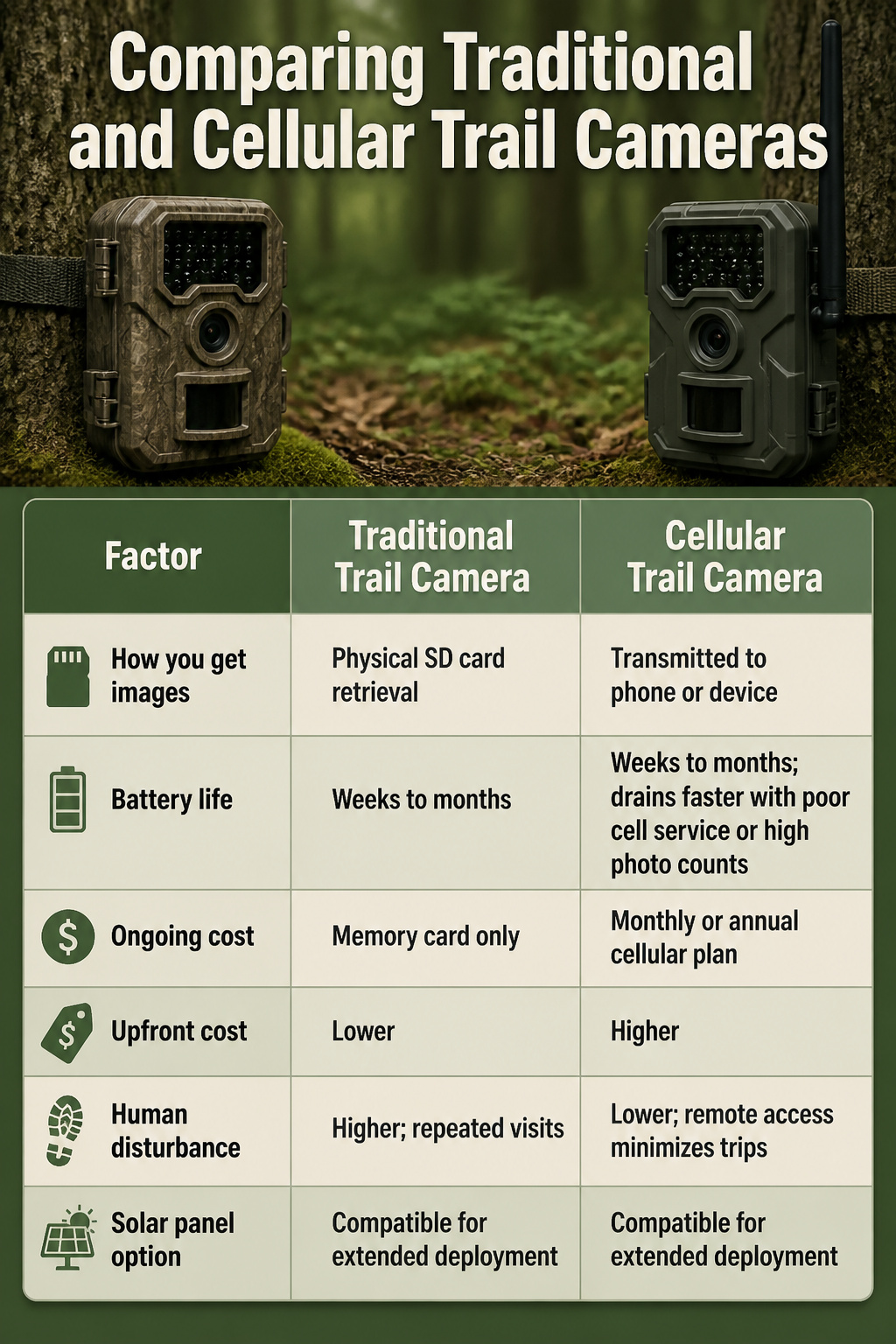
Most trail camera uses come down to one choice: whether you need to hike out to collect an SD card or whether the photo comes to you. That split changes almost everything about how you run the camera.
| Factor | Traditional Trail Camera | Cellular Trail Camera |
|---|---|---|
| How you get images | Physical SD card retrieval | Transmitted to phone or device |
| Battery life | Weeks to months | Weeks to months; drains faster with poor cell service or high photo counts |
| Ongoing cost | Memory card only | Monthly or annual cellular plan |
| Upfront cost | Lower | Higher |
| Human disturbance | Higher; repeated visits to check cards | Lower; remote access minimizes trips |
| Solar panel option | Compatible for extended deployment | Compatible for extended deployment |
The battery math matters more with cellular models. A camera in a dead zone burns power searching for signal, and heavy traffic means more transmissions. Either way, solar panels or external battery boxes can stretch operation to a year or more, which also means fewer trips to spook whatever you’re watching.
Cellular service is the hard limit. No signal, and you are back to pulling cards anyway. For spots with solid coverage, the subscription buys real-time alerts and cleaner data. For remote ridges or deep timber, traditional usually wins.
Where to Place a Trail Camera

Three kinds of spots consistently produce usable trail camera footage: food sources, travel routes, and bedding areas. Ag fields, food plots, or feeders where legal give a broad view of the local herd. Creek crossings, worn trails, and soft edges funnel movement predictably. Saddles, pinch points, and bluff gaps work well because they concentrate traffic without requiring you to hunt the spot directly. Scrapes function as natural communication hubs, sometimes showing several different bucks in rotation.
Height and angle matter more than most people expect. A camera set too low catches legs and leaves; too high and you miss the body profile that identifies individual animals. Sun glare across the lens will burn through a whole memory card of false triggers, so the angle relative to sunrise and sunset needs checking at different times of day. Concealment reduces theft risk, which is real on public land or anywhere foot traffic passes.
Species behavior changes the math. What works for whitetails in summer scouting fails during the rut when core areas shift. Layering cameras helps: edges of ag fields or oak flats as low-intrusion zone one, staging areas and major trails as zone two, bedding area edges as zone three. Zone three only works if you place cameras months before season and pair them with external battery sources.
Before walking away, run through the same checks that once cost me a week of empty frames: confirm the detection zone clears all swaying branches, verify the timestamp, test the trigger from the expected approach distance, check that sun angles at dawn and dusk miss the lens, and make sure the strap or security box still locks tight.
Power and Battery Life

Lithium AAs are the only chemistry worth the money for a trail camera that sits through winter. Alkalines swell and die fast in the cold; lithiums keep their voltage down to temperatures where most of us have stopped checking cams anyway. The "months of battery life" printed on the box was measured in a lab, not in a New England January.
I ran a Reconyx HyperFire 2 on lithium AAs through one season, and the difference between October and February told the whole story. Mild fall gave me about four months of trigger-happy use on a deer trail. The same camera, same settings, same battery count, placed in a swamp that held below 20 °F for weeks straight: dead in seven weeks. Not the camera’s fault. Cold saps capacity across every battery type, just faster with some than others.
External power changes the math, but only where the sun actually reaches the panel. Solar makes sense on a south-facing field edge or a logging road with open sky. Tuck that same panel under hemlock canopy and it becomes dead weight. The Moultrie Edge 4 Solar pairs a larger panel with an internal rechargeable, which is the smarter design: the rechargeable handles daily load, and the panel’s job is to keep it topped off. In thick woods, skip solar and run a sealed external battery box instead. It costs more up front and adds bulk, but a dead camera in November tells you nothing.
Frequently Asked Questions
What are the best uses for trail cameras?
Trail cameras excel at wildlife monitoring, hunting strategy, property security, and research. Wildlife monitoring uses passive infrared sensors and invisible infrared flash to capture animals without disturbance. Hunters build data on movement patterns across layered camera setups. Property owners deploy them where power lines are impractical, and researchers use standardized grids for population counts that would cost far more with human observers.
How do cellular trail cameras work?
Cellular trail cameras transmit photos and video directly to your phone or device over 4G LTE networks, skipping the need to physically retrieve an SD card. This cuts human disturbance and delivers real-time alerts, but requires a monthly or annual subscription. They burn battery faster in dead zones where the unit keeps searching for signal, and without cellular coverage at all, they revert to card-only operation.
Can trail cameras be used for security purposes?
Yes, trail cameras work well for property security in remote locations where running power lines costs too much or takes too long. Cellular models like the Moultrie Edge 4 send alerts straight to your phone when a gate opens or someone approaches an outbuilding. Angle the lens inward toward your own property rather than public paths or neighboring land to avoid legal and trust issues around surveillance statutes.
What should I consider when placing a trail camera?
Place cameras near food sources, travel routes, or bedding areas for the best results. Ag fields, food plots, creek crossings, worn trails, and scrapes all concentrate animal movement. Check sun angles at dawn and dusk to avoid glare that triggers false shots. Set height to capture full body profiles, clear all swaying branches from the detection zone, and verify timestamp and trigger distance before leaving.
How do I extend the battery life of my trail camera?
Use lithium AAs, the only chemistry that holds voltage through real winter cold. Alkalines swell and die fast below freezing. Solar panels stretch operation to a year or more on south-facing edges with open sky, but become dead weight under dense canopy; there, run a sealed external battery box instead. Either add-on costs more upfront, but a dead camera mid-season tells you nothing.