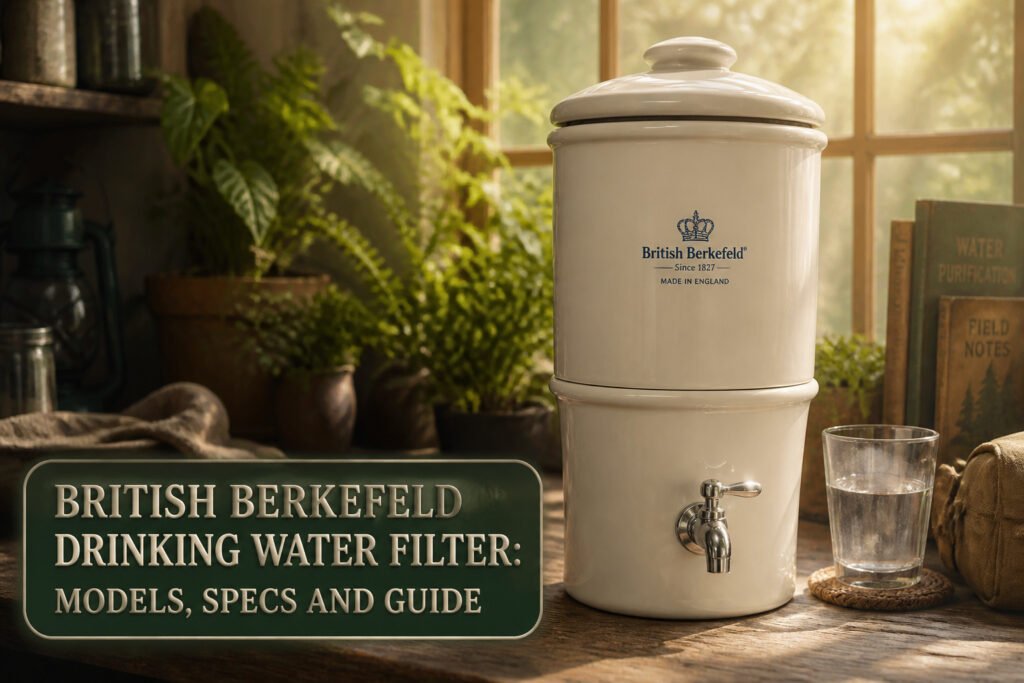
British Berkefeld drinking water filters are gravity-fed ceramic systems sized for countertops, but the flow rate forces a choice most buyers miss. The Ultra Sterasyl drips at 0.27 gallons per hour, slow enough that you’ll plan fills overnight; the Ultra Fluoride manages 0.38 GPH only by trading speed for fluoride and lead removal your water may not even contain. Those handmade English ceramic shells compost after use, yet the screws come off first.
Ultra Fluoride Filter

The British Berkefeld drinking water filter line includes an option built specifically for fluoride removal: the Ultra Fluoride Water Filter, model W9120133. Doulton and British Berkefeld state this candle carries the same base capabilities as the Ultra Sterasyl but adds media targeted at fluoride and lead. Where the standard Sterasyl stops, this one continues on to reduce fluoride, chlorine, microplastics, trace organics, pharmaceuticals, and heavy metals including lead.
Flow rate is the tradeoff. The Ultra Fluoride filters at 0.38 gallons per hour, slower than gravity filters with less aggressive media. Gravity does the work, so patience matters. A two-pack of the 7-inch candles runs $124, with replacement every six months or 800 gallons.
Whether the extra capability is worth the slower speed and higher cost depends on your water. Pull your local water quality report before buying; not all municipal supplies carry fluoride levels that justify the step up. The ceramic shell and plastic mounts recycle or compost after use, same as the Sterasyl line.
Ultra Sterasyl Filter

The Ultra Sterasyl sits in the British Berkefeld lineup as the option for households that do not need fluoride stripped from their tap water. It handles the same 99.9% bacteria and cyst elimination as the fluoride-removing sibling, which matters more in practice than the spec sheet suggests: a cracked well casing or a post-storm boil notice turns that figure from abstract to essential.
Filtration speed drops to roughly 0.27 GPH. That is slow enough to notice when you are filling the upper chamber after dinner, and fast enough that a full Berkefeld system still keeps pace with a family’s morning rush if you planned the batch the night before. The ceramic candles themselves are handmade in England from natural, compostable materials; the screws and small plastic fittings come off before the clay goes into the ground.
For anyone whose municipal water already runs low on fluoride, or who has tested their well and found it absent, the Ultra Sterasyl skips the extra media stage and the flow penalty that stage adds. That is the judgment call: pay for capability you do not need, or accept the slower throughput and match the filter to the actual contents of your water.
All in One Filter
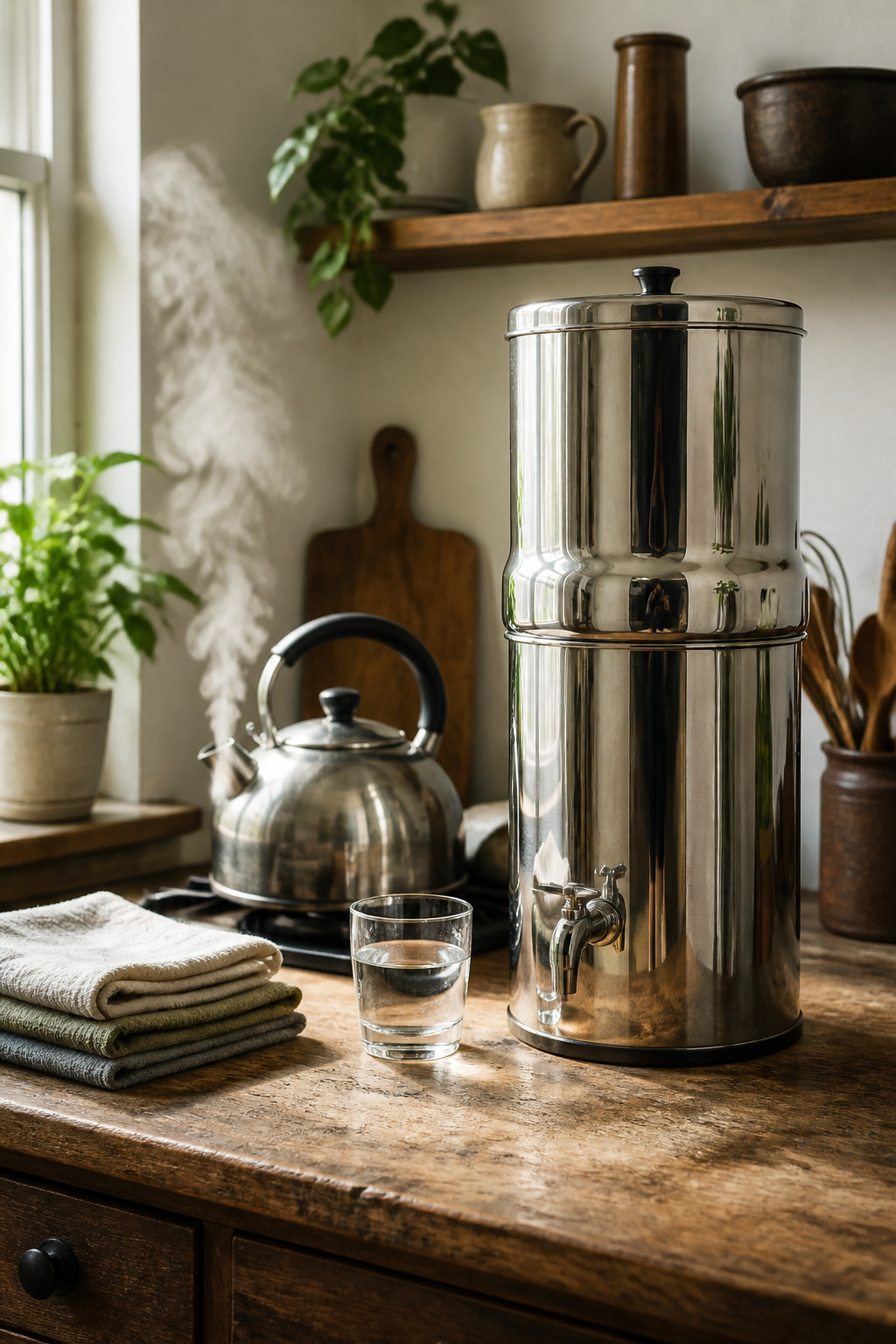
The All in One Filter combines the fluoride reduction of the Ultra Fluoride with the bacterial protection of the Ultra Sterasyl in a single cartridge. That means one filter doing two jobs instead of stacking separate stages.
Stacking filters works, but it costs more and slows flow. The All in One simplifies the setup. Water passes through the fluoride media first, then hits the ceramic shell with its silver-impregnated layer for the biological end.
Who actually needs this? Someone running a single housing who does not want to choose between chemical and biological protection. Rural well owners on fluoride-treated municipal lines fit here. So do travelers who pack one system and face uncertain source quality.
The tradeoff is filter life. Dual-purpose cartridges typically exhaust faster than single-purpose ones because both media share the same volume. Replacement intervals run shorter, and the per-cartridge cost sits higher than either standalone type.
If your water source demands both fluoride and bacterial control, this saves hardware. If you only need one or the other, you are paying for capacity you will not use.
Duchess System

The Duchess Berkefeld water filter holds 1.58 gallons (6 liters), a capacity that sits right at the edge of too small for most households. That volume translates to roughly enough filtered water for one to two people who cook at home regularly, or a couple who mostly drinks coffee and fills bottles for work.
Stainless steel construction keeps it light enough to move, though the squat footprint eats more counter depth than the taller Duke model. For a single apartment dweller or a weekend cabin that sees occasional use, the Duchess fills its role without the unused capacity going stale. Run it daily and the water stays fresh; let it sit three days and you’ll want to drain and refill.
Buying the Duchess directly from Doulton, the parent company behind British Berkefeld, typically wins on price and filter compatibility compared to third-party sellers who bundle mismatched cartridges. The system uses the same ceramic shell filters as its larger siblings, so upgrade paths stay open if your household grows.
Duke System

The Duke holds 2.25 gallons, up from the Duchess’s 1.58, and that extra two-thirds of a gallon changes who this system fits. Three to four people is the practical zone; a couple stretching it over a weekend, or a small family running it daily without the constant refilling that shrinks the smaller pot from useful to chore.
Physical footprint scales with the capacity, though the exact inches matter less than the counter space it actually claims. The Duke sits where the Duchess did, just taller and wider, still the same ceramic build and the same two-filter default. The four-filter configuration runs $280 if speed matters, up from $260 for the standard pair, and that upgrade is worth weighing if mornings involve a line of thirsty people.
Buying direct from Doulton for the Duke lands at that $260 mark, same channel that wins on price for the whole line. Fluoride filters still come separate, so the real cost stacks higher if your water needs that layer. For households past the couple stage, the Duke is the first size that stops feeling like a compromise.
NSF Certifications

British Berkefeld filters carry NSF/ANSI 42, 53, and 401 certifications for health effects, which is more than most gravity systems on the market bother with. The 42 standard covers aesthetic issues like chlorine taste and odor, the 53 standard tests for the heavy stuff like lead, mercury, asbestos, and cryptosporidium, and 401 addresses emerging contaminants including pharmaceuticals and pesticides. Without these third-party marks, a company is basically asking you to trust their own lab. Some competitors do exactly that, and maybe their testing is rigorous, maybe it is not. The NSF route costs money and time, which weeds out filters that cannot perform. For a gravity system that sits on your counter and claims to reduce bacteria by 99.9%, those certified numbers are the difference between knowing and hoping.
Contaminant Reduction

British Berkefeld filters target bacteria, fluoride, chlorine, microplastics, and heavy metals through two main cartridges. The Ultra Sterasyl carries 99.9% reduction claims for bacteria and cysts, the figure that usually matters most to anyone filtering untreated or questionable water. That same element is certified under NSF 42, 53, and 401 for particulates, cysts, turbidity, and microplastics.
The gap between claim and certification is worth watching. British Berkefeld also says the Ultra Sterasyl handles PFAS, E. coli, lead, glyphosate, pesticides, herbicides, and pharmaceuticals, but those reductions have not gone through independent verification. The Ultra Fluoride filter adds fluoride reduction as its selling point, yet it only holds the same three NSF certifications for turbidity, particulates, and microplastics, and notably lacks NSF 53 certification for the very fluoride performance that distinguishes it.
All British Berkefeld filters are third-party certified, which means the units are tested against what the company claims, but the claims themselves are not uniform across contaminants. For anyone comparing systems, the practical difference is this: the Ultra Sterasyl has the broader verified pathogen protection, while the Ultra Fluoride’s advantage in fluoride reduction rests on manufacturer claims rather than independent standard confirmation.
Filtration Speed
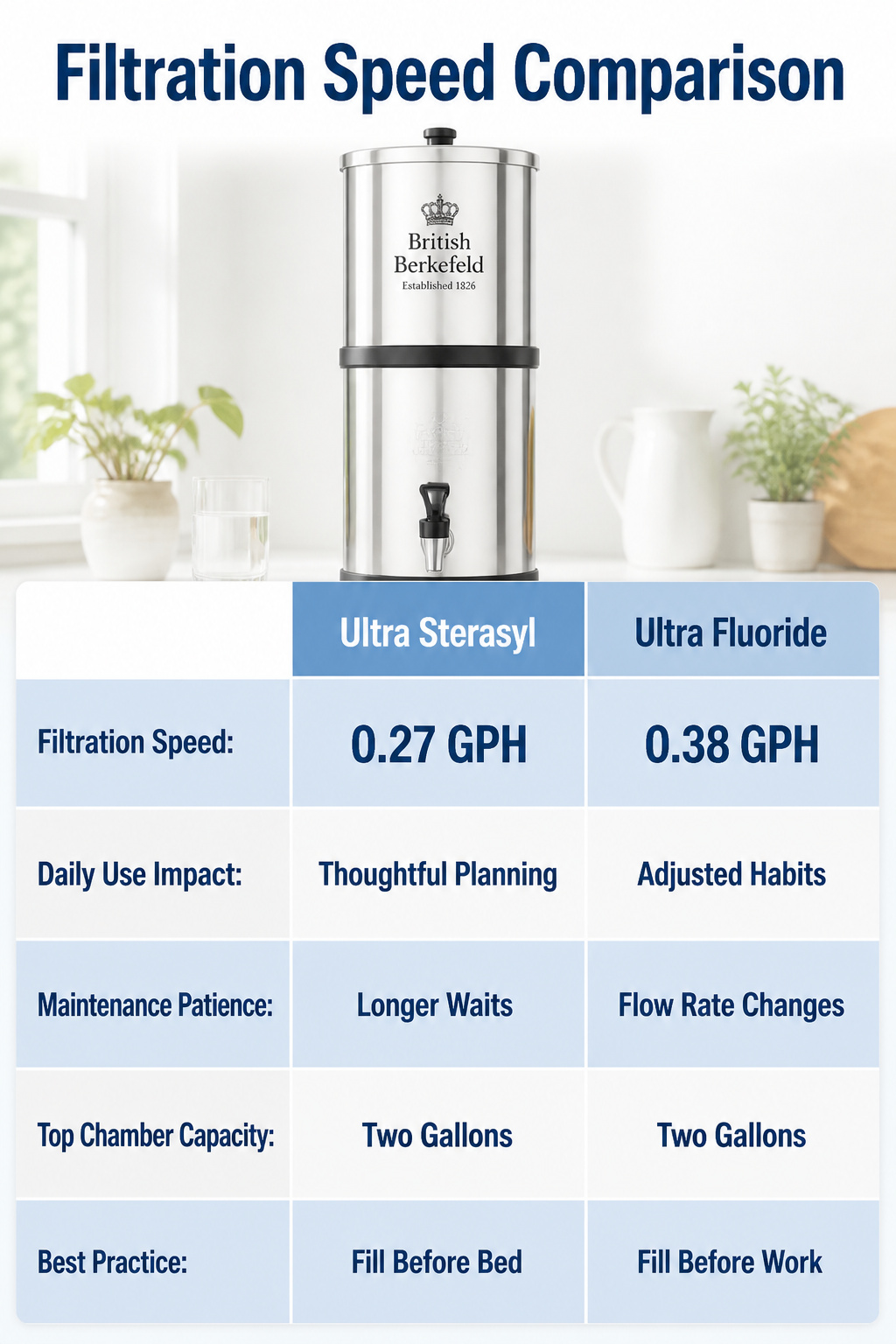
Ultra Sterasyl filters push water through at roughly 0.27 GPH, while Ultra Fluoride cartridges manage about 0.38 GPH. Both figures sit well below what you’ll see advertised for competing gravity systems, and that gap shapes the daily rhythm of using a British Berkefeld.
A top chamber that holds maybe two gallons can take the better part of a morning to drain. For a household running on filtered water, the wait trains you to plan ahead: fill before bed, fill before work, keep a reserve jug so you’re never caught dry. The filter isn’t broken when it drips slowly; ceramic depth and dense media just resist rushing.
Patience becomes part of the ownership cost. Someone accustomed to the faster flow of a Sawyer or Berkey will notice the difference immediately, especially during the first few cycles when the ceramic is still bedding in. My own habit shifted to filling at night and drawing in the morning, treating the unit more like a slow cooker than a faucet. If your household burns through water quickly or you lack counter space for a staging reservoir, this cadence will grate before the first month is out.
Filter Lifespan
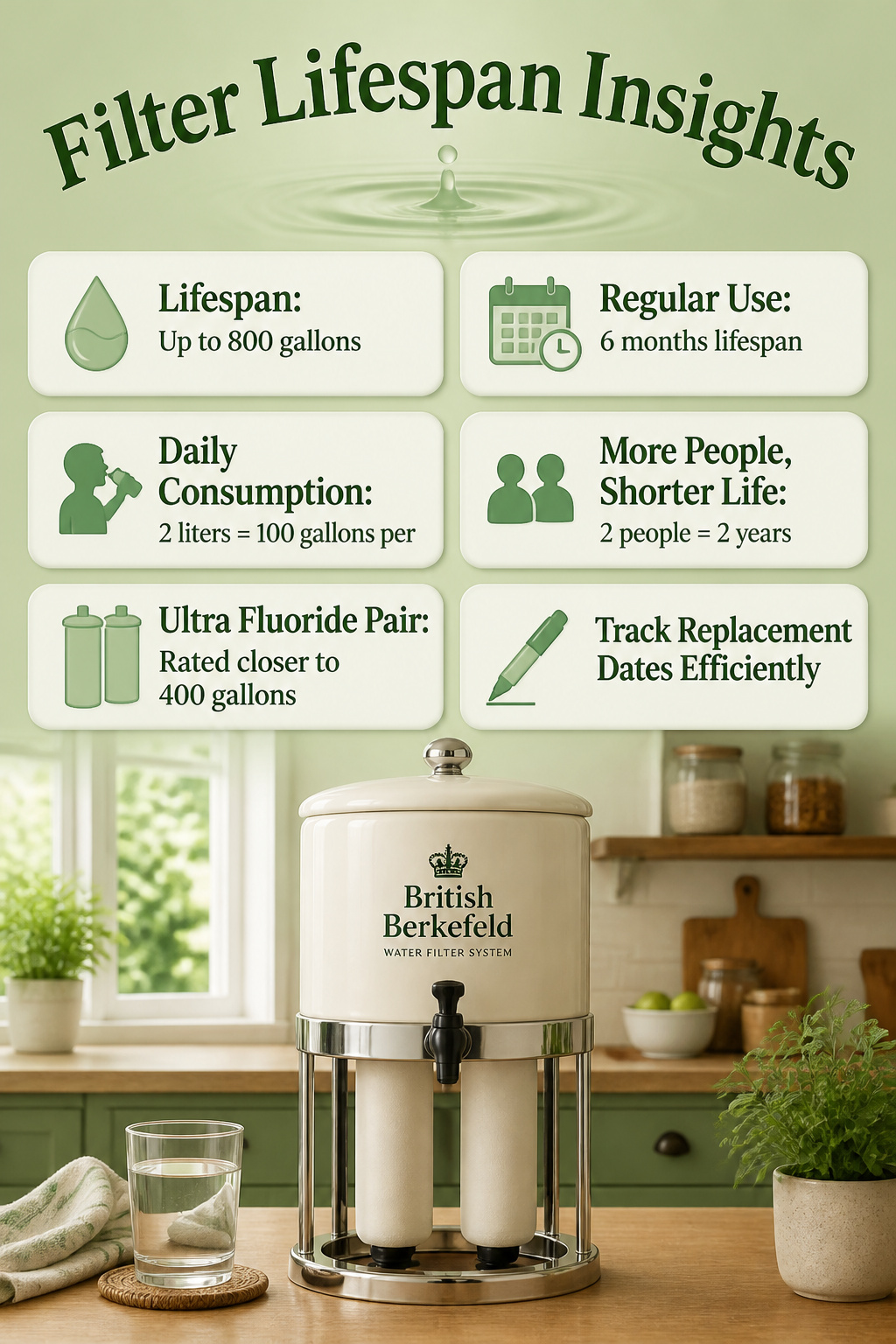
Two filters in a British Berkefeld drinking water filter system handle up to 800 gallons, or roughly six months of typical household use. That figure shifts with your actual consumption. One person drinking two liters daily burns through about a hundred gallons in six months, which stretches two filters toward a four-year life. Add a second person and that drops to two years. The math gets messy fast, and the brand’s own numbers do not always line up: the Ultra Fluoride pair is rated closer to 400 gallons, half the main-site claim, with cleaning and incoming water quality factoring in.
Tracking means picking a method and staying with it. A Sharpie mark on the filter base with the install date works. So does a phone reminder set for six months out, adjusted downward if your household runs heavy on cooking water or coffee. Waiting until flow slows is waiting too long: by then the ceramic matrix is already loaded, and what slips through is not what you bought the system to catch.
Six months is the safer mark than the gallon ceiling. Microbial growth and ceramic fatigue run on time, not just volume. Replace on schedule, or sooner if your local water report flags something aggressive. The cost stings less than guessing wrong.
Setup and Maintenance

- The British Berkefeld drinking water filter arrives ready to use, with no priming of the ceramic candles required. Unlike other brands where you soak filters for hours or even days, you simply install the candles into the top chamber, tighten them by hand (the washers sit inside the top portion), and run a few gallons through to flush the system.
- The first two batches will filter slowly, sometimes three hours or more for a full upper chamber. Flow rate picks up noticeably after that initial break-in period. Most users find an overnight fill becomes routine; once conditioned, a midday refill often finishes in under an hour.
- Maintenance centers on cleaning the ceramic surface when output slows. A new, clean sponge and plain water do the job. Scrubbing restores flow without replacing the filter. Mark your calendar for eventual replacement based on your actual throughput, since capacity depends on how fast you draw water rather than a fixed calendar date.
- If the system sits idle beyond 24 hours, run two liters to waste before drinking again. That keeps the stored water fresh without disassembly or extra steps.
Frequently Asked Questions
What contaminants do British Berkefeld filters remove?
British Berkefeld filters handle bacteria, fluoride, chlorine, microplastics, and heavy metals, though verified performance varies by cartridge. The Ultra Sterasyl carries NSF certification for 99.9% bacteria and cyst reduction, turbidity, particulates, and microplastics. The Ultra Fluoride adds fluoride and lead reduction but lacks independent certification for that specific claim.
How often should I replace the filters?
Replace British Berkefeld filters every six months or after roughly 800 gallons, whichever comes first. That gallon figure drops to about 400 for the Ultra Fluoride pair. Time matters as much as volume; ceramic fatigue and microbial growth do not wait for a counter to hit a ceiling.
Are British Berkefeld filters NSF certified?
Yes, under NSF/ANSI standards 42, 53, and 401. The 42 mark covers taste and odor issues like chlorine, 53 addresses health effects including lead and cysts, and 401 applies to emerging contaminants such as pharmaceuticals and pesticides. No priming is required before first use; run a few gallons through and the system is ready.
How do I set up a British Berkefeld filter?
Thread the ceramic candles into the upper chamber by hand, tighten gently, and flush a few gallons through to clear the system. The first batches run slowly, sometimes three hours for a full chamber, but speed improves after the ceramic beds in. Fill overnight and the unit keeps pace with daily use.