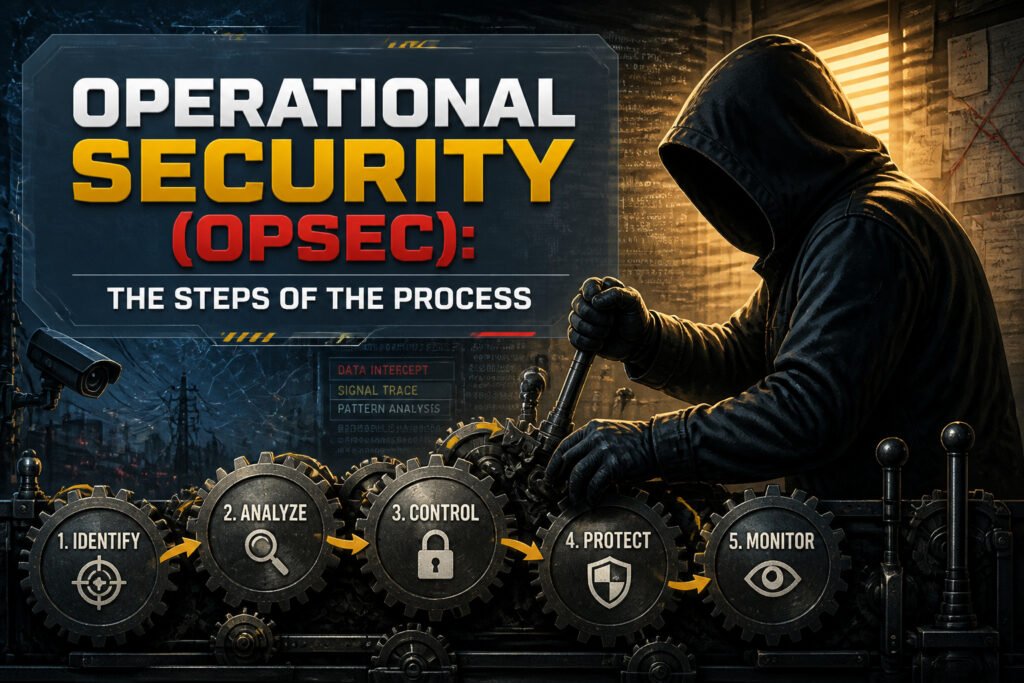
Operational security is a systematic process to identify, control, and protect sensitive information that adversaries could exploit. It only works as a continuous cycle, not a one-time project, because threats adapt faster than static checklists. The framework was born in 1966 when Admiral Ulysses Sharp’s Operation Purple Dragon team discovered U.S. forces were revealing critical information through their own operational patterns, not through broken codes or captured spies.
What OPSEC Means
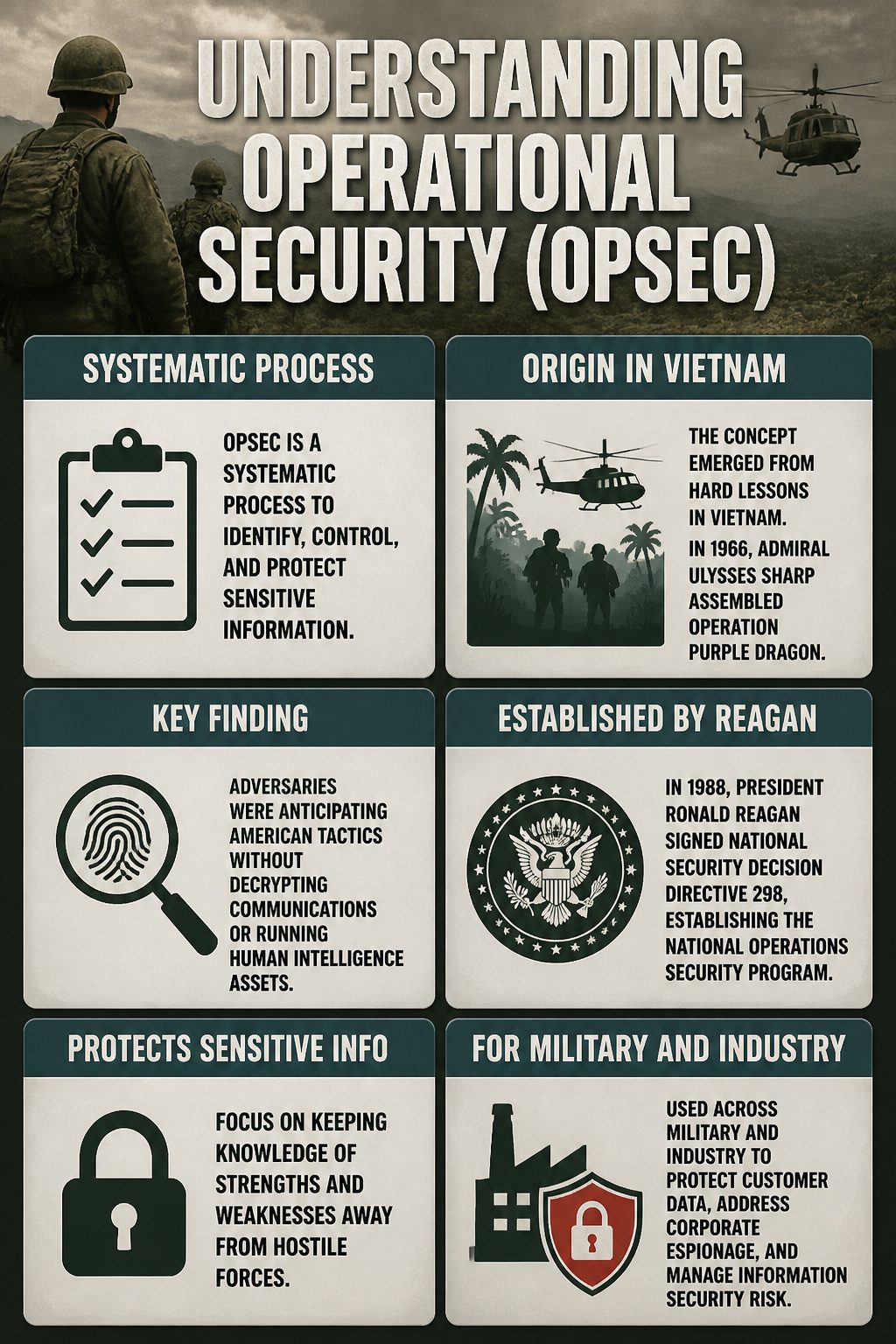
Operational security is a systematic process to identify, control, and protect sensitive information that adversaries could exploit to gain advantage. The concept emerged from hard lessons in Vietnam. In 1966, Admiral Ulysses Sharp assembled a multidisciplinary team called Operation Purple Dragon to investigate why certain U.S. combat operations were failing. The team included personnel from the National Security Agency and the Department of Defense. Their key finding was sobering: adversaries were anticipating American tactics without decrypting communications or running human intelligence assets. U.S. forces were inadvertently revealing critical information through their own patterns and behaviors.
The Purple Dragon team codified their recommendations into a new process they deliberately named "Operations Security" to distinguish it from existing security programs and protect its inter-agency support. Their original definition focused on keeping knowledge of strengths and weaknesses away from hostile forces.
This military framework became formalized government-wide in 1988 when President Ronald Reagan signed National Security Decision Directive 298. That directive established the National Operations Security Program, named the Director of the National Security Agency as the executive agent for inter-agency OPSEC support, and created the Interagency OPSEC Support Staff. What began as a wartime fix has since spread well beyond defense, with organizations now using these same principles to protect customer data, address corporate espionage, and manage information security risk.
1. Identify Critical Information

The first step in any opsec operational security process starts with an honest inventory of what actually needs protecting. Customer records, financial statements, employee details, credit card data, intellectual property, and ongoing product research all belong on that list. What convinced me, reading through the guidance from security professionals, is how often organizations skip this cataloging work and jump straight to buying tools.
If you do not know the threat, you do not know what to protect — that principle shapes everything that follows. A thorough audit matters here, because the harm from a breach depends entirely on what gets out. Trade secrets carry different weight than facility schedules; login credentials and access keys sit in their own category of urgency. The evaluation should measure both the significance of each data type and the real repercussions if it surfaces where it should not.
Personal identifying information, or PII, typically ranks high on any critical information list, but the exact priority order shifts with what the organization actually does. A company running sensitive R&D will weight intellectual property differently than one handling mostly retail transactions. The work of this step is not just naming categories but assigning them relative urgency based on your own operations.
2. Analyze Threats

Threat analysis means naming who wants what you have and how badly they can hurt you getting it. The FBI has stated publicly that over 90 nations currently run intelligence operations targeting the United States, and at least 50 of those possess sophisticated technical capabilities: signals interception, imagery collection, and the human networks to place spies where data flows. That is not movie plot material. It is the baseline.
Your adversary list will almost always include four groups. Cybercriminals want customer records, payment data, anything they can monetize quickly. Competitors conduct corporate espionage, sometimes through hired intermediaries, sometimes through direct infiltration. Nation-state actors target intellectual property and strategic position, with twenty nations actively collecting economic intelligence inside U.S. borders per past CIA testimony. Then there are insiders: the disgruntled employee, the negligent contractor, the third-party vendor with credentials they should not have.
Each group brings different tools. Human intelligence, signals interception, open-source scraping, technical surveillance: the methods vary, but the pattern does not. Someone out there has already decided your information is worth the cost of collection. The second step of opsec operational security is figuring out who, and what they can actually do.
3. Assess Vulnerabilities

The third step in the opsec operational security process is where assumptions get tested against reality. Poorly managed user access or shared credentials are among the most common weak points, and they are also the easiest to overlook when a system appears to be functioning. I have watched teams treat credential sharing as a shortcut rather than a vulnerability, only to discover later that a single compromised account opened every door at once.
Unpatched software and outdated hardware sit on the same shelf. The technical inadequacy is visible to anyone who looks, but organizations often deprioritize updates until an adversary forces the issue. Unsecured networks and physical access points extend the attack surface in directions that procedural checks rarely reach. An IoT device with default settings, a lobby entrance without visitor logging, or sensitive data overshared through email or social media each represents a gap that a threat assessment identified in theory but practice left open.
Procedural flaws compound the technical ones. Inadequate training protocols mean that even well-designed controls fail at the human layer. The vulnerability analysis is not a one-time inventory; it is the discipline of asking, repeatedly, where the next exploitation is most likely to occur.
4. Evaluate Risk
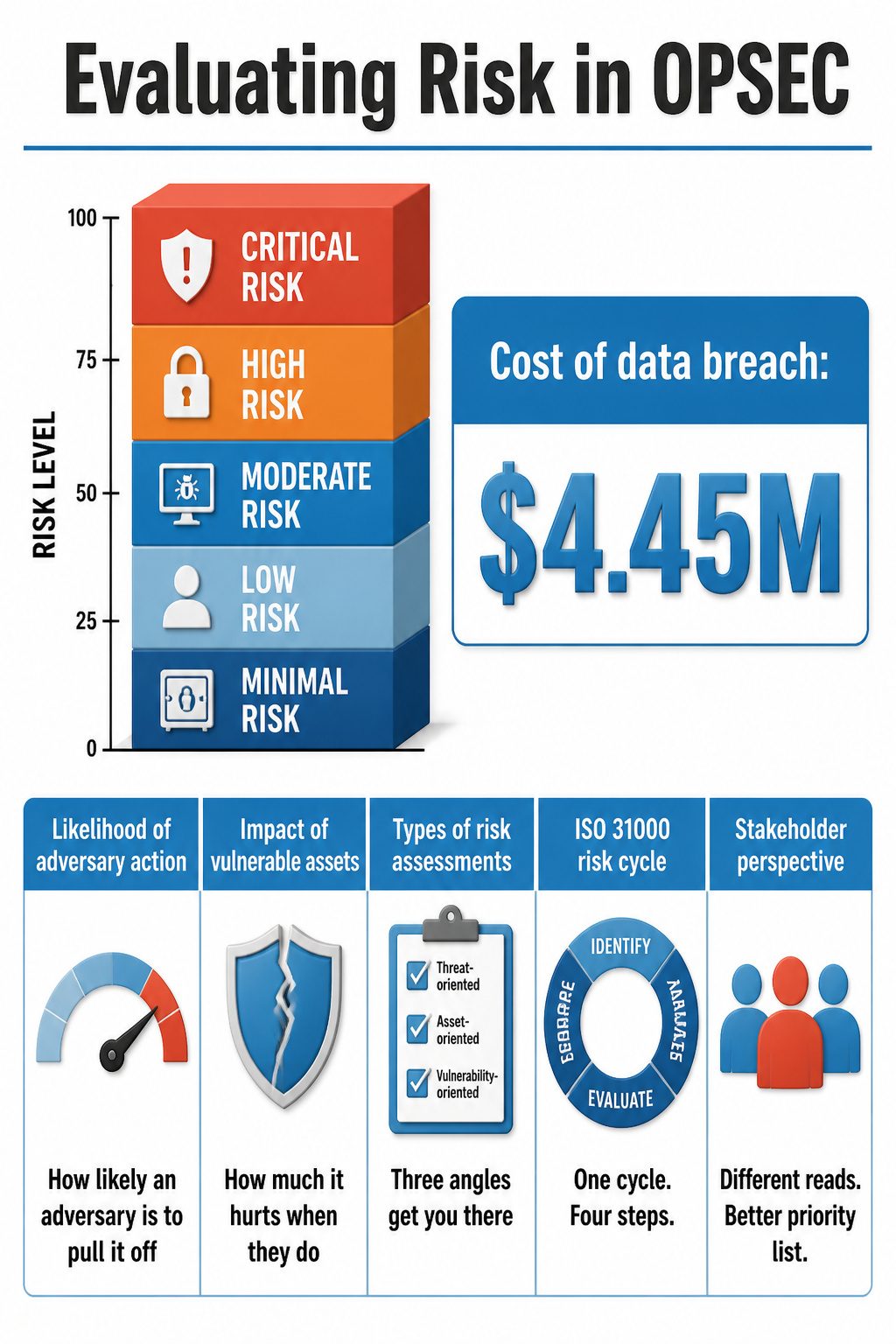
Threats and vulnerabilities mean nothing until you stack them against what actually happens when they meet. The IBM Cost of a Data Breach Report 2023 puts the global average cost of a data breach at $4.45 million, the highest on record. That figure is what turns a theoretical risk into a budget line and a boardroom conversation.
I tend to map risk two ways: how likely an adversary is to pull it off, and how much it hurts when they do. A vulnerability in a public-facing server with no patch available scores high on likelihood. A vulnerability in an air-gapped backup system that would require physical intrusion scores lower, but the impact of that backup failing during recovery can still be severe.
Three angles get you there. A threat-oriented review starts with who wants your data and traces how they’d move. An asset-oriented review starts with what you cannot afford to lose and works backward to the events that would cost it. A vulnerability-oriented review starts with the weaknesses you already know, then imagines the exploit. ISO 31000 treats all of this as one cycle: identify, analyze, evaluate, then compare against what your organization can stomach.
The owners of critical information should sit in that room. So should anyone who watches the adversary directly. Their read on what is acceptable risk will differ from yours, and the final priority list should reflect that tension, not bury it.
5. Apply Countermeasures

The fifth step of the OPSEC process is where plans turn into action. Countermeasures only work if they do not choke legitimate business in the process, so the balance matters from day one.
Updating hardware, writing clear policies around sensitive data, and running employee training on security practices are the standard moves here. Access controls get patched, systems run on least-privilege principles, and monitoring tools watch for unusual activity. The NIST SP 800-53 framework asks three things of any control: whether it is required, whether it is implemented or scheduled, and what level of assurance proves it works. ISO/IEC 27002:2022 lays out 93 controls across organizational, people, physical, and technological domains for organizations that want that structure.
The OPSEC process is iterative, not a one-time project. Threats shift, so the countermeasures shift with them. Periodic reassessment is not optional; it is how the process stays relevant. What worked last quarter may not cover the gap that opened this month.
Restrict Access and Least Privilege
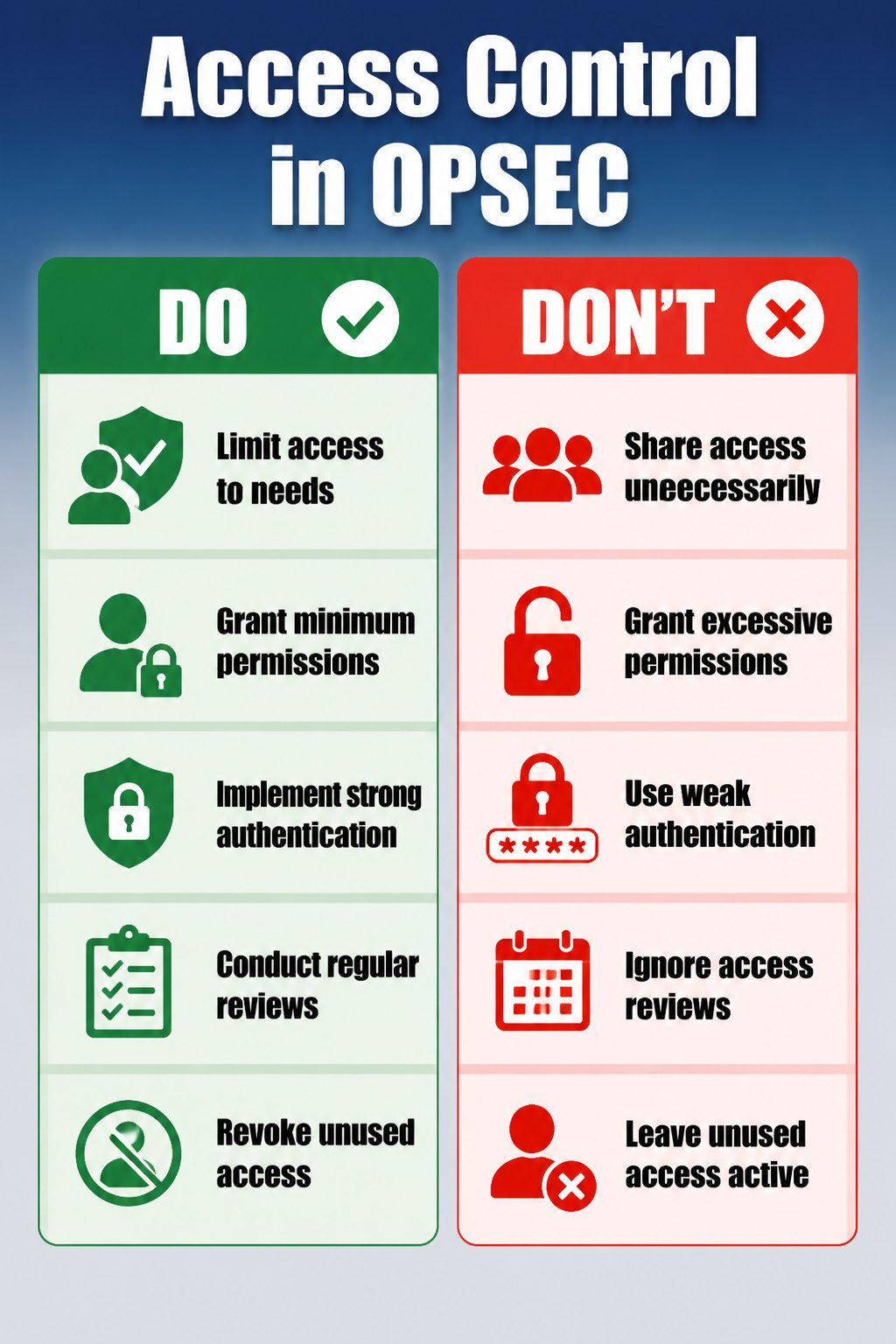
Tight control over who can reach sensitive information sits at the center of any working opsec operational security plan. Two principles handle this: limit access to those with a genuine need to know, and grant each person only the minimum permissions their role requires, nothing extra. The first principle, need-to-know, means information flows only toward people who legitimately require it for their function, with clear restrictions on how they can share or use it. The second, least privilege, narrows each user’s permissions down to exactly what their duties demand. These two work together. One sets the boundary of who gets in the door; the other limits what they can touch once inside. Together they shrink the number of points where data could be compromised or leaked. Putting this into practice takes detailed user account management, regular reviews of who holds what access, and revocation procedures for accounts or privileges that go unused. Strong authentication, including multifactor authentication, belongs here too. The layered effect matters: if one control slips, the narrow scope of access still contains the damage.
Audit and Train

Two practices separate an OPSEC plan that works from one that sits in a binder. Audits catch what countermeasures let through, and training closes the gap between policy and the person who clicks the link.
Audits should ask the same questions NIST SP 800-53 frames: which controls are in place, which are planned, and what assurance you have that they actually work. I have watched teams discover that a policy requiring two-factor authentication was written but never pushed to the shared workstation in the back office. The log review, the spot check of physical access points, the test of whether someone can walk out with a drive: these find the drift that happens between implementation and day three.
Training works the same way. Annual sign-offs on security awareness training are easy to track and hard to trust. The better move is shorter, more frequent contact with real scenarios: a phishing exercise that uses current tactics, a walkthrough of what an adversary might see from public social media posts, a reminder of why the clean desk policy exists. ISO/IEC 27002:2022 lists personnel security and awareness as controls across its 93-item framework, not as afterthoughts.
The two practices connect. Audit results should shape the next training cycle. Training feedback should flag controls that need audit attention. Without that loop, you are running two programs instead of one.
Monitor Continuously

Prevention eventually fails. Someone clicks a link they should not have, or a patch lags behind a new exploit. Monitoring tools close that gap by catching anomalies in real time, the layer that lets you respond before small intrusions become full breaches.
Behavior monitoring and social media monitoring are where I have seen this work in practice. The first flags unusual login times, data access spikes, or lateral movement inside a network. The second catches employees posting photos that reveal floor plans, travel schedules, or badge details. Both feed into the same discipline: treating your own operations as an attacker would, watching for the leak before they do.
OPSEC is not a one-time checklist. Threats evolve, and so must the watch. A monitoring rule that worked last quarter may miss a new phishing pattern today. Leadership and staff at every level need to understand what normal looks like for their systems so they can spot the deviation when it arrives.
OPSEC Versus Cybersecurity
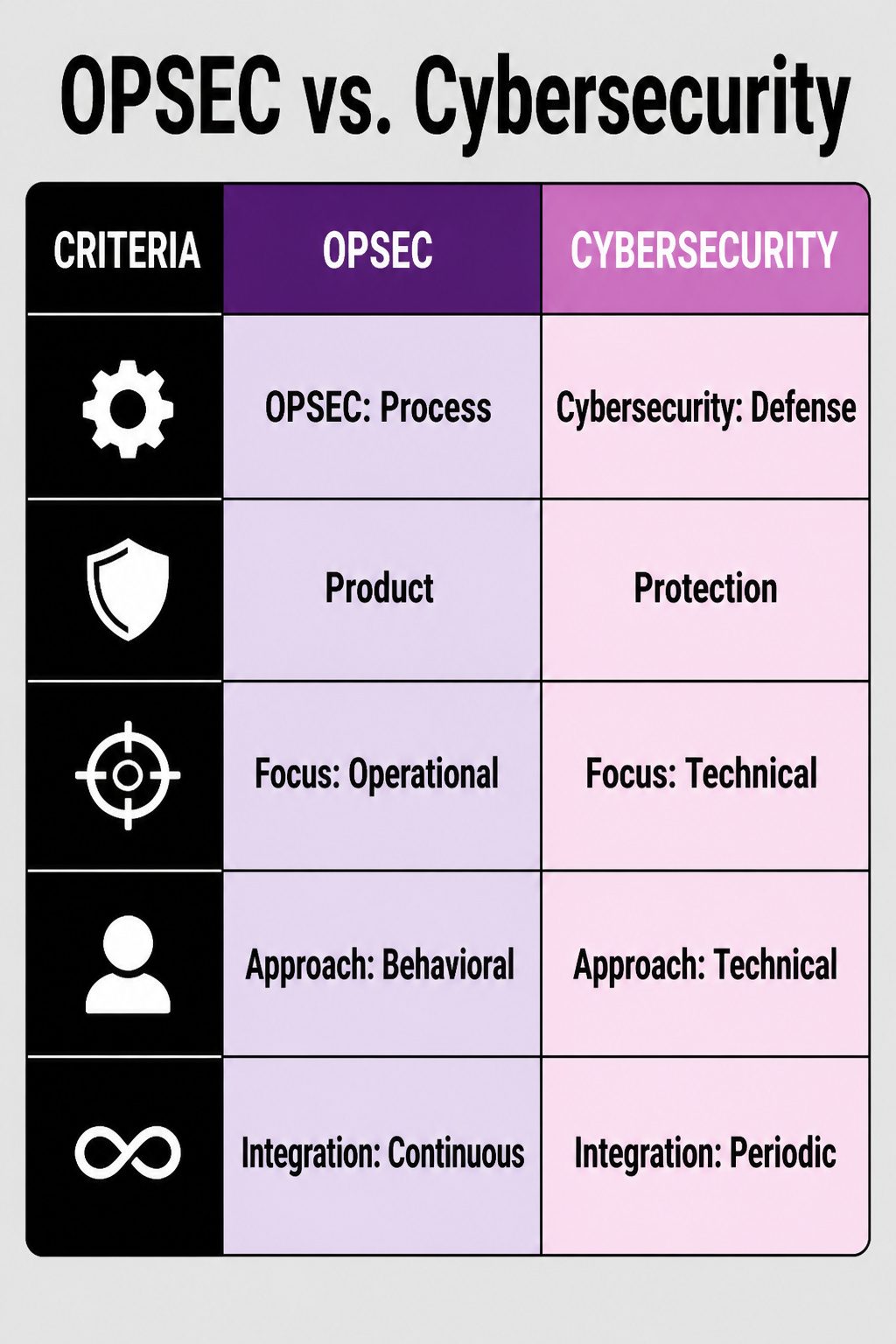
OPSEC is a process, not a product, and that distinction matters most when you set it next to cybersecurity.
A firewall or endpoint detection platform defends the boundary of a system. OPSEC asks what an adversary could piece together from your operational patterns, your supply chain details, even the job postings you leave up too long. Cybersecurity protects bits in motion; OPSEC protects the story those bits tell.
I have watched teams spend six figures on SIEM tooling while an attacker reconstructed their entire shift schedule from public social media posts. The technical defenses held. The human behavior around them did not.
OPSEC integrates physical security measures with cybersecurity protocols while shaping how personnel act day to day. It requires viewing your own operation through an adversary’s eyes, then controlling access to anything that looks valuable from that angle. The discipline is continuous, not a one-time checklist, because threats and operational environments keep changing.
Cybersecurity without OPSEC defends the network. OPSEC without cybersecurity still leaves the network exposed. The two overlap, but they are not the same job.
Why OPSEC Keeps Changing

The first time I treated OPSEC as a finished project, I missed a shift that cost me. A process I had mapped six months earlier still looked fine on paper, but the threat had moved. That static checklist gave me false confidence while the real exposure sat untouched.
OPSEC demands continuous evaluation, not a single pass. Adversaries study your patterns and adapt; your countermeasures have to adapt faster. What protected a workflow last quarter becomes a liability when tools change, staff rotates, or new technology opens fresh attack surfaces.
Web3 is the clearest recent example of this pressure. Blockchain transparency clashes directly with operational secrecy. Distributed teams complicate who sees what. Private keys for cryptocurrency assets introduce single points of failure that traditional IT security never designed for. Smart contracts, once deployed, cannot be patched; vulnerabilities live forever on-chain. Open community governance means more eyes on code and more mouths that can leak.
These are not edge cases. They are the new normal for anyone operating in that space, and they illustrate why OPSEC must be woven into daily operations rather than parked in a binder. Leadership and staff at every level need to recognize when the terrain has shifted. A formal program helps, but only if the review cycle is shorter than the adversary’s learning cycle. When executed well, this discipline limits information leakage and strips sophisticated opponents of their intelligence advantage. When neglected, it hands them a time machine into your present defenses.
Frequently Asked Questions
What is OPSEC (Operational Security)?
OPSEC is a systematic process to identify, control, and protect sensitive information that adversaries could exploit to gain advantage. It emerged from military operations in Vietnam and was formalized across the U.S. government in 1988. Organizations now use these same principles to protect customer data, address corporate espionage, and manage information security risk.
What are the 5 steps of operational security?
The five steps are: identify critical information, analyze threats, assess vulnerabilities, evaluate risk, and apply countermeasures. This sequence creates a dynamic defense that adapts as new threats emerge. The process is iterative, not a one-time project, so periodic reassessment keeps it relevant.
Why is operational security important?
OPSEC prevents adversaries from anticipating your tactics without ever decrypting communications or running human intelligence assets. The IBM Cost of a Data Breach Report 2023 puts the global average cost of a data breach at $4.45 million, the highest on record. Good OPSEC limits information leakage and strips sophisticated opponents of their intelligence advantage.